

A sideways look at economics
I spend far too long writing emails. Before eventually hitting send, I have re-read and edited the message countless times. I double-check any information, of course, but most of my time is spent trimming it down. Repetitions are removed and waffle cut, within the constraint of not sounding rude or robotic. The objective is to maximise brevity and clarity whilst minimising the probability of miscommunications. The other constraint here is my time, which I am currently overspending. It takes effort to write concisely.
Some recent advice I got before writing a long report put this more profoundly, with a quote from a letter by French mathematician Blaise Pascal:
“Je n’ai fait celle-ci plus longue que parce que je n’ai pas eu le loisir de la faire plus courte.”
Profound, right? But if, like me, you don’t actually know what that means, then here is what it means in English:
“I only made this longer because I didn’t have time to make it shorter.”
Evidently this struggle to be brief transcends any one language. But are there some languages that struggle less than others?
An efficient language is one in which the message, regardless of form, is transmitted successfully with minimal effort from both sender and receiver. A more efficient language should therefore be able to communicate the same information faster. If you’ve ever boarded a train in Italy without a ticket, then you know how fast they can speak. Surprisingly for me however, they aren’t actually the fastest speakers. That award goes to the Japanese, who according to one study speak on average 8 syllables per second, compared to just 4.7 by Thai speakers, the slowest in the study. There is a wide dispersion in speech rates across languages, with English speakers coming out slightly slower than average at 6.3 syllables a second.
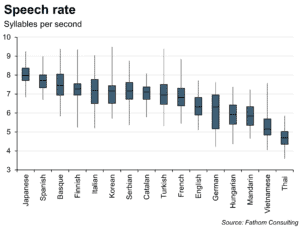
But just because we get syllables out slower doesn’t strictly mean we are communicating less efficiently than the Japanese. Take a generic response to “How are you?”. In English this could be:
“Good, thanks. What about you?”
whereas the Japanese equivalent would be something like:
“Arigatou, genki desu. Anata wa?”
The same information is conveyed in each language, but the English version has 6 syllables compared to 13 in Japanese. So, despite speaking around 25% faster, a Japanese speaker has to get through more than double the syllables. Here there is a trade-off: denser syllables (those which carry more information) tend to be spoken slower. A driver of this is the number of distinct syllables a language has. A greater number means each is more unique and thus enables each syllable to carry more information. As a result, fewer of them are needed to convey the same message. By contrast, having fewer and therefore simpler syllables means you can articulate them faster. Distinct English syllables, for example, outnumber their Japanese counterparts by an estimated 11 to 1.
So, we need to consider not just the speech rate but also the syllable density to work out the amount of information communicated per unit of time, the information rate. When comparing languages on this measure there is a lot more clustering, but French and English come out fastest. The results suggest that this trade-off between syllable density and speed causes a convergence, with the range between the fastest and slowest information rates about half that of speech rates.

Interesting. But my emails and Pascal’s letters aren’t spoken, and so what about written language? Well, a similar trade-off exists here, this time between complexity and length rather than syllables. On the measure of length, more complex languages such as Mandarin seem better. They can afford to use fewer characters, which in Mandarin’s case are actually more akin to English words, and as such can keep text length more compact. But ‘shorter’ doesn’t mean ‘more efficient’. Efficiency we define as successful communication with minimal effort for sender and receiver. A shorter text can be cheaper in characters but expensive in effort through its complexity. As such, efficient language seems less a ranking than a budget constraint.
Through relentless usage, languages continually adapt to their contemporary context. Over time, common sayings become shorter as they become more familiar: ‘I have’ shortens to ‘I’ve’. New words emerge to take the job of longer descriptions. The Inuit have more words for snow because they more frequently describe it. This process of change and abbreviation has been supercharged by the rise of the digital world, where the incentive of compressing text is much greater. “idk” is equally easy to say as “I don’t know” but requires far less effort to type out. At Fathom, in the context of the amount of Excel data analysis we do, a common abbreviation for “spreadsheet” has become “ss”. Obviously, out of that essential context, this could get you into trouble: “I think the ss needs an update”.
Context, I feel, is the only way communication becomes genuinely more efficient. When I said at the beginning that I spend too long writing emails, really it depends. Emailing a client, who I may never have met, requires more effort to overcome the lack of shared context, whereas an email to a colleague whom I’ve known for years is painless, largely as a result of that richer context. Context means messages become more predictable, and both sender and receiver can use this to minimise the effort of communicating. Perhaps the problem highlighted by Pascal is therefore unavoidable until that context is built.
Time to go over this blog again. There must be some way I can get this message across more efficiently.
More by this author