

A sideways look at economics
My journey to work a few weeks ago began with a distinct sense of January gloom. After glancing out of my flat window at the grey skies and misty drizzle, I made a beeline for the nearest Lime bike bay to claim the bike I’d reserved – it was the last one left. As I got closer to my green iron horse, a teenager in a parka jacket made some type of kick to the back wheel, jumped on the bike and faded away into the mist. I trudged to the bus stop – a mode of travel that would add 15 mins to my journey compared with cycling ‒ but as I approached I accidentally stepped in a deep puddle and soaked my foot and sock in freezing cold water. Finally aboard the bus, I reached into my pocket for my AirPods case, flipped the lid, and found… nothing. The pods themselves were on my bedside table. My morning was going from bad to worse. As a lot of commuters do, I decided to open my phone and do some doom-scrolling on social media. My feed contained many hot takes on how London is lawless and society is unravelling in real time. Overwhelmed with my bad luck and a sense of despair, I slid my phone back into my pocket, looked out of the rainy window and asked myself, How unlucky am I?
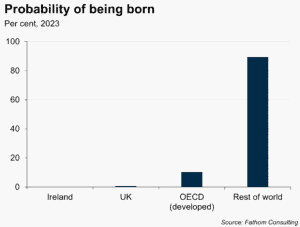
But you can’t stay sunk in self-pity for long. As I zoomed out from my wet sock and started to relax, I thought about the statistical improbability of where I was sitting. In an attempt to quantify this, I looked at latest available birth data (2023) to calculate the odds of being born in my native Ireland or my adopted home in the UK. Imagine for a moment that you are a soul floating in a celestial waiting room, ready to join the world. The chance of you landing in Ireland is a microscopic 0.04%. Even here in the UK, the odds are barely higher at 0.50%. In fact, the probability of landing in any developed OECD nation is just 10.20%. That leaves a staggering 90% chance of being born in the ‘rest of world’ category – quite probably in a place that lacks the basic infrastructure, free health care or rule of law that we take for granted every day.
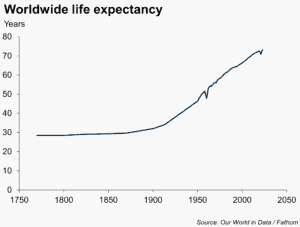
Winning the geographic lottery is only half the story. We have also hit the jackpot regarding when we are alive. I often see stories on social media about the “good old days”, perhaps envisioning a slower and more leisurely pace of life, but the data disagree. For the vast majority of human history, global life expectancy was around 30, only recently hitting a high of approximately 73 years. Again, looking down at my wet sock I thought not only am I insanely lucky to be born where I was and live where I do, but I am also in a time period where the average person lives twice as long.
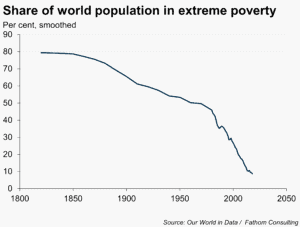
Now that we’ve looked at the odds of actually being here and the fact that we’re living about twice as long as we did 100 years ago, I decided to look at the quality of life. Again, social media would have you believe that living in London or Ireland means the economic game is rigged against you with no possible choice of escape. And let’s be honest, it often feels that way. When rent swallows nearly half your salary and the price of a pint keeps creeping up, it’s hard not to feel squeezed. But again, to feel unlucky you’d have to ignore the past. The chart below shows the share of population living in extreme poverty over 200 years. In 1820 nearly 80% of the world’s population lived in extreme poverty whereas that figure has dropped to below 9%. I am not trying to say the cost-of-living crisis isn’t real. But perhaps it would feel less acute with some perspective.
So where does this leave me and my soggy foot? Well in truth it leaves me with a heavy dose of perspective. My morning was an apparent disaster: the Lime bike heist, the ice-cold puddle, and the silent commute which is a form of Gen Z torture. But these are the problems of someone who has already hit the universe’s jackpot three times over. I get to go home to a warm flat with electric light and running water. Even better, I have a supercomputer in my pocket that grants me access to the internet, a collection of every human thought and discovery ever recorded. It is a tool our grandparents would have viewed as witchcraft when they were kids.
In the end, it’s about putting things in perspective – sometimes this can shine light on how trivial our problems are. My morning commute didn’t include any hardship, it was merely a slightly soggy commute. There are worse problems to have.
More by this author
State-sanctioned wealth destruction