

A sideways look at economics
From the moment we’re born, we are all compelled to enter the lottery of life. We have no choice in the matter. We don’t pick our parents, our genetics, or where we grow up. We’re simply dropped into the middle of what I call the “statistical soup of life”— a messy, unpredictable concoction of luck, tragedy and opportunity that is constantly washing around us. For the rest of our days, we navigate this soup, sometimes unaware that it is swirling around us and sometimes trying to make sense of the randomness. We celebrate the good fortune and brace against the bad, all while knowing we have very little control over when either will strike. It’s a universal condition, this dance with uncertainty, and it’s what makes life both terrifying and beautiful.
If you ever want a quantifiable, real-time picture of this statistical soup, look no further than the stock market. It’s a chaotic system driven by a mixture of cold logic and pure emotion. To illustrate this, I ran a small experiment. I looked at how an initial $10,000 investment in the S&P 500 — a proxy for the US market — would have fared over the course of my life. In this experiment there are three separate paths. The original, black line, is simply how the investment would have fared with a buy and hold strategy. The green line represents the performance had I managed to miss the single worst trading day of each year. Finally, the blue line shows the performance had I missed the single best trading day of each year.
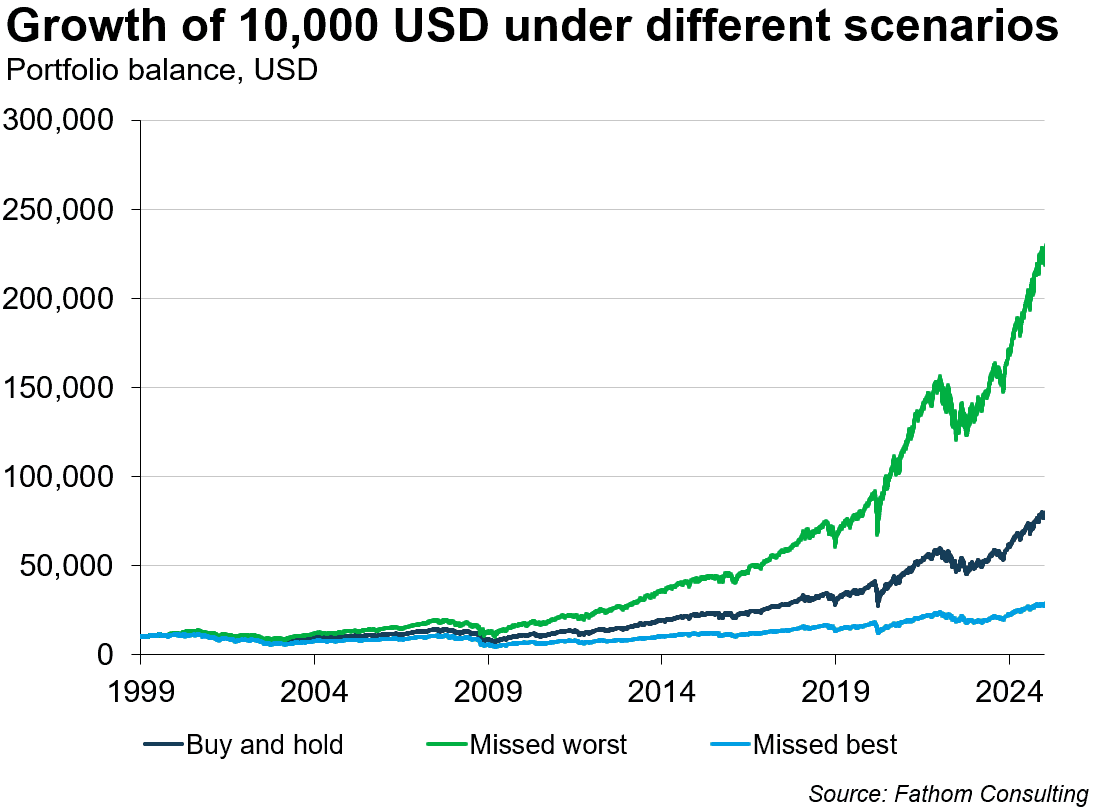
The effects from missing either the single best or single worst trading day out of all 252 trading days are quite striking. Our buy and hold investor managed to turn their $10,000 into $85,000. Had they missed the best day of each year they would have ended up with $25,000 but had they missed the worst day of each year they would be up to a nice $260,000.
It’s hard to think this is the result of just 26 out of over 6,500 trading days but the force at play here is compounding. When you miss a top-performing day, the loss isn’t just that day’s gain; it’s the lost potential for that gain to grow for decades to come. Similarly, dodging a big loss doesn’t just prevent the initial pain; it preserves capital, allowing the entire portfolio to compound from a higher base. The chart is a fascinating picture of how tiny hinges can swing enormous doors over time.
When thinking of this financial principle I can’t help but think there is a parallel in our own lives but to a lesser degree. I’m not thinking of grand, predictable milestones such as graduating university but of smaller pivotal moments. In your career, it could be starting a casual conversation with someone who will eventually become a lifelong mentor. In your personal life, it could be the simple decision on a Friday night to go out instead of staying in, an act that places you in the path of the person you end up building a life with. These moments look like lucky breaks in hindsight, but they’re usually the byproduct of small decisions that exposed us to possibility. Like the market’s best days, they are single points in time that can fundamentally alter the trajectory of everything that follows, with the positive effects compounding quietly for decades.
My analogy does have a distinction. One can choose to stay out of the stock market, avoiding both the risk of loss and the chance of reward. Life, however, offers no such option. We are all, by default, ‘invested’. We are automatically exposed to life’s downside risk — tragedy, misfortune, illness — whether we consent to it or not. Since we are forced to accept the possibility of life’s worst days, it seems illogical to then avoid the risks that might lead to the best ones. If there is little way we can avoid our worst days and end up on the trajectory of the green line than my advice is to get out and go take the risk or end up along the same path as the blue line, a life of unfulfilled potential and perhaps even regret.
Life, like the market, is shaped less by grand plans than by small moments that quietly compound. Since we can’t avoid life’s worst days, the only rational choice is not to shy away from risk but to stay open to it to seek the best days.
More by this author