

A sideways look at economics
“Hard work beats talent, when talent doesn’t work hard.” This is one of my favorite aphorisms, and that’s because I’ve seen examples of it in action in so many different areas of life. Across the sports we love, I’m sure we can all think of a player who took the world by storm but eventually faded away. Or even peers in school who were brilliant at understanding what was taught in class but never got around to doing the assignments. Just like these examples, there are ‘talented’ countries that, for various reasons or a series of unfortunate circumstances, fall short of their potential despite or even because of their significant natural gifts. In economics we call this phenomenon ‘Dutch Disease’ or the ‘Resource Curse’.
In trying to explain my analogy, I risk getting a bit theoretical — but I promise it’s worth it, so do bear with me. Let’s say that there are three sectors in a production economy: a resource-exporting sector that exports commodities and natural resources, a manufacturing sector and a services sector. Dutch Disease can occur when a country experiences a discovery of natural resources or a rapid increase in the price of a commodity it already exports. This raises the potential output of the resource-exporting sector, which in turn raises the returns to labour and capital within it, resulting in a movement of labour and capital from the manufacturing sector to the resource sector. The increase in demand for the country’s resource exports also results in an appreciation of its currency, making its manufactured exports less competitive on the global market. Again, the lower returns for manufactured exports results in a movement of labour and capital away from that sector.
At the same time, the uplift in income from a higher level of net exports increases domestic demand for both manufacturing and services. However, the price of manufactured goods does not increase in response to the higher demand, because these prices are set in the global market, which domestic supply and demand dynamics are unlikely to affect, especially in small economies. But services prices do rise in response to higher domestic demand, because these are not so easily traded across borders. As a result, the price of services relative to imports also increases — and so, again, labour and capital are pulled from the manufacturing sector towards the services sector. In sum, the increase in exports leads to a contraction of the manufacturing sector. This can be a problem, because the manufacturing sector can actually be very important in increasing productivity and in setting up a solid base to support further growth. One only has to look at South Korea and Taiwan to see how a strong manufacturing base can support rapid economic growth.
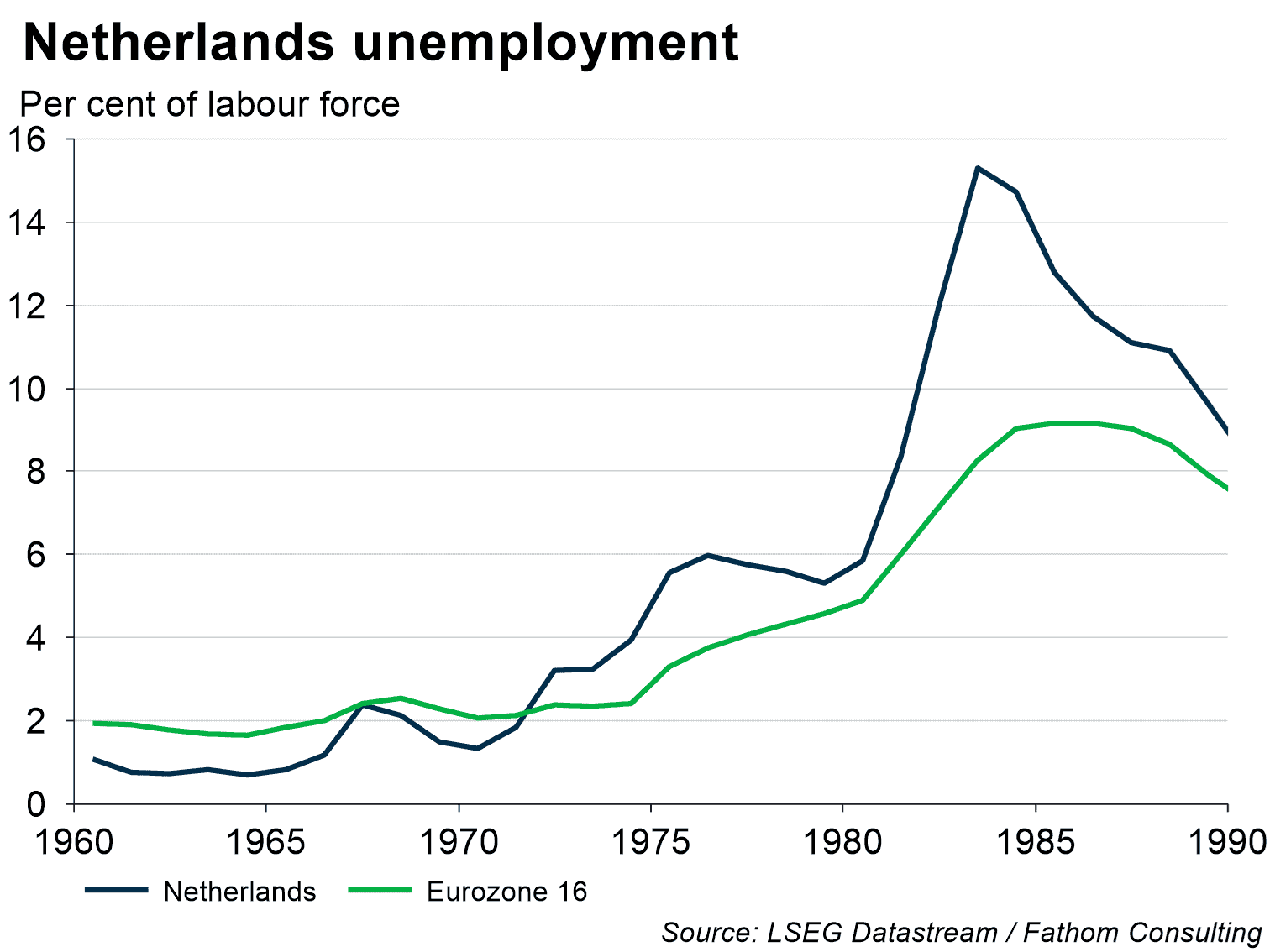
Dutch Disease got its name in 1977 when The Economist used it to describe the decline in other Dutch industries after the discovery of a large natural gas field in the Netherlands in the late 1950s. Through the late 1970s and early 1980s Dutch manufacturing industry shrank and unemployment soared, while GDP growth slowed significantly compared to its European counterparts. The Dutch eventually navigated their way out of the problem by instituting a policy of fiscal restraint and a slew of labour market reforms. However, not all countries have been able to correct themselves. For example, after the Nigerian economy started exporting oil in the 1960s, other sectors shrank, including agriculture — taking it from a net food exporter to an importer. The structural imbalances created by the over-reliance on oil exports are still plaguing the country today, with the high levels of inequality in the country being just another symptom of its battle with Dutch Disease.
Today, there exist many resource-rich developing economies that risk contracting Dutch Disease if the incomes from their resources are not used wisely. One such country is Guyana, where very significant oil reserves were found in 2015. The discovery resulted in a surge in oil production and exports, which has allowed Guyana to post extremely high GDP growth numbers in recent years. Strictly in terms of GDP, the discovery of oil reserves in Guyana has so far been a positive. But if it wants to avoid the hazards of Dutch disease, the Guyanese government will need to intervene and employ a series of pragmatic spending and investment solutions to ensure that the inflow of wealth leads to sustainable, long-term and broad-based growth.
These solutions may look like employing a wealth fund to manage and smooth the newfound income, as Saudi Arabia and Norway have — as the UAE has exemplified, by focusing on tourism, aviation and, most recently, AI.

So, talents or gifts — in the form of athletic ability, a big brain or large deposits of oil — can certainly be useful building blocks for success, but it is important to remember that these gifts aren’t the whole story. As an individual or a government, it is in our hands to ensure that we make the most of the talents we have and turn them into something worthwhile, rather than being complacent or naïve and letting these gifts turn into a curse.
More by this author