In May 2015, President Xi Jinping unveiled ‘Made in China 2025 (MIC25), a plan to transform the country from the world’s low-cost factory into a leader in emerging technologies, capable of rivalling the US across several high-tech industries. A decade on, we use our proprietary RiCArdo trade database — covering more than 1800 goods across over 200 countries from 2003 to 2023 — to deliver a verdict on what Made in China 2025 actually achieved.
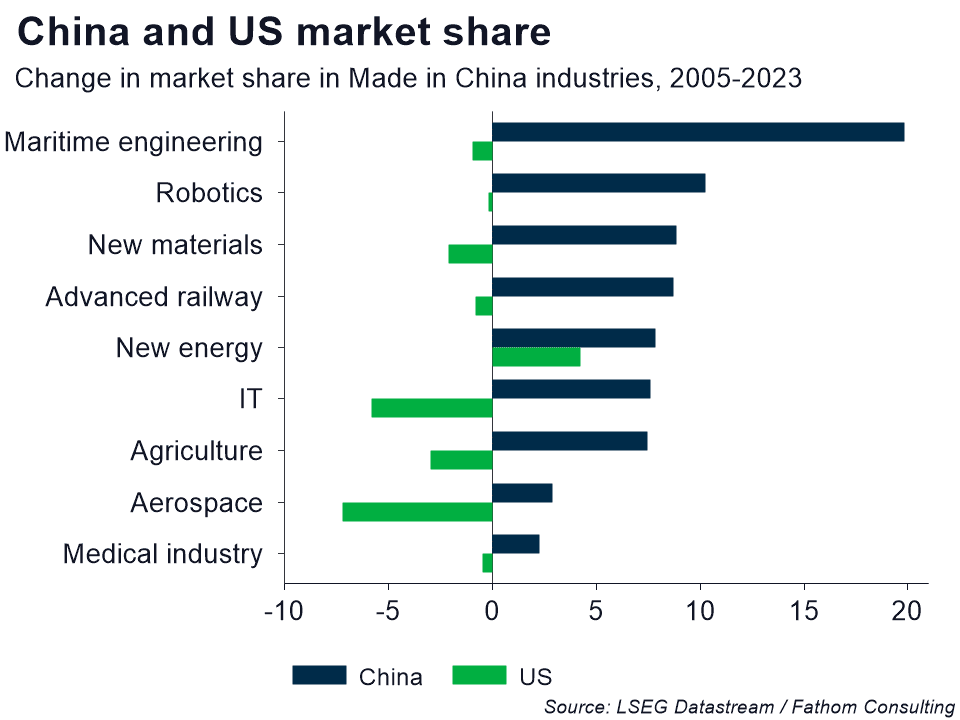
The headline finding is that China has largely hit its market-share targets. It is now the world’s largest exporter across the nine industries MIC25 targeted, leading outright in advanced railway, maritime engineering, new energy and new materials, and ranking second or third in three others.
But the full picture is more complicated. A significant chunk of that gain happened before MIC25 even existed, in China’s post-WTO accession years; market share grew six percentage points between 2003 and 2013, and only two points since. China also hasn’t become meaningfully more specialised in its target sectors than it was a decade ago — it has simply gained share almost everywhere, in 19 of the 20 sectors we track, while the US lost ground in 16. The principle of comparative advantage, traditionally the foundation of international trade, seems irrelevant to China’s strategy.
There are real success stories — electric vehicles chief among them, with a playbook of acquisition, absorption and scale-up that may already be repeating in AI. But semiconductors remain the glaring exception: China still runs a $460 billion deficit in IT products, leaving it exposed on Taiwan-dependent chips even as its overall MIC25 trade deficit narrows.
So has MIC25 worked? Read on for our full Made in China 2025 verdict: where China has won, where it hasn’t, and what comes next as US-China competition enters a new phase.
[Please click below to read the full note]