

A sideways look at economics
France is the euro area’s swing voter: where France goes, the euro area as a whole tends to follow. It’s not just the canary in the coalmine, it’s the miners at the coalface. That is why it’s concerning when, as now, France shows signs of stress. Many sovereign bond yields are rising rapidly, but French bond yields are popping relative to everyone else right now. This note takes a look at why. It’s not about growth; it’s not about inflation; it’s not even about government debt. So what is it about? Read on.
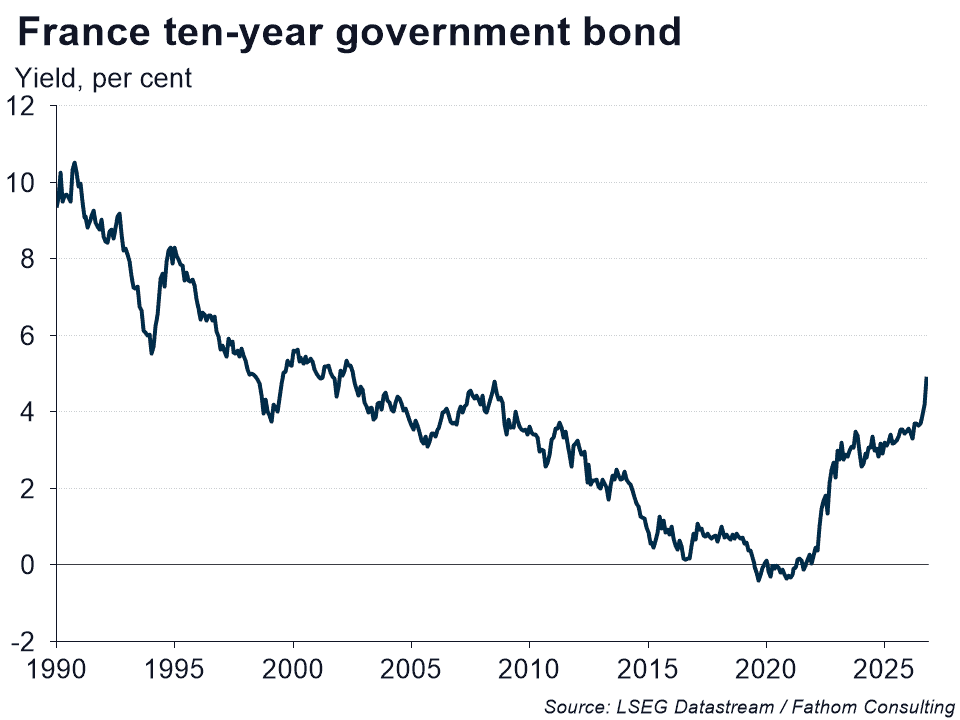
The French ten-year bond yield had been on a declining trend for thirty years before hitting zero with the monetary loosening (conventional and unconventional) at the outbreak of COVID in 2020. Ultra stimulative macro policy, both monetary and fiscal, in France and just about everywhere else, unlocked a bout of inflation, once the economy had recovered from the sharpest recession of all time. That inflation drove yields up in France, as in most other countries; and yields have stayed up ever since, even as inflation slowed. They have stayed up everywhere, but they have popped in France.[1]
The signal in French bond yields is even clearer if we look at the spreads over bunds. The bund spread increased after COVID, and again at the end of 2024. But it has spiked in recent months and is now back to where it was at the height of the euro crises in 2012. That was a moment when the future of the euro itself was at stake. The absence of mutualised government debt across the whole euro area drew attention to the fundamental unsustainability of debt ratios in the peripheral economies. Without some resolution, there was a risk the currency area would implode, causing (among other things) French bonds to sell off relative to the perceived safety of bunds. Resolution duly arrived in the form of Mario Draghi, with his ‘Whatever it takes’ speech of July 2012. In that speech, he effectively announced that the euro system as a whole and all the member states within it, would, if necessary, underwrite all euro area government debt, no matter which country issued it. This step was implied, not stated. That was because Draghi did not have the formal consent of the member states for debt mutualisation. But the bluff was enough: he was believed, and the implied mutualisation was never tested.
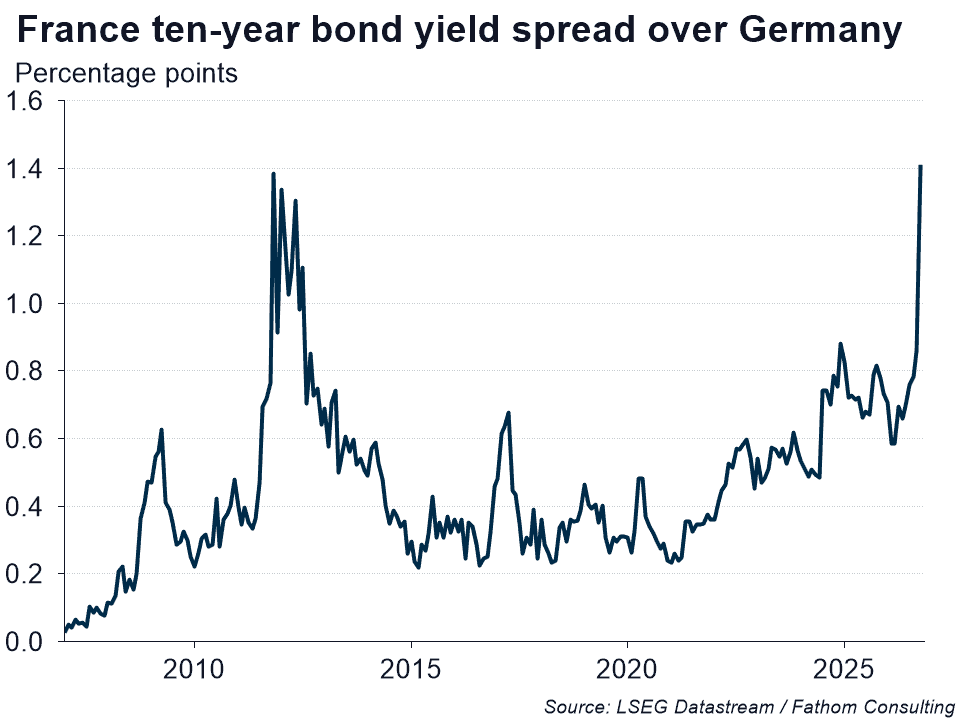
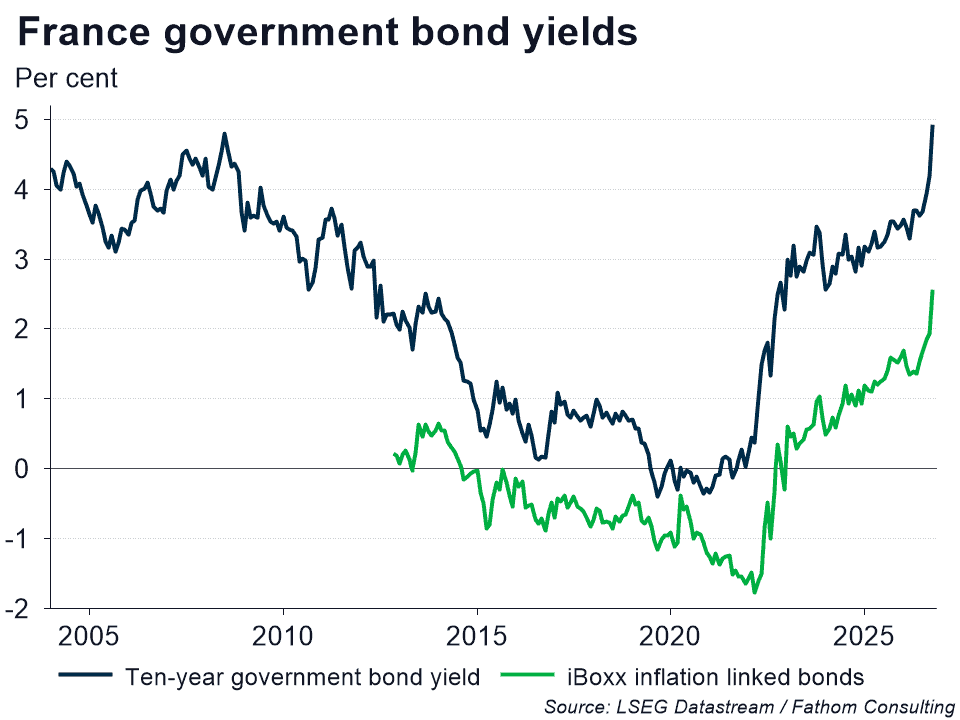
It is salutary that the French bund spread has reached the same levels again. What is driving that repricing? It’s not inflation, since the index-linked yield has tracked the nominal yield almost exactly.
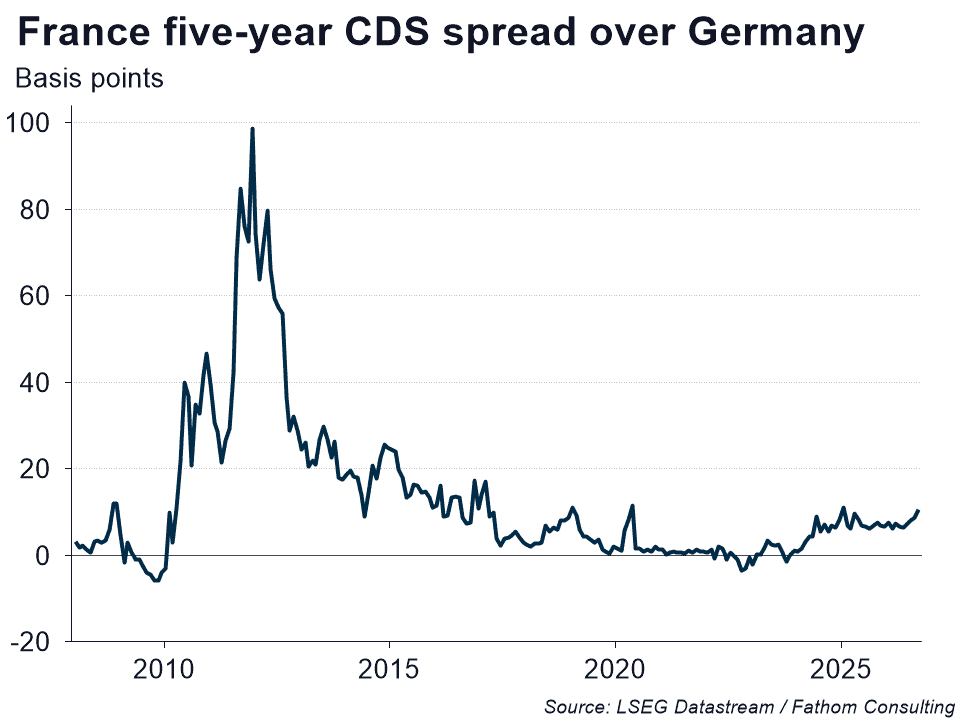
And it’s not that markets are anticipating a credit event in France: the CDS spread has picked up fractionally, but it barely registers relative to Germany. A sharp spike in bond yields without a corresponding spike in CDS spreads shows that it’s not default that investors are worried about, but something else. Fathom would concur: according to our Financial Vulnerability Indicator, France’s risk of a sovereign crisis right now is very low. The danger period was last year and the year before, but that was successfully navigated without a crisis.
What is the something else? French growth is dire, but no more so than other euro area economies. Nothing to see here. In fact, none of the macro indicators are registering anything out of the ordinary in France. So what are markets stressing about?
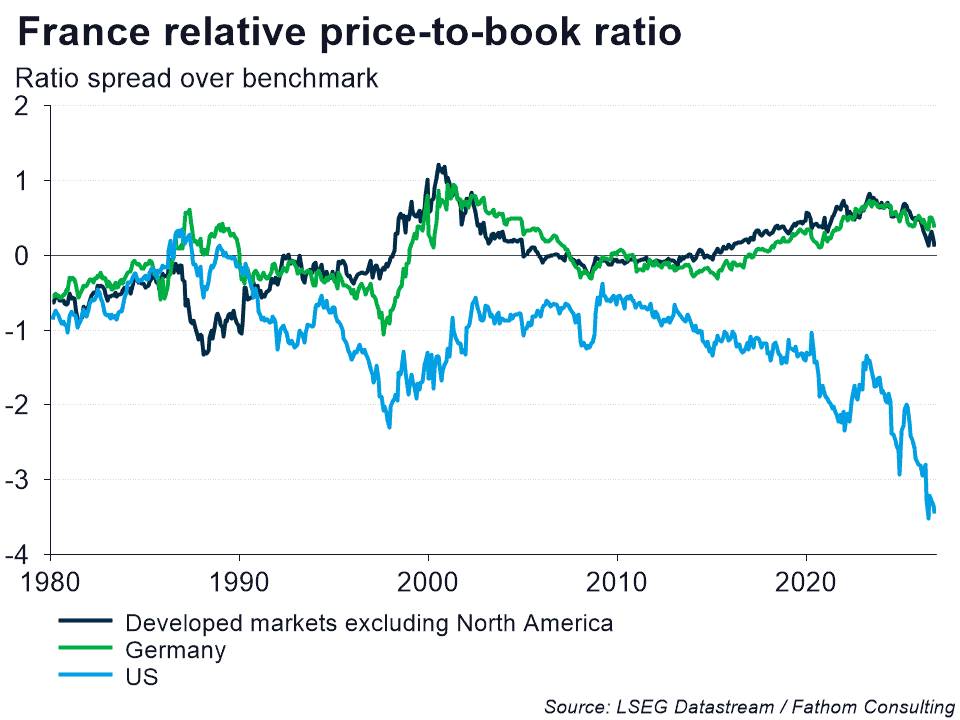
Perhaps a bit of triangulation will help: markets are selling French government debt relative to bunds. And they’re also selling French equities relative to other developed markets: the spread between the French price-to-book ratio and the developed-market average has spiked down to levels last seen in 1988. That ratio is often thought of as a proxy for the expected growth of the corporate sector.
But mostly what’s happening is that French equities are giving back a premium they had built up over other non-US equity markets. Every equity market looks weak compared to the US right now, because that’s the epicentre of the AI boom (or bubble, which is Fathom’s view). Something has changed for the worse in markets’ view of France, compared to the rest of the world outside the US since the AI bubble started in 2023; but it is much less dramatic than the positive repricing of US equities over that period.
Putting all of this together, there’s something about French debt that markets do not like, which is neither inflation nor default risk; and there is something about the outlook for corporate growth that markets do not like either. Perhaps it’s the same thing in both cases.
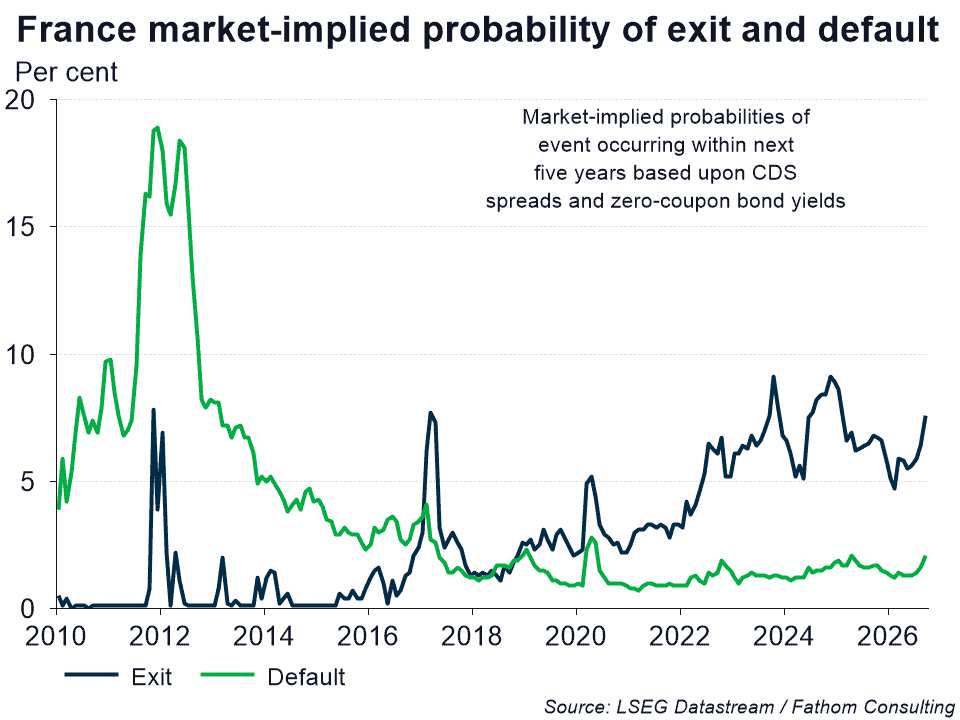
Are we seeing a re-run of the euro crisis? No, for two reasons. First, it’s mostly just France this time. Second, the market-implied risk that France will default on its government debt[2] is nowhere near where it was back in 2012. It’s around 4% now, compared to nearly 22% back in 2012. However, the market-implied risk that France will exit the euro is higher now, at 13.5%, than it was at its peak in 2012 (of 12.5%); and it has popped in the most recent month or so. The risk that markets were pricing in 2012 was that France would default within the euro, with an outside chance of exiting the euro too. This time, there’s a slightly bigger chance of exit but, according to market pricing, no material risk of default.
So the thing that seems to be spooking the bond markets is the perception of an increasing risk of France exiting the euro, and the redenomination risk[3] that would flow from that.
It’s hard to square the market-implied probability of exit with the noises from the Rassemblement National (RN) in recent months. The RN is the likeliest political driver of Frexit, even though since 2019 it has been very vocal in backtracking from former commitments to quit the EU. The circle could be squared if markets had sharply changed their view of the party most likely to win the Presidential elections, due next April.
Polling for the RN has improved only slightly in recent months. So, it’s not that the RN’s chances have improved dramatically: they are maintaining a comfortable lead for now.
What has changed are the odds on who will be the candidate facing the RN in the run-off. When Macron first took office in 2017, he came through the middle from a very weak position to win. That could happen again. But, for the centrist candidate to win, they have to make it to the second round.
The odds of that happening in the coming election have deteriorated sharply in recent months. It’s now a tie between a centrist candidate (probably Édouard Philippe) and a leftist candidate (probably Jean-Luc Mélenchon) for who will be the second candidate facing the RN’s Marine Le Pen (probably) in the second round. Mélenchon’s position on the euro has also softened, like that of the RN, but it remains substantially harder than that of Philippe. That could be the driver here: the euro-friendly centre is being squeezed out of contention. Le Pen’s election might mean, say, a 20% risk of Frexit (to be clear, we have no information on that probability, although it is likely to be lower now than it was a few years ago). A Mélenchon presidency, though less likely on current polling than Le Pen, might imply a similar risk of Frexit. That could be what the market is picking up. It looks like the centre will not hold, which means French euro membership is seriously in doubt once again.
The momentum is with Mélenchon and against Philippe (or any centrist candidate) at present, so the scenario in which the centre comes through is getting less and less likely. A run-off between Le Pen and Mélenchon is most unlikely to go against Le Pen, because the stranded centrists will either abstain or go with the least scary option on offer, which is probably Le Pen. A run-off between Le Pen and a centrist like Philippe would be a different matter. The stranded leftists, logically, would either abstain or vote for the least right-wing candidate on offer, probably Philippe. That gives the centrist a realistic shot. However, the horseshoe theory of politics suggests that the extremes of left and right actually meet at the bottom, implying Mélenchon has more in common with Le Pen than either of them does with Macron. In that case, the centre would be supported by centrists only, and they are a dwindling share of the electorate.
The collapse of the centre in France, if that’s what happens, would have implications far beyond its borders. Where France goes, the euro area as a whole tends to follow. If it led to another test of the euro, all the considerations about debt and debt mutualisation would resurface, and bond yields would pop right across the euro area (perhaps with the exception of Germany) and beyond.
We will be following these indicators closely in coming months and through the election and will keep you posted.
Register your interest for a free opportunity to hear insights from Fathom’s latest Global Outlook, an independent assessment of the global economy and the risks shaping markets and geopolitics.
PS: Eng 6: 4 Fra. Just saying.
Further reading
Global Outlook, Winter 2025: a fiscal wreckoning for Japan?
The euro system is stressed, again
[1]. Giles, Chris, 6 October 2026, ‘Why Are Bond Yields So High?’, Financial Times, Why are bond yields so high?
[2]. This is based on Fathom estimates of default and exit probabilities that are derived from bond yields and CDS spreads: if bond spreads within the euro area widen without a corresponding widening of CDS spreads, that must imply something about expectations that one or more member states will exit the euro system, redenominating assets issued by the exiting country along the way. That redenomination is likely to be associated with a reduction in the value of the new currency, or at least an increased risk of that, which will likely reduce the value of those assets.
[3]. Blanchard, Olivier, Leandro, Alvaro; Merler, Silvia, and Zettelmeyer, Jeromin, November 2018, ‘Impact of Italy’s Draft Budget on Growth and Fiscal Solvency’, Policy Brief 18-24, Peterson Institute for International Economics Policy Brief 18-24: Impact of Italy’s Draft Budget on Growth and Fiscal Solvency