

A sideways look at economics
It’s always exciting to go somewhere new. China is so different from anywhere I’ve ever been before, as well as being the focus of so much of my work at Fathom, that my recent ten-day trip was more highly anticipated than the average holiday. I am not exactly sure what I expected in advance, aside from good food, of which there was fortunately plenty. I suppose I was hoping to increase my understanding of China, flesh out some of the numbers I look at daily, although ten days is barely time to scratch the surface of somewhere as vast and multi-faceted as the Middle Kingdom. Now I’m back I feel as though I know even less than when I left, but such is the path of knowledge, it constantly turns back on itself. Or as the Chinese would say: ‘xué rán hòu zhī bù zú’ ‒ to learn is to encounter one’s own ignorance. Below are my Fathom Thoughts, from Abroad.
Dear Fathom,
I have arrived in China! And right away I’m impressed by the infrastructure (this will be a theme). Beijing Daxing airport seems to be very new and very clean, but also strangely empty. It’s largely grey granite and so cannot be called ‘warm’, giving off that ‘authoritarian, but competent’ vibe. I’m not sure that doesn’t still beat the type of ‘deeply-depressing-maybe-looked-new-in-the-70s’ grey we seem to favour at airports like Stansted, JFK, or worst of all, Charles De Gaulle. Nor am I merely impressed by the physical infrastructure in China. As most tourists, I made sure to download Alipay before coming, and the one-stop-shop payment system, taxi app, translator and who knows what other services is extremely practical and works exceptionally well.
I have only one full day in Beijing, and it feels in some ways similar to London in that it’s absolutely massive, with things that appear right next to each other on the map actually being an hour apart. The grey drizzle that cloaks the day does nothing to dispel the feeling of similarity. In many other ways Beijing is, of course, completely different: where London is tightly packed, especially in Central, with buildings from a jumble of different eras competing for space, everything in Beijing seems wide, uniform and spacious. Even the hutongs (small alleyways) seem pretty big, although perhaps I didn’t find the authentic ones.
What both cities share are vast opportunities for shopping. Different belief and political systems aside, it seems we all worship at the altar of Mammon. Most of the shops appear to be located in shopping centres, rather than lining the street as they would at home (I’ll later learn this is the case for the other cities I visit as well). From the outside I can see lists of typical Western brands as well as countless non-Western ones. At street level meanwhile there are huge showrooms full of the newest BYD, Geely or Ora SUVs, symbols of China’s ability to ‘veni, vidi, vici’ ever-expanding sectors of manufacturing. There’s a flagship Huawei store placed across from the flagship Apple one, a neat exemplification of the US-China rivalry defining our time. I don’t bother going in, as my foray into the Qianmen street hutongs where I’ve spent most of the morning has put a dent in the shopping budget and left me overburdened with parcels and packages. Built to look traditional (although I’m sure a lot of it was new) the alleyways throng with touristy shops: silver sellers, small stalls selling beads and bracelets, a fan shop, and boutiques selling silks and traditional Chinese clothing (I spend far too much time and money in these). There are vendors of all the types of knick-knacks we typically consider Made in China (the non ‘2025’ type), although here of course they count as locally sourced which somehow makes them less knick-knacky and more viable as souvenirs. It’s peak tourist trap, obviously, and if this were anywhere in Europe I’d be avoiding it like the plague, but China is sufficiently different that any inauthenticity feels excusable.[1]
Qianmen street in Beijing

I make some time for culture as well, traipsing around the Forbidden City with my array of shopping as with the distances there is no time to go back to the hotel. The Forbidden City is gigantic, unfolding room upon room, although I think of them more as courtyards given most have no covering. Allegedly there are 9,999 rooms in total, because 9 is a lucky number, though that’s apparently been debunked and in reality there are only 8,886 (so says Wikipedia). Some of them are absolutely rammed with tourists, while large swathes of the complex are almost completely empty. I wonder what it must have been like to live here. Seems like it would be lonely, caged in by ritual, ceremonies, and formalities, although perhaps that is not so different from the routines that encase our own modern lives. The grandeur of the place is evident in any case. In the Palace Museums I unfortunately end up spending so long in the splendour of the ceramics exhibition that I don’t make it to the paintings and calligraphy section before closing time. Only one day to explore Beijing is clearly not enough, and I would have liked more time.
It’s an early start on day two as I’m set to travel to Xinyang, which is just your regular, small Chinese city of a mere six million people (more than the population of Norway), located in the southernmost part of the Henan province. This is where my friend is getting married, which is the main reason for this trip. I find myself quite excited to experience China’s high-speed rail, nor does it disappoint: large windows, comfortable seats and a super-smooth ride at 300km per hour. I’m somewhat surprised at how easy it is to navigate the train station. Even though little of the signage is in English and it’s full of people it somehow feels neither crowded nor chaotic. I’m pretty sure you’d feel much more disoriented being dropped into the midst of St Pancras.
The TV screens in each carriage are playing a loop of videos about a recent military parade commemorating the end of the Japanese occupation in 1945, and interviews with who I assume are important PLA veterans – I can’t be sure, as it’s in Mandarin, but I somehow doubt the role of the nationalist KMT in fighting Japan is given much air-time. I can’t help feeling that the train itself is a better advertisement for Chinese superiority than the parade footage, because anyone who has experienced the ambling pace of Great Western Rail as it rattles through Cornwall, or wondered at the complete lack of public transport infrastructure in the US, can’t fail to be impressed. Of course, as with much of China’s infrastructure, there’s been huge overinvestment, with much of the nearly 50,000km network running at a loss and unlikely to ever become profitable.[2] And yet the voice of economist Elisabeth seems faint when tourist Elisabeth is smoothly speeding along at wicked speeds.
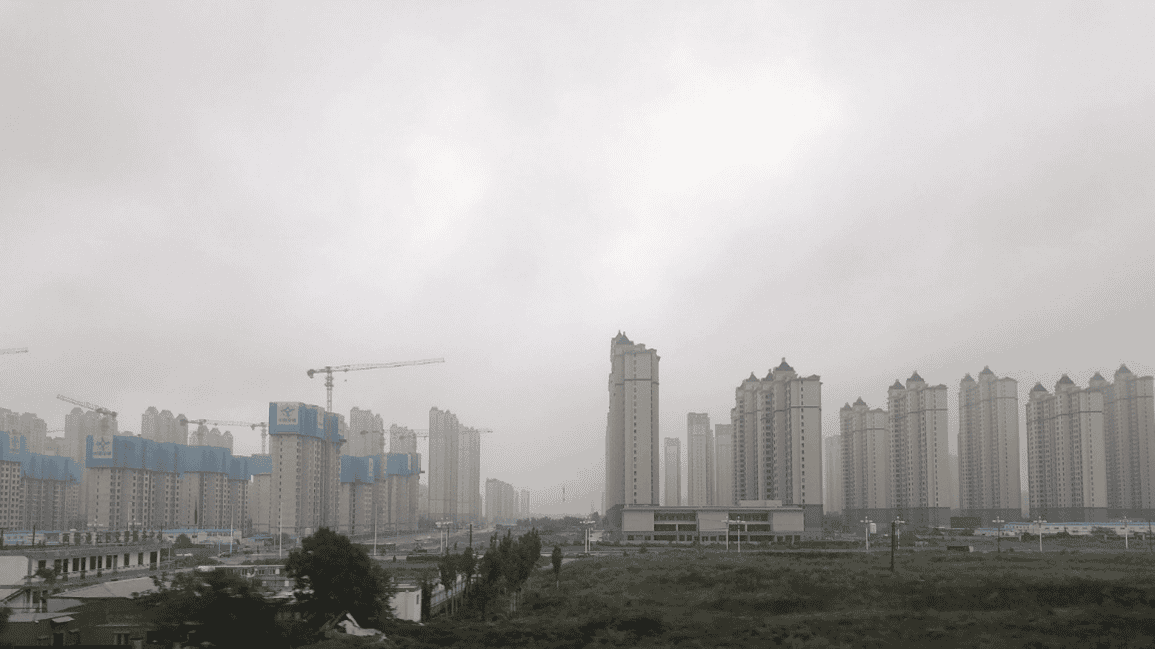
Speaking of overinvestment, the landscape is dotted with clusters of high-rises, nearly all identical, sticking up like toothpicks on the outskirts of the towns and cities. I am clearly suffering some work-related derangement, as the sight of these makes me quite excited. I wonder how many of the buildings I see would be captured under Fathom’s proprietary China housing indicators, classed as ‘paused’ or ‘under construction’ to mask the extent of real-estate oversupply. I take pictures out of the train window as a gift for our Head of Brand, Emma, who collects images for use on Fathom literature. The train pulls into Xinyang station precisely on time, and I meet up with friends at a large and luxurious hotel that seems broadly empty aside from the wedding party. Six million people there may be in Xinyang, but I have no idea where they all are; probably at work on a Friday of course, but certainly not in the eerily wide and empty streets.
Housing developments on the outskirts of Beijing
The next day is a whirlwind of activity. In the morning from 8.30 we participate in traditional games at the home of the bride. This is followed by a wedding banquet which, while apparently small compared to standard festivities, counts close to 130 guests, with seemingly enough food to feed at least twice as many but far less alcohol than your standard Western affair. Each table is furnished with a pack of complementary cigarettes, which you can (and people do) light up at any time. As I understand it, the banquet lunch usually marks the end of the wedding, but in this case the bride and groom have organised additional activities for the ‘European delegation’. We are ferried to a tea plantation for a tour, with a 30-minute turnaround before the Chinese BBQ dinner (delicious), followed by karaoke. This is a foreshadowing of how busy the next few days of group holiday are set to be, as well as a testament to the bride’s stamina. Not only has she organised the wedding, but also set up something akin to a travel agency for the group who have come over.
The extended events give us a bit more time to get to know the Chinese guests, which for the evening section largely consist of the bride’s childhood friends. Some language limitations aside, these interactions solidify the impression that in China working hard is just something you do, not a choice you make. I find that I have renewed appreciation for Fathom’s annual leave policy, after chatting to a guy who has 5 days leave per year. In a different conversation, one of the bride’s friends tells me how surprised she was at the early closing times on a recent trip to Europe.
“In China, we want to make money,” she tells me jokingly. “The shops stay open as long as people want to buy.”
I can’t fault her observation that Europeans, myself included, generally seem to value leisure over graft, although it also occurs to me that being in a position to choose is an expression of privilege that we perhaps take too easily for granted.
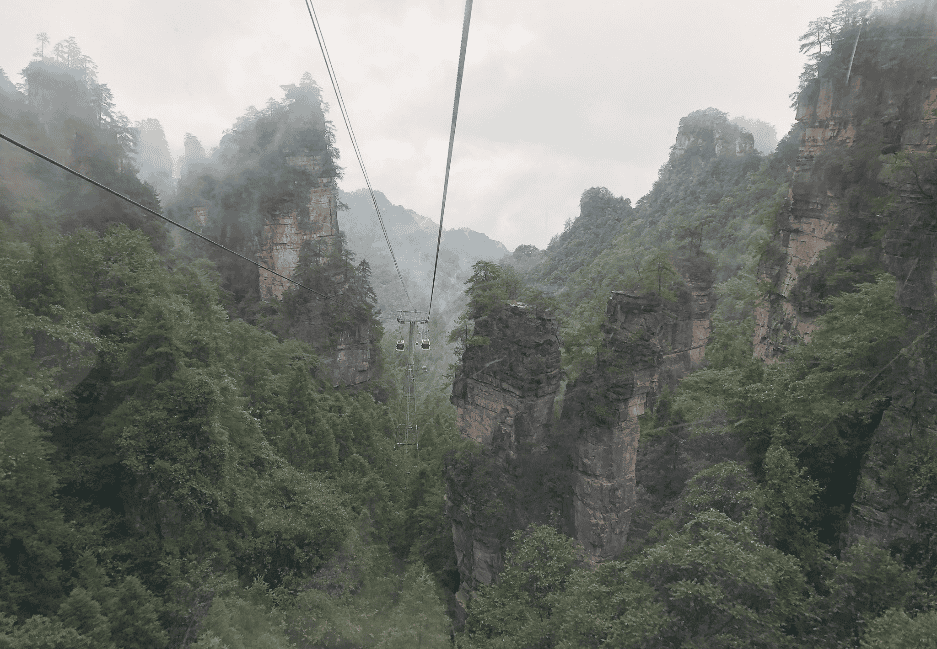
On Sunday we leave the rain in Xinyang for the rain of Changsha, further west in the Hunan province, staying only one night before heading further west to Zhangjiajie and its national park. This is the landscape that inspired the film Avatar, with sandstone rocks eroded over time into huge pillars. We see very little of this however, owing to the extensive fog (generally we are incredibly unfortunate with the weather throughout). The infrastructure (I did say this would be a theme) is again impressive though, with nearby Tianmen mountain and the park serviced by a system of buses, cable cars and the Bailong elevator which takes you more than 300m up the mountain side in one minute and 32 seconds, affording you stunning, albeit vertigo-inducing, views on the way up as the whole thing is made of glass. As is the case for the train tickets, everything is connected to your passport, which gets scanned on your way into the park and then again every time you use one of the amenities (bus/cable car). In the national park this is taken one step further with facial recognition matching you to your passport at the various ticket barriers. Its extremely convenient, and also a little bit creepy. Admittedly you could argue that the extensive CCTV coverage in London and the Met’s own use of live facial recognition means Big Brother is watching you regardless of where you are. That said, I’d put money on somewhat better image quality in China’s surveillance equipment than in the UK’s.
View from a cable car in Zhangjiajie national park
As a visitor, trading privacy for convenience while you holiday in China is not much of a choice, and so you enjoy the convenience and don’t worry overmuch about the security aspect. Meanwhile, the screens at pedestrian crossings displaying traffic violations and the violators (for the purpose of public shaming, I presume) seem at first glance just one more interesting peculiarity of China. But of course these technologies and the wider surveillance systems they belong to are not just used to make the cable car queue more efficient or for the fairly laudable purpose of stopping people from running red lights. Perhaps it is because we know of some of the ways in which China uses technology to clamp down on dissent and criticism that we see so clearly the ways this technology is insidious. But are our own societies not moving more in the same direction as China, trading freedom for safety (but safety defined by whom)? Meanwhile, we allow unelected business leaders ever-increasing access to our data, paying for their services with our privacy.
With my shitty burner phone I have no access to an e-sim and therefore am trapped behind China’s ‘Great Firewall’. Perhaps it is the enforced digital detox, as, I often find myself in this type of reflection throughout the trip, trying to square the China I read about with the China I see. I’m painfully aware that I am only seeing a fraction of the country, and that as a tourist on holiday, and especially one who doesn’t speak the language, I’m experiencing only the very upper surfaces of the culture. But following a conversation with our food guide in Shanghai, I think that even for the Chinese themselves it must be hard to see the whole picture, not simply because of the state media, or because the country is so huge and diverse, but because of how fast it is changing. Our guide tells us about his grandparents who grew up in a small fishing village in what is now just a district of Shanghai, who never spoke Mandarin and had never left the province. Even in his thirty or so years (all of which had been spent in the city) so much of Shanghai had been built up that in many neighbourhoods he felt himself a stranger, a tourist.
Maybe this rate of change will slow if China’s domestic imbalances, brought on in part by its considerable infrastructure investments, prove too weighty, dragging growth into stagnation and keeping China at the macro level trapped in middle-income status for the foreseeable future. Fathom’s own measure of China’s economic growth seems to point in that direction. Then again, perhaps the CCP will succeed in its pursuit of ‘new industries’, successfully leveraging the ingenuity and work ethic of China’s population, increasing overall productivity and cementing the country and the party even more securely in the key nodes of global value chains. Will China’s leaders then make good on their promises to redistribute this back to the people? Will the people be willing to wait? What will China look like five, ten, twenty years from now? I guess I’ll just have to go back some day and see.
[1] Qianmen street is the first, but certainly not the last, time during the trip that I am forced to admit that perhaps in the case of China, I too am a tourist, rather than a discerning traveller, and that perhaps I should not scoff so heavily at tourists elsewhere. I am sure this newfound sympathetic stance will wear off, however, the next time I set foot on Oxford Street.
[2] https://asiatimes.com/2025/06/chinas-fast-growing-high-speed-railway-network-faces-reality/
More by this author