

A sideways look at economics
Every transaction, every asset, that is denominated in a particular currency, has an impact on the nation issuing that currency. It’s all part of the same economy. But what if the same country issues more than one currency? This is probably a closer approximation to the Chinese situation: one currency for use at home; another one for use abroad. Two circulations. Does this mean there are two Chinese economies?
Not quite: there is only one issuer. Questions around the solvency of that issuer (the Chinese state) or about its use of seigniorage (the purchasing power that issuing currency confers on the issuer) arise from both currencies that they issue, the onshore renminbi and the offshore. ‘Dual circulation’ slows down the mechanisms that would otherwise immediately close any arbitrage opportunities between the two currencies: slows it, but it is unlikely to stop it altogether. Here we look at one scenario that would pull the domestic and foreign circulations further apart: an AI upside, where the concerns that AI is a bubble – concerns that form Fathom’s central case in our Global Outlook, Autumn 2026 – prove to be unfounded. As things stand, this is a world in which China’s performance in global export markets is likely to thrive, but it is unlikely to benefit the domestic economy significantly.
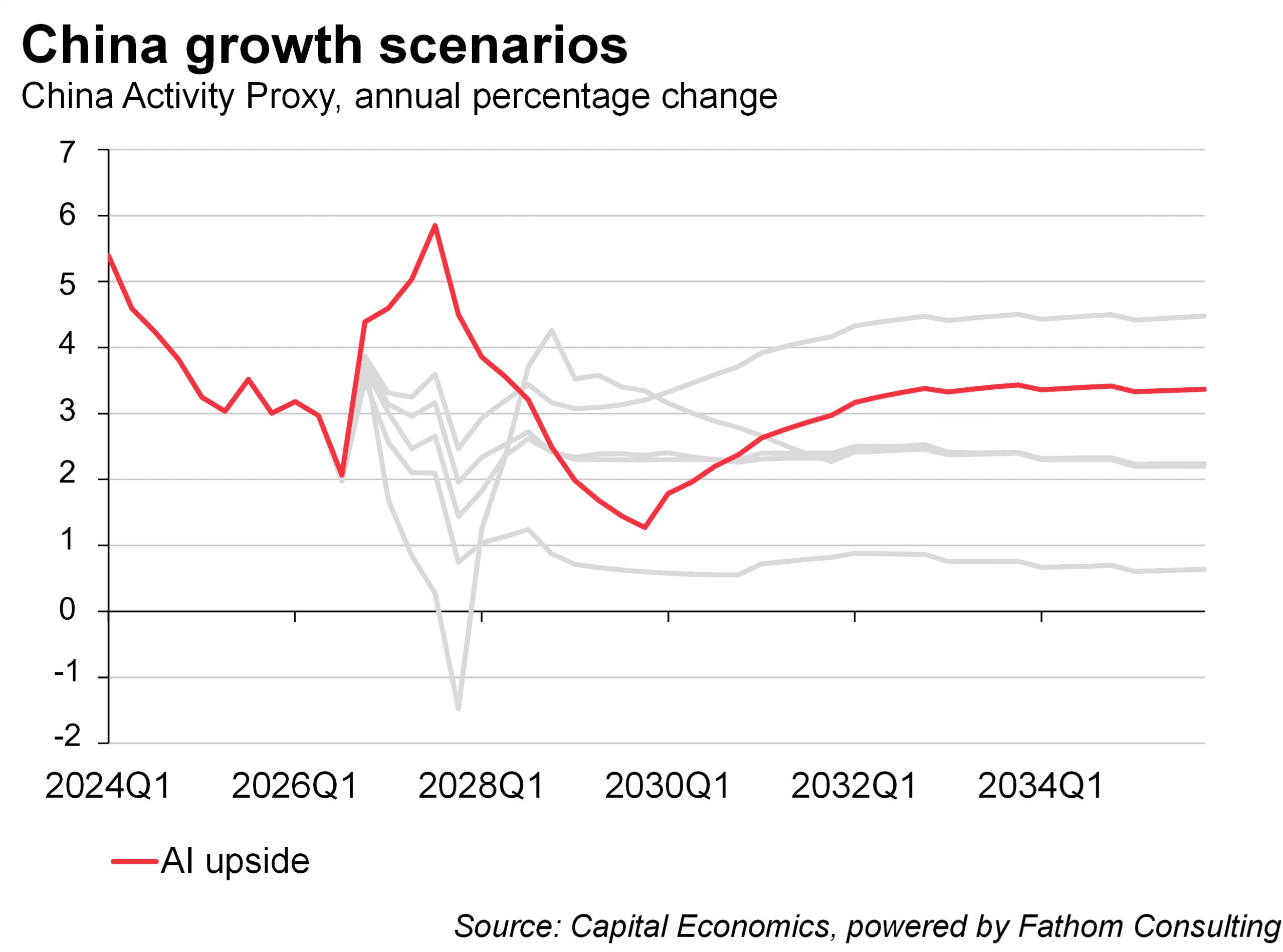
The chart above highlights in red the AI upside scenario.[1] In this scenario, AI proves more productive than we expect in the central case, and spreads faster than expected (although, note, there is no artificial general intelligence envisaged in this scenario), and China is well placed to benefit. An investment boom lifts growth to 5.0% in 2027, and the economy is about 3% larger than in the central case by 2028. There is some payback in 2029–30 as the boom ends and global capacity catches up with demand, but the economy is still 2% larger than in the central case in 2030. By then the second act is under way: productivity is rising faster than in the central case as AI is adopted across industry.
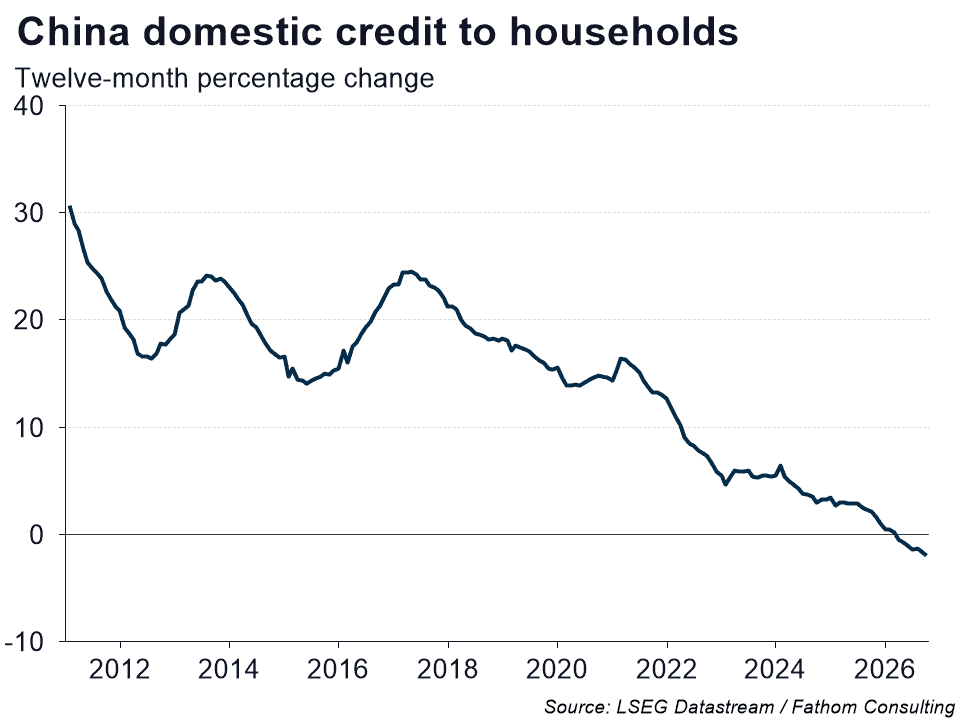
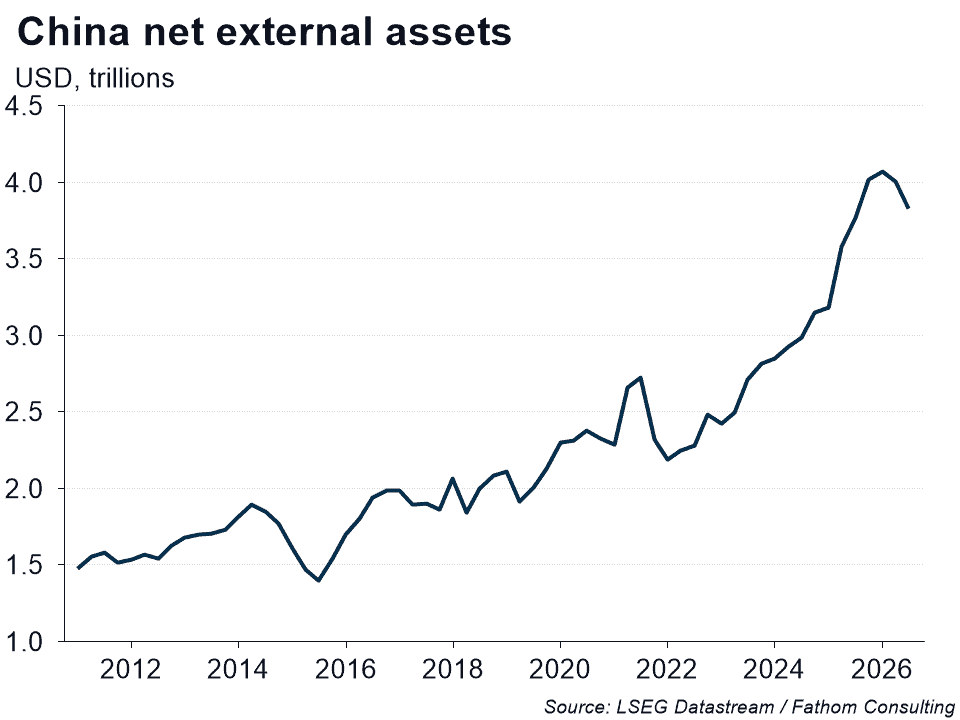
The backdrop to this upside scenario for China is a continuing reduction in the contribution that private consumption makes to growth. One illustration of this decline is pictured in the first chart below: the growth of domestic credit to households in China has been falling since 2017 and, in 2026, it has turned negative. That has occurred alongside a huge build-up of net external assets (second chart): China is not lending at home, but it is certainly lending abroad.
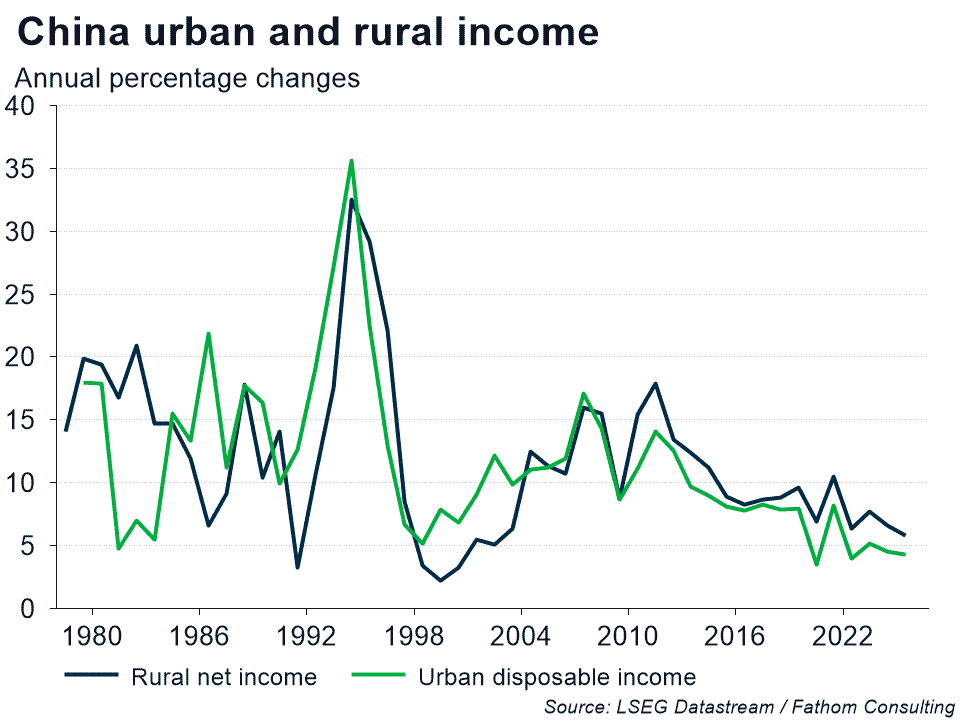
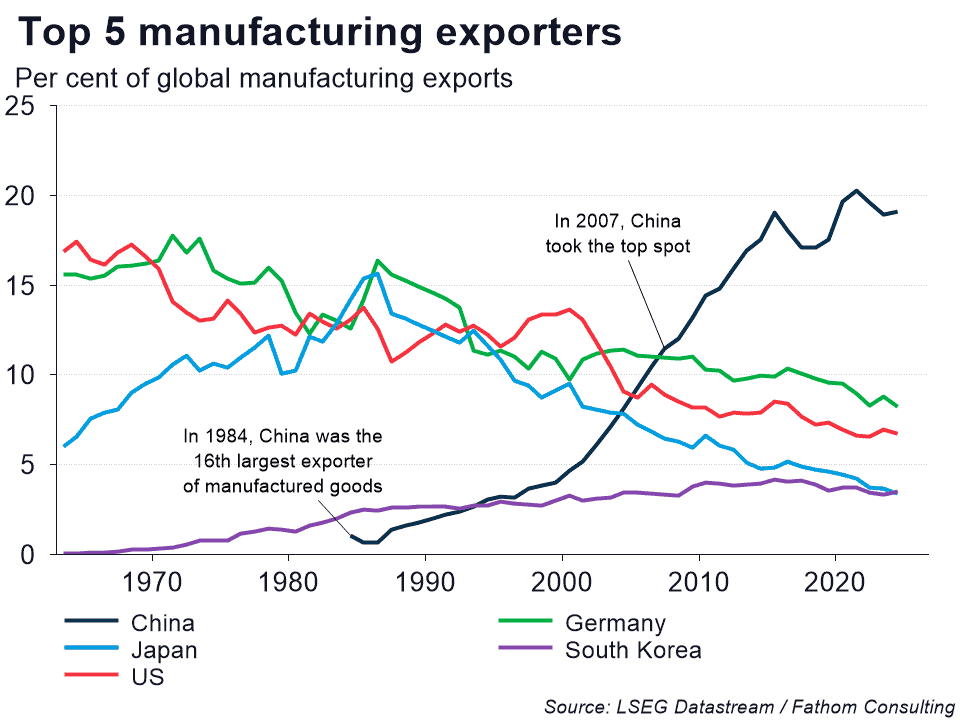
Chinese households are borrowing less. And the growth in their income is slowing too, as the first chart below shows: more so in the richer, urban areas than in rural areas. Income growth is expected to slow further, according to surveys of income expectations. In addition, total employment is falling, dependency ratios are increasing, the participation rate is on a trend decline, the fertility rate is extremely low and falling, and, above all, house prices are collapsing. At the same time, China’s dominance of global manufactured export markets continues to increase, albeit at a slower rate than previously. Those former manufacturing powerhouses, Germany, Japan and the US, have all been eclipsed by China, which now accounts for almost 20% of global manufactured exports, higher than the peak share achieved by any of the other three.
All of this is happening despite extremely stimulative settings of both fiscal and monetary policy. The government budget balance is profoundly negative (implying fiscal stimulus and/or, worse, a dwindling tax base), and interest rates are very low.
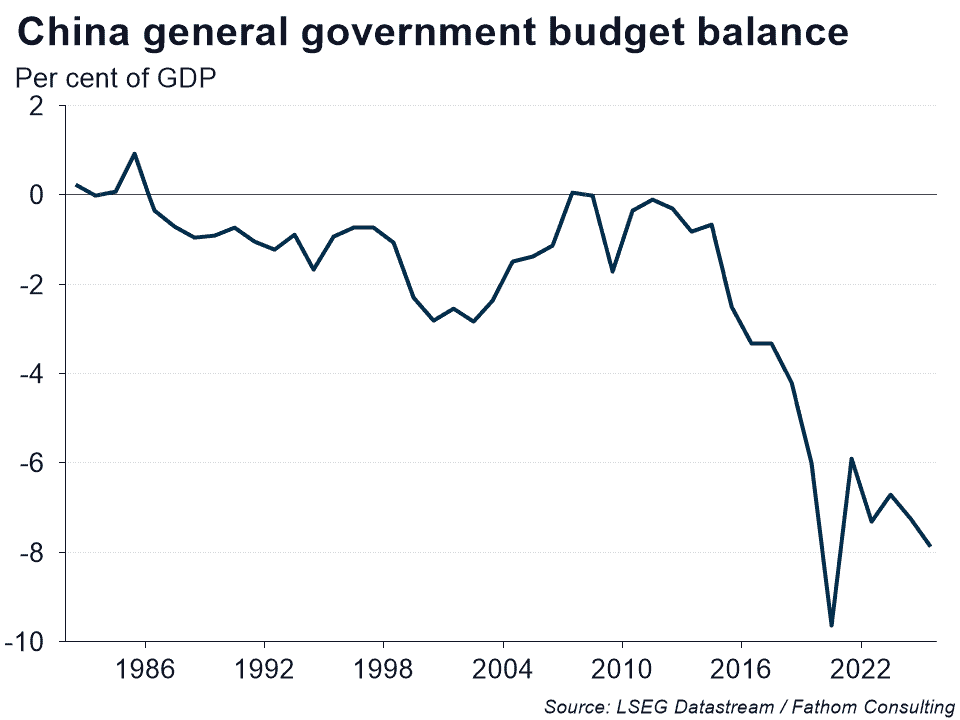
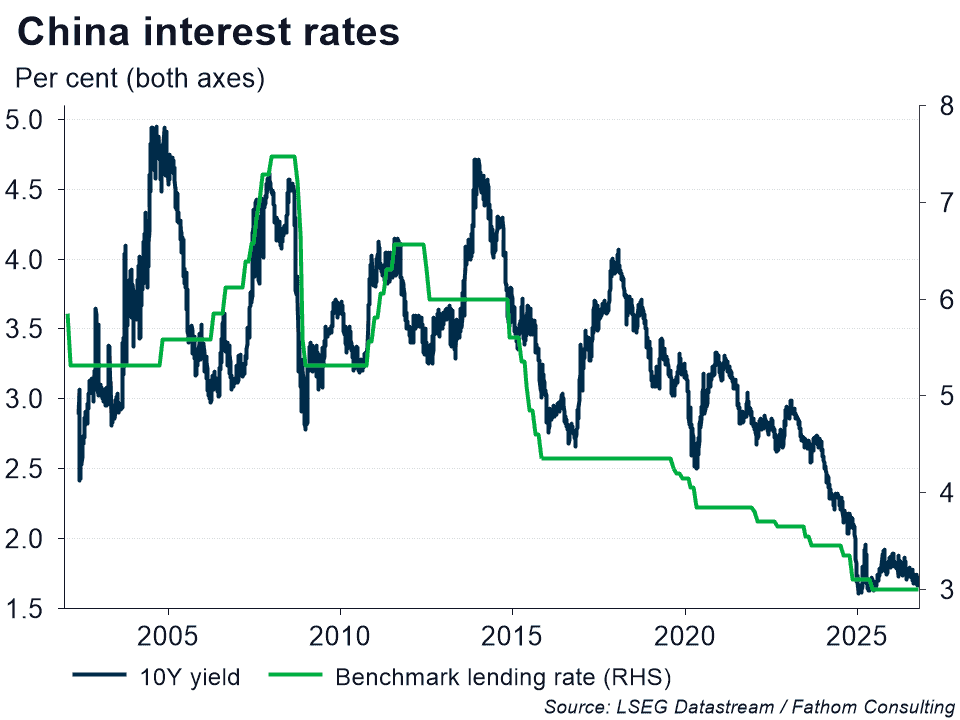
Macro policy settings in China are extremely supportive, but they are not sufficient to counter the powerful headwinds to growth in consumer spending. The net effect is continuing disinflationary pressure within China: or ‘involution’ as it has been euphemistically labelled by policymakers in Beijing. But China’s external footprint is growing, and these two processes are related. The savings generated in the domestic economy, of which household savings are part, are not being absorbed in that economy, especially now that the policy of effectively burning those savings by diverting them towards residential construction, destined to be demolished without ever having been occupied, has ended. The result is that the excess saving at home must be funnelled abroad. The flipside of this is the huge and increasing current account surplus, and the build-up in net external assets.
The point of the discussion above is this. The pattern of Chinese growth, led more than ever by net trade and the flows of finance abroad, suggests that China stands to benefit from an upside scenario for AI. It is likely to access the world’s leading technology in that space. It is likely to build scale aimed at export markets in AI and related industries (and it does not lack the resources to achieve that scale). Its offering is likely to undercut any other competitor, heavily subsidised as it is likely to be, even if it might not be generating the frontier technology itself.
China does not need to be advancing the frontier itself: it can rely on others to do that, picking up the know-how through investment and trade, as it typically has in the past. China’s superpower is acquiring frontier know-how and figuring out how to adapt it so it can be rapidly and cheaply scaled. China wants and needs the mass market, and it knows how to dominate it. The AI upside scenario, in which our central case that the AI industry is in a bubble proves to be incorrect, is a scenario in which China’s net trade improves even further, led by investment into AI-related export industries.
In this scenario, China will come to dominate the global export market in this sector as it already does in many other high-tech sectors. That would be great for Chinese growth for the next couple of years but will increase the distance between a flagging domestic and a thriving foreign sector: dual circulation will pull those two sectors even further apart. This, by now, has to be accepted as the revealed preference of the Chinese state. Dual circulation works, for the CCP. And it works even better in this scenario, as global demand for a new technology explodes, with China dominating the mass market.
If the story sounds familiar, that’s because it is. China set out its stall to do exactly this with respect to the high-tech sectors it identified in its 2015 ‘Made in China’ strategy, and it has largely succeeded. The final chart below shows Fathom’s estimate of China’s exports in the Made-in-China sectors identified in 2015, captured in our proprietary RiCArdo database, alongside official estimates of China’s high-tech exports.
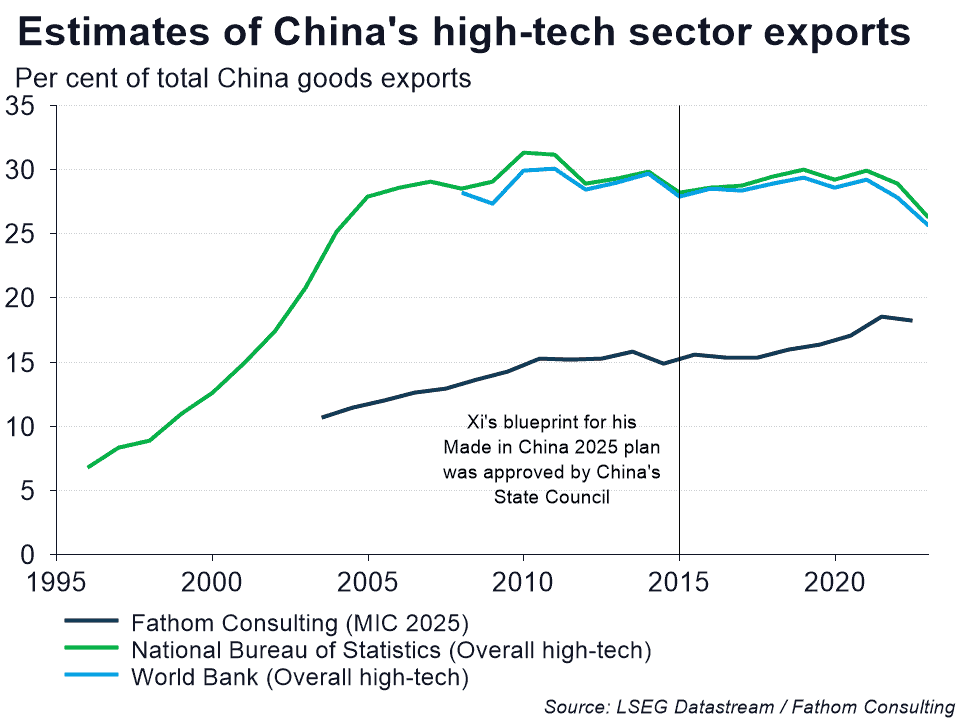
The official account suggests China has not increased high-tech as a share of its total exports, but the MIC sector story is different, as the chart above shows. That share has been increasing steadily: an extraordinary performance given the spectacular growth in China’s total exports over the same period. 2025, the target year for MIC-25, has been and gone. Now, other emerging sectors are in China’s crosshairs, and AI and related industries are among them. The performance over the last two decades suggests they will succeed here as they have before, no matter how grim the outlook for the domestic economy might be.
Register your interest for a free opportunity to hear insights from Fathom’s latest: Global Outlook., an independent assessment of the global economy and the risks shaping markets and geopolitics.
Further reading
China and the AI boom, or is it a bubble?
[1] This is one of six risk scenarios for China that we will be producing on a quarterly basis henceforth, in partnership with Capital Economics. You can find information on this new service here.