

A sideways look at economics
More than two years ago, my first Thank Fathom it’s Friday explored the question of how Formula One could transition to net zero by 2030. The solution? Optimise the racing calendar to minimise the total distance travelled from race to race. Easy. I even offered a revised schedule. Since then, there have been 53 iterations of fast cars going vroom vroom and Dutch stars going quicker than everyone else because the Red Bull car was the fastest… But has the motorsport taken any measures to rationalise its calendar? Or is more extravagant action required to decarbonise Formula One?
In July 2025, Formula One (F1) released a Sustainability Update covering its current trajectory to net zero by 2030. The headline: F1 has delivered “a 26% reduction (including sustainable aviation fuel certificates, or )[1] in its carbon emissions by the end of 2024 compared to its 2018 baseline”. This reduction comes despite an expanded calendar, rising from 21 races in 2018 to 24 from the 2024 season onwards. The fans have grown in number too. According to F1, race attendances are up from 4 million to 6.5 million, and the franchise’s global fanbase is around 826 million people — over 10% of the world’s population.

In 2018, logistics[2] and business travel contributed to 72.8% of F1’s emissions. As impressive as F1’s reductions are, these two categories still made up 72% of its emissions in 2024 — and when SAFc are excluded, the share rises to 74.9%. Analysing 2024’s race calendar, this is hardly surprising. In total, all ten teams travelled 71,552 nautical miles (nmi) last year, a 3.4% increase from 2018. In retrospect, the scheduling of races was an improvement on 2023 — last year’s season journeyed around 5846 nmi less than the year before, even with one additional race. But, alas, the consistent improvement did not last. This year, with the same set of Grand Prix locations as 2024, F1 will have accumulated 73,802 nmi, the equivalent of circumnavigating the world 3.4 times.
However, there is some hope. F1’s head of environmental, social and governance For example, rather than travelling from central Europe to Montreal, and then back again, the Canada Grand Prix will be held straight after Miami. The report states that “this change consolidates the European leg of the F1 season into a single period, eliminating an additional crossing for vital freight and equipment and delivering significant carbon reduction.” The result in geographical terms? A 6.8% decrease in overall calendar distance.
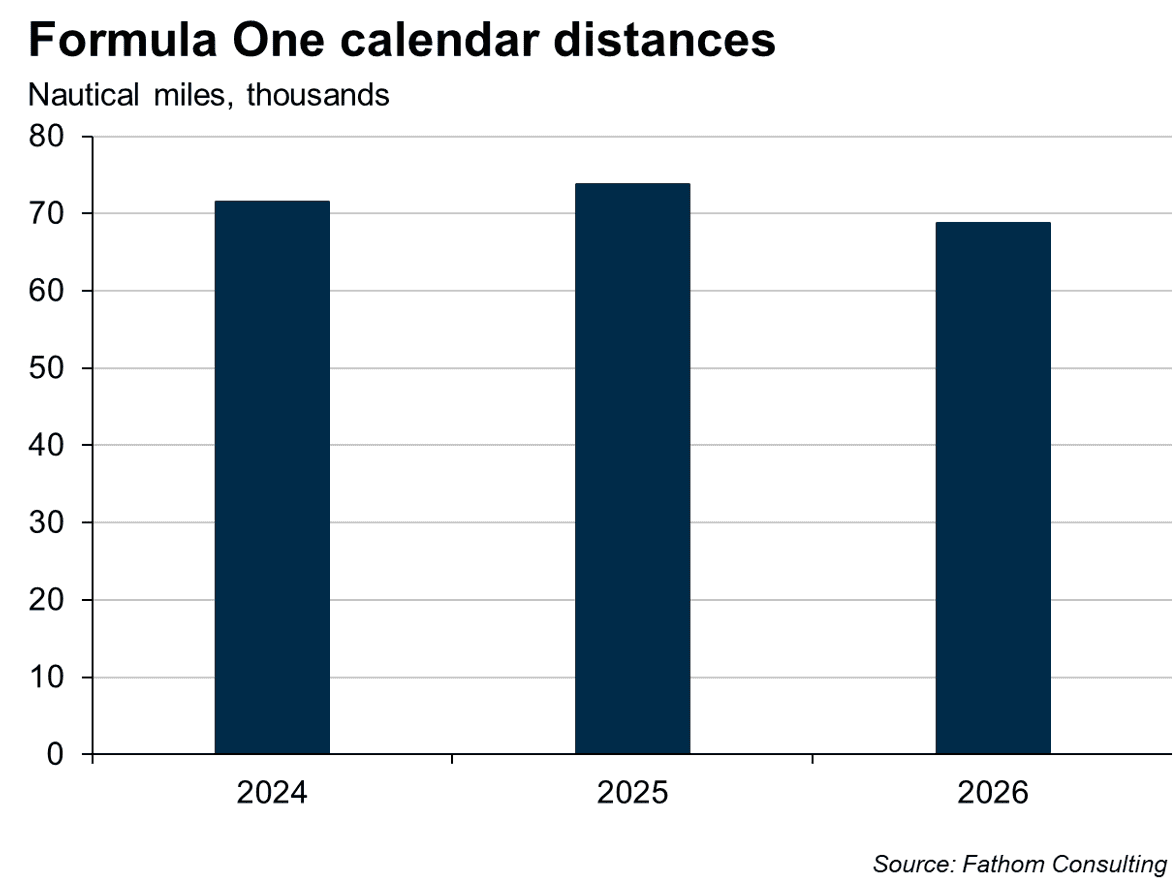
So, it appears F1 has had the same train of thought as me by considering calendar restructuring to reduce emissions. But had anyone at F1 subscribed to Thank Fathom it’s Friday, they could have just copied my optimised calendar, bunging the Chinese Grand Prix in after Melbourne. Had they done that, the total distance covered in the 2025 F1 race season could have been… 46,391 nmi. A whopping 37.1% reduction from 2024. Although this doesn’t imply that F1’s 2025 emissions would decrease by the same magnitude, it should certainly be the most straightforward change to make, right?
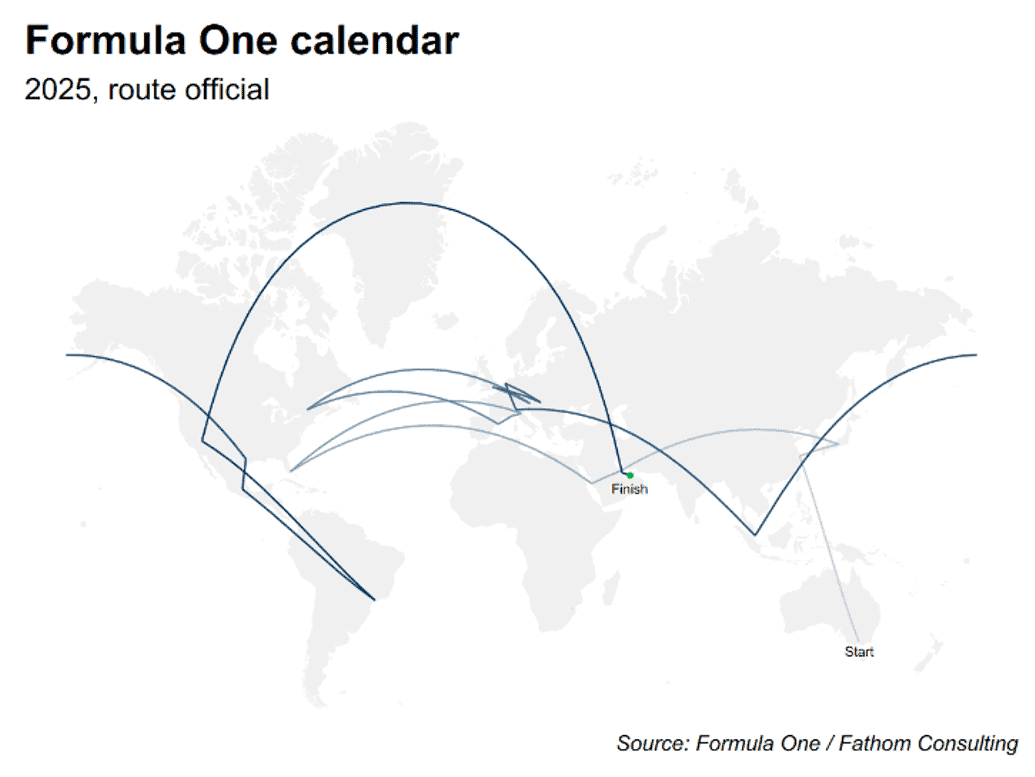
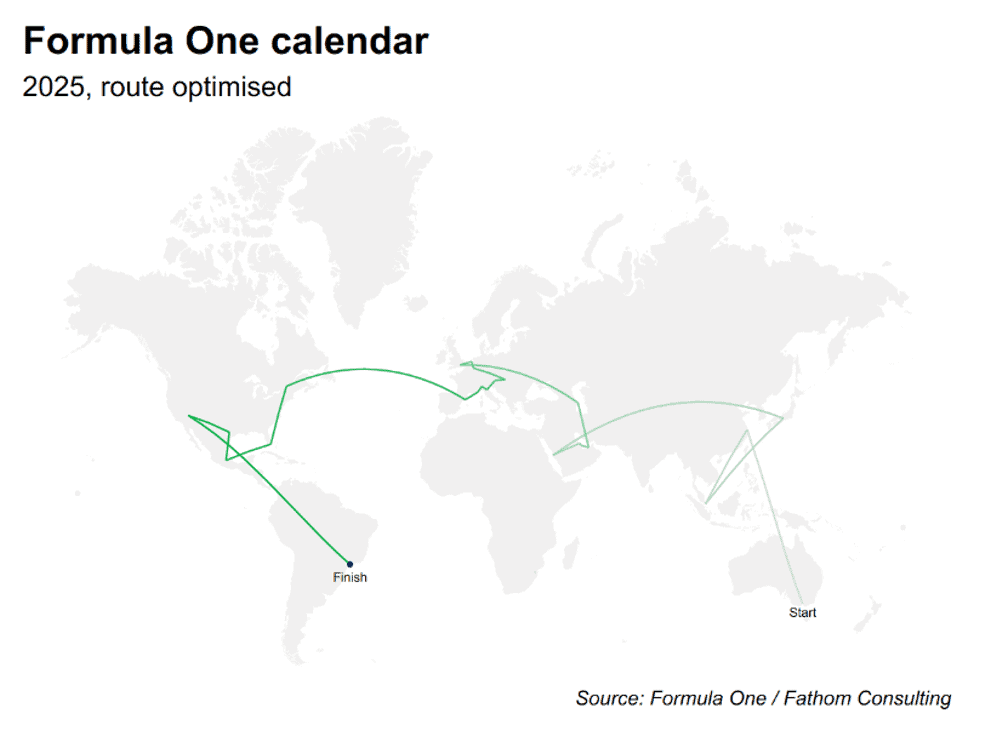
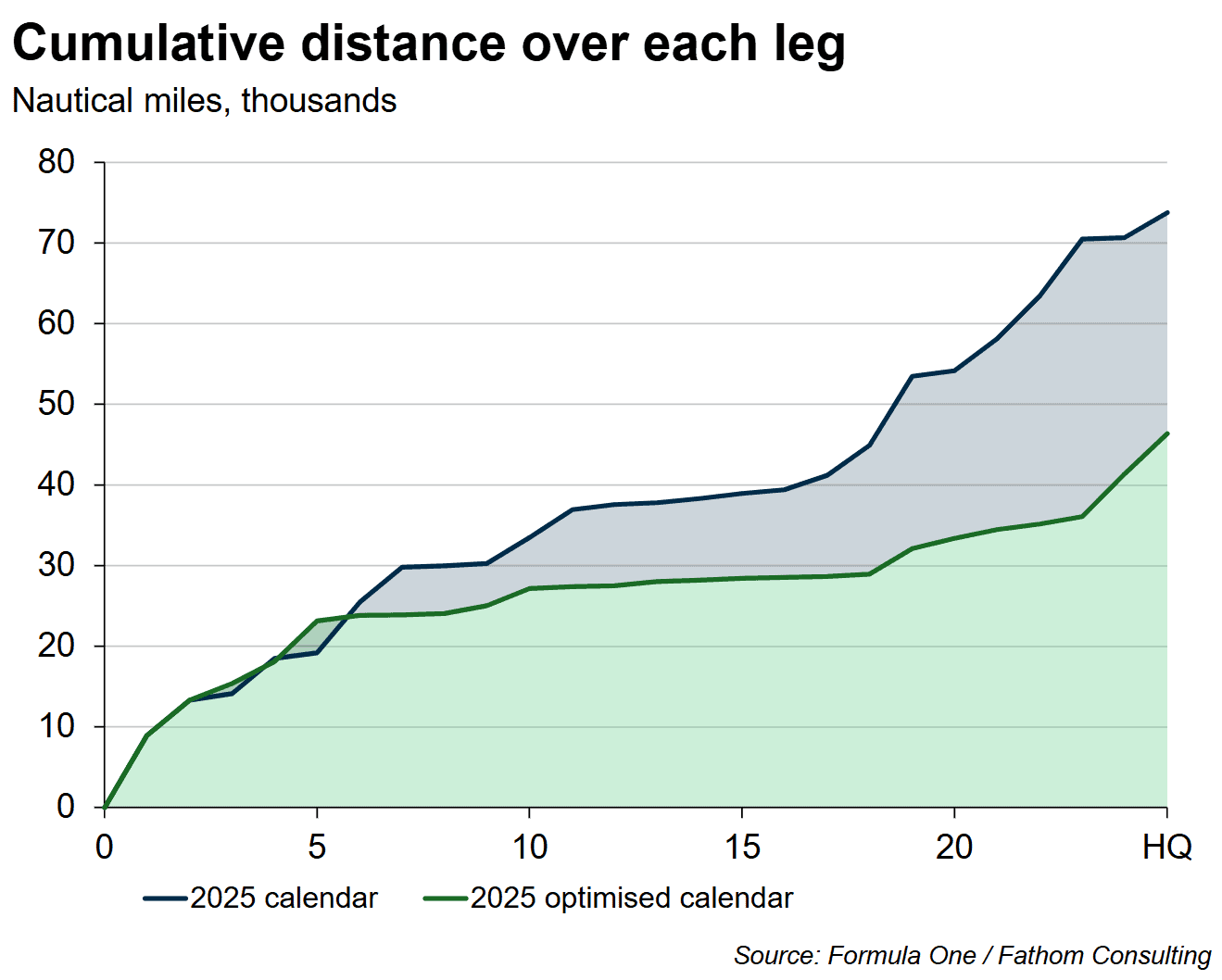
While the F1 franchise does produce positive externalities derived from R&D, driving forward sustainable fuel efficiency and automobile design, at the end of the day it’s still a private firm. Like any private firm, profit maximisation is of paramount importance. Holding every single Middle Eastern Grand Prix back-to-back would certainly cut the air miles of logistics and business travel, but at what detriment to ticket sales? Indeed, scarcity often increases the value of a normal good, so what’s the use of staging Miami’s race a week or two after the United States Grand Prix? Repeat customers are also inclined to consume F1 seasonally; if I enjoy eardrum abrasion, once per year, at the same time each year, you better believe an unexpected change in scheduling will shift my preferences. From F1’s perspective, it makes very little commercial sense to jeopardise any of the 6.5 million fans that attend races each year, regardless of the potential emissions reductions.
However, an alternative and arguably stronger argument exists, and one which could apply to a variety of sports transitioning to net zero. It concerns F1’s beating heart: the wellbeing of its staff who keep the show running. Last year, during the first 24-race season, drivers and their respective teams endured four [3]. Lando Norris and Charles Leclerc have both voiced concerns for the hundreds of travelling mechanics, engineers and team personnel who bear the brunt of the lengthy F1 calendar, often away from their families for extended periods. Max Verstappen has complained about the additional stress the sprint weekend format[4] puts on the mechanics. F1 president Stefano Domeniciali has mooted the idea of multiplying these newer races in the future, increasing F1 worker’s hours even further. But ultimately, the future success and sustainability of the franchise, and in turn its cash flow, is built upon F1’s staff. As such, their present and future wellbeing should be a strongly weighted variable within F1’s profit function.
Oftentimes, re-framing the problem from a monetary perspective, in this case underlining the importance of preventing staff burnout, can elucidate a simple solution’s utility! However, be warned; if no significant changes are made to the 2030 race-calendar, my next motorsport-related TFiF will be titled; ‘Why everyone should stop watching Formula One’. Arrivederci!
Formula One calendars
| Leg | 2024 destinations | 2025 destinations | Optimised 2025 route | 2026 destinations |
|---|---|---|---|---|
| 1 | Bahrain 2934.17 nmi | Melbourne 8960.73 nmi | Melbourne 8960.73 nmi | Melbourne 8960.73 nmi |
| 2 | Jeddah 687.18 nmi | Shanghai 4349.53 nmi | Shanghai 4349.53 nmi | Shanghai 4349.53 nmi |
| 3 | Melbourne 6911.83 nmi | Nagoya 811.88 nmi | Singapore 2055.75 nmi | Nagoya 811.88 nmi |
| 4 | Nagoya 4404.16 nmi | Bahrain 4350.42 nmi | Nagoya 2745.98 nmi | Bahrain 4350.42 nmi |
| 5 | Shanghai 811.88 nmi | Jeddah 687.18 nmi | Jeddah 5029.41 nmi | Jeddah 687.18 nmi |
| 6 | Miami 7167.27 nmi | Miami 6279.11 nmi | Bahrain 687.18 nmi | Miami 6279.11 nmi |
| 7 | Bologna 4400.56 nmi | Bologna 4400.56 nmi | Doha 76.67 nmi | Montreal 1227.25 nmi |
| 8 | Monte Carlo 175.35 nmi | Monte Carlo 175.35 nmi | Abu Dhabi 161.36 nmi | Monte Carlo 3306.34 nmi |
| 9 | Montreal 3306.34 nmi | Barcelona 271.40 nmi | Baku 980.70 nmi | Barcelona 271.40 nmi |
| 10 | Barcelona 3184.36 nmi | Montreal 3184.36 nmi | London 2143.80 nmi | Spielberg 644.16 nmi |
| 11 | Spielberg 644.16 nmi | Spielberg 3452.81 nmi | Amsterdam 192.92 nmi | London 636.52 nmi |
| 12 | London 636.52 nmi | London 636.52 nmi | Liege 106.90 nmi | Liege 220.95 nmi |
| 13 | Budapest 782.40 nmi | Liege 220.95 nmi | Budapest 561.48 nmi | Budapest 561.48 nmi |
| 14 | Liege 561.48 nmi | Budapest 561.48 nmi | Spielberg 173.48. nmi | Amsterdam 618.75 nmi |
| 15 | Amsterdam 106.90 nmi | Amsterdam 618.75 nmi | Bologna 217.56 nmi | Milan 447.96 nmi |
| 16 | Milan 447.96 nmi | Milan 447.96 nmi | Milan 108.58 nmi | Madrid 641.37 nmi |
| 17 | Baku 1793.68 nmi | Baku 1793.68 nmi | Monte Carlo 128.53 nmi | Baku 2409.03 nmi |
| 18 | Singapore 3750.99 nmi | Singapore 3750.99 nmi | Barcelona 271.40 nmi | Singapore 3750.99 nmi |
| 19 | Austin 8545.46 nmi | Austin 8545.46 nmi | Montreal 3184.36 nmi | Austin 8545.46 nmi |
| 20 | Mexico City 654.73 nmi | Mexico City 654.73 nmi | Miami 1227.25 nmi | São Paulo 4370.78 nmi |
| 21 | São Paulo 4012.73 nmi | São Paulo 4012.73 nmi | Mexico City 1115.28 nmi | Mexico City 4012.73 nmi |
| 22 | Las Vegas 5281.80 nmi | Las Vegas 5281.80 nmi | Austin 654.73 nmi | Las Vegas 1312.22 nmi |
| 23 | Doha 7041.13 nmi | Doha 7041.13 nmi | Las Vegas 941.11 nmi | Doha 7041.13 nmi |
| 24 | Abu Dhabi 161.36 nmi | Abu Dhabi 161.36 nmi | São Paulo 5281.80 nmi | Abu Dhabi 161.36 nmi |
| 25 | Back to HQ 3150.92 nmi | Back to HQ 3150.92 nmi | Back to HQ 5034.04 nmi | Back to HQ 3150.92 nmi |
| Total | 71,551.54 nmi | 73,801.79 nmi | 46,390.50 nmi | 68,769.65 nmi |
[1] A SAFc is a market mechanism for carbon offsetting that represents the environmental attributes of a metric ton of sustainable aviation fuel. They enable firms to purchase, track, and claim the emissions reductions of using SAF without having to buy the physical fuel.
[2] F1 utilises travel by air, land and sea to conduct its logistics. Between races, a proportion of equipment may be transported back to a team HQ, however, most of the equipment as well as team staff will go directly from one race to the next. Within the European portions of a season, most business travel/ logistics is via truck.
[3] A double-header implies two races in a row, in back-to-back weekends, and a triple-header implies three races in a row, back-to-back-to-back, involving a period of weeks away from homes and families for many F1 staff.
[4] Introduced in 2021, a sprint weekend is identical to a traditional Grand Prix weekend but extended with an additional short race named ‘The Sprint’. It covers around a third of a typical Grand Prix distance, and there are no mandatory pit stops.
More by this author