

A sideways look at economics
My partner Tom often accuses me of what he calls my ‘Scandinavian supremacy’, essentially that I think most things Scandi are superior to their UK or other counterparts. I, of course, find this an unfair accusation as it is simply factual that Norway has better washing up liquid (Zalo), superior suncream to everyone but the Koreans, that Danish mid-century furniture is the most aesthetically pleasing, and that Swedish pick and mix is of god-tier quality. On a recent trip home, I was reminded of yet another thing to add to the list of what the Scandis (in this case Norway does well), namely elections, or more specifically voting infrastructure.
You see, in Norway not only can you pre-vote for whole month prior to the election, but you can also do this from any municipality (regardless of where your address is registered), there’s no need to pre-register to vote either, just show up and bring your id (passport, drivers licence or national identity card all count). The location of these pre-polling stations are usually also set up for maximum ease of access with many located within shopping centres or other buildings you would be likely to pass by on a daily basis.
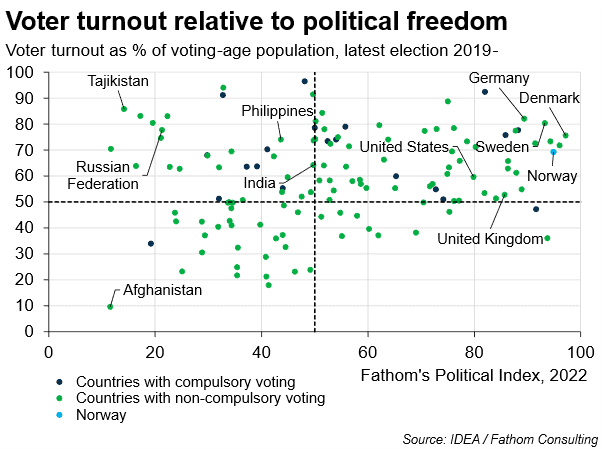
With elections coming up on Monday 8th September I took the chance to cast my own ballot while I was home: in the cellar of my dad’s local shopping centre, it took about three minutes from start to finish, including a nice chat with the people manning the polling station. Of course, it is not the first time I’ve experienced how easy it is to vote in Norway, but moving abroad has a way of changing your perspective on where you come from, making you notice things (both good and bad) you might previously have taken for granted. So as I was contemplating the exorbitant price of Norwegian groceries (more on that at a later time), I started thinking both about how easy it is to vote in Norway, why more people don’t vote (it should be especially bruising to our national pride that we underperform the Danes and Swedes, for if the Scandi supremacy ‘be great’ the Norwegian supremacy ‘be greater’), but also wondering how much all this might cost.[1]
First how much does the pre-polling period cost. Pre-polling this year started on August 11th and ended today, but opening hours vary between polling stations with some open ten hours on weekdays and others only six, an average of eight hours say. Meanwhile, Saturdays they close earlier, so say they are open for three hours, in total, then we’re looking at 169 operating hours for each polling station. Say you need a minimum of two people to man a polling station, but that for bigger areas you might have up to ten people working at one time, we’ll set an average of four, somewhat lower than the mathematical average to account for the fact that Norway is spread out and largely empty, so a lot of stations aren’t likely to need much in the way of manpower. Likely some of the people working the polling stations are full-time employees of the various councils, but they also recruit externally at an hourly rate of NOK246 per hour (or around £18).[2] Therefore, for the average polling station pre-polling labour costs will sum to about NOK166 thousand (£12.3 thousand) in total.
Now to the big question, how many pre-polling stations are there? Well fortunately that information is very easy to find as valg.no have information on all polling stations so that you can search up the one closest to you and see its opening hours. Less fortunately there’s no aggregate list, probably because that information (surprisingly) isn’t all that interesting to most people. So what to do? Guesstimate based on the number of election districts (19) and municipalities (357)? Or click onto each individual province, each municipality within that province and manually count the number of stations. As this is a completely inconsequential analysis, for a light-hearted blog, I obviously went with… the latter. And found that Norway (assuming I didn’t mess up the count) had for this election a total of 910 pre-polling stations. Interestingly, the number of stations don’t seem to be correlated with population, and are only moderately explained by size of urban areas in the districts as the charts below show, but coming back to the question at hand, this means that the grand total of the pre-polling costs sums to about NOK151 million (£11.2 million) about the same as this three-bed four-bath penthouse on Southbank. All told, a pretty reasonable cost especially if it gets more people out voting.


But what about the costs of polling on election day itself? Working a polling station on election day gains you around NOK4000 (£296) depending on which region you’re in, about £24 per hour given that you would be expected to work about 12 hours. We’ll go with the same average number of workers per polling station, four, but the number of polling stations increases on election day, to 1638 (don’t worry, I counted), bringing total election day labour costs to NOK26 million (£1.9 million), again not so bad.
One final aspect remains to calculate , namely the rather than working. We’ll assume that anyone who pre-votes does so in their spare time and we’ll also assume that no one votes in their spare time on an election day, but that they would rather go when they would normally be at work. Furthermore, we’ll say they are all employed and earning a median wage of NOK356 per hour (£26). In 2025 there are just over four million eligible voters in Norway, but not everyone votes so, assuming the same voter turnout as in 2021, that number drops to 3.1 million. As of 4 September a record-high 1.7 million had voted, assuming a constant number of pre-votes per day you could therefore expect around 1.77 million people to pre-vote in total this year, leaving 1.3 million to vote on election day, assuming they all spend an hour voting (queues can be quite long on the day) this lost productivity cost sums to NOK478 million (£35.2 million).
A grand total cost therefore of NOK656.2 million (£48.5 million), not bad in an annual budget of NOK2020.8 billion (£149 billion), but that could be brought down further if more people took advantage of pre-voting.
Godt valg!
[1] Only the labour costs associated with holding the election and people voting has been calculated here, and I’ve ignored postal voting and voting from abroad.
[2] This rate varies between municipalities, but I’ve gone for the rate offered by Norway’s fifth largest city, Kristiansand (population 116 thousand just to give you an idea of the kind of population density Norway has).
More by this author