

A sideways look at economics
UK productivity growth is not what it was. After averaging some 2.2% per annum through the 1970s, 80s and 90s, it took a significant step down around the time of the GFC, averaging just 0.5% a year between 2007–2019. Things have not improved since COVID – in fact, in the four quarters to 2025 Q2 a 0.6% reduction in output per hour took place, according to the latest ONS statistics. Against this depressing backdrop, some are beginning to wonder whether UK economic performance suffered a further adverse shock during the pandemic. One client asked, during a discussion of our Global Outlook, Winter 2025, whether ‘working from home’ (WFH) was to blame. It is certainly a question worthy of further consideration.
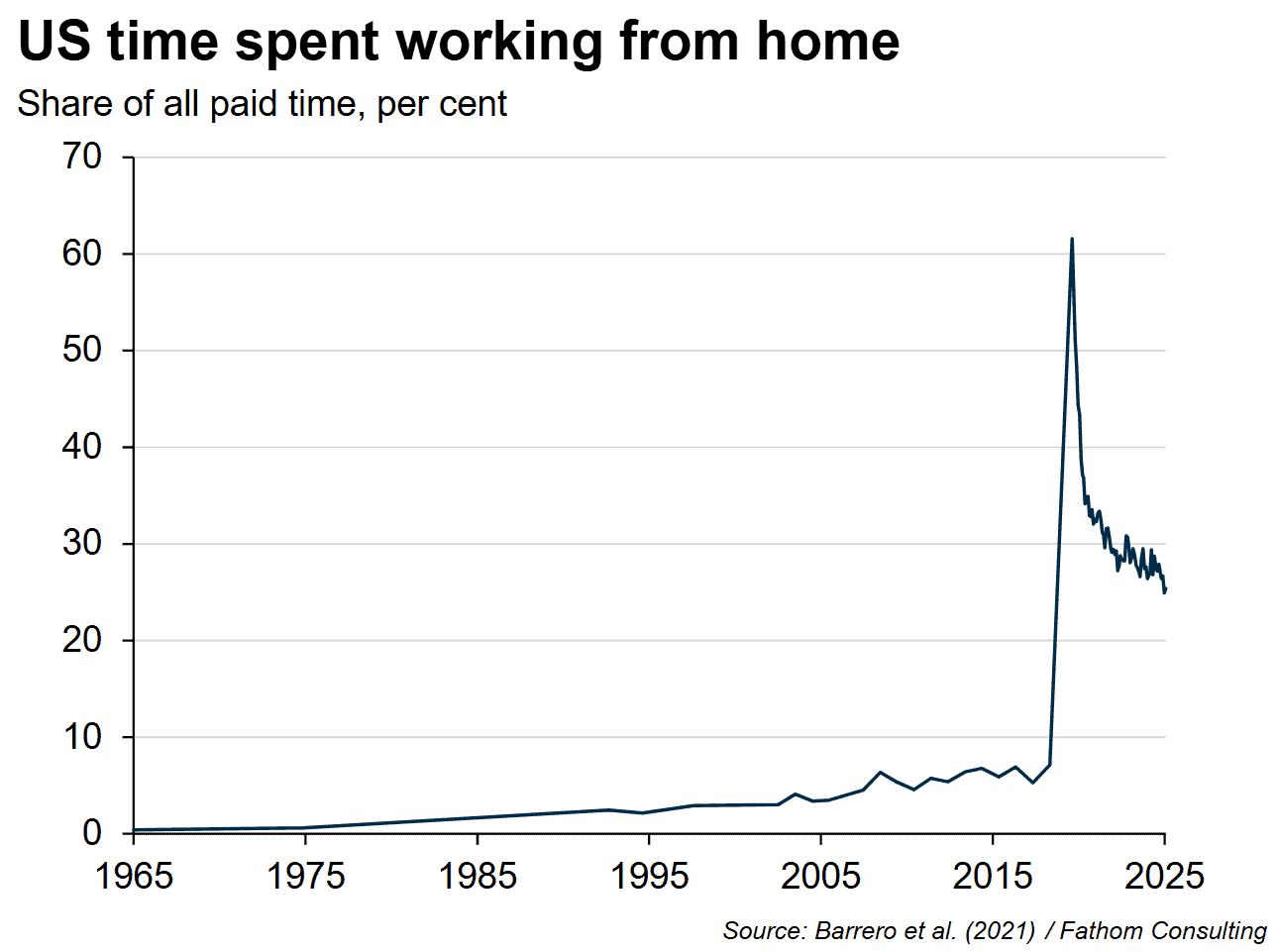
The increase in WFH that took place, largely by necessity, during the pandemic can be seen as a dramatic acceleration of a trend that had been in place for several decades. As an example, our first chart shows the proportion of paid working time that has been carried out at home in the US since 1965.[1] It leapt from 7% on the eve of the pandemic, peaking at more than 60% in May 2020, before falling back as COVID became less of a threat to public health, settling at around 25%–30% through 2025. On that basis one could argue that, in the US, an adjustment in working practices that on pre-pandemic trends would have taken more than 60 years to materialise, happened almost overnight.
The prevalence of home working varies across countries. According to the latest Global Survey of Working Arrangements (G-SWA), conducted by the Stanford Institute for Economic Policy Research (SIEPR), on average across the 40 countries sampled the typical employee with a tertiary level of education worked 1.2 days from home each week.[2] That figure rose to 1.9 for Canada, where WFH was most prevalent. The UK, where 1.8 paid days of work were carried out from home each week, was in second place. Interestingly, according to research conducted by Zarate and others using the SIEPR dataset, neither GDP per capita, nor the industrial composition of GDP, had any statistically significant impact on the amount of time spent WFH. By far the most important driver was the importance of ‘individualism’ in each country, with countries that had a low score on the Hofstede index of cultural individualism, like China and other East Asian economies, tending to work far fewer hours from home than countries that had a high score on that index, including most English-speaking countries.
So much for the practice of WFH; what of its costs and benefits? Does WFH raise or lower productivity? There are arguments in each direction. Nicholas Bloom, a Stanford University economics professor and senior fellow of SIEPR, is firmly on the ‘pro’ side. Writing in the IMF’s Finance and Development magazine, in an article entitled ‘Working from home is powering productivity’, he draws attention to “the great productivity gains promised by the pandemic-induced jump in working from home”. To be fair, once one looks beyond the headline, he does argue that these gains are largely prospective rather than already in place. One of the principal advantages, in his view, is a reduction in commute time, which could result in higher productivity per worker (if the time saved is spent working), or higher productivity per hour (if the time saved is spent at leisure, but the worker feels more refreshed, and is more productive as a result). The author argues that a further potentially important benefit comes from the release of redundant office space for other, now more productive uses. The value of office space relative to the value of other buildings, as measured by the prices of real estate investment trusts (REITs), has fallen significantly since the pandemic, suggesting, unsurprisingly, that the rebalancing of the capital stock is yet to take place.
The practice of WFH certainly has its opponents. Prominent among these in the UK, during and after the pandemic, is former cabinet minister Jacob Rees-Mogg, who famously visited government departments leaving cards with the message ‘Sorry you were out when I visited’ on the desks of civil servants not present at the time he happened to swing by. Presumably his unspoken suspicion is that, away from the watchful eyes of management, those working from home will engage in ‘shirking’. They will take time away from their laptop screens to carry out household chores, to watch the television or simply to do nothing. For economists, ‘shirking’ is not a new phenomenon. In a seminal paper, Carl Shapiro and Joseph Stiglitz used the concept of a ‘no-shirking condition’ to explain persistent unemployment.[3] Their idea was that, to incentivise workers to be productive, firms would need to offer a non-market clearing wage so that the costs of being fired if caught shirking were sufficiently high to discourage the practice. In their model, a change in working practices that made monitoring the supply of effort more costly, such as remote working, would lead to higher wages and more unemployment. I don’t believe that is the world we are in just yet.
For me, the biggest risk to working from home comes not from shirking, but from impediments to communication. Pre-pandemic, I could turn to my colleagues and ask for their help or advice if it was needed, as we were all in the same room (and they, in turn, could ask much the same of me). If it was not the right moment, either because they were talking to someone else, or because they were concentrating intently on their own piece of work, I would bide my time. That whole process is much harder and more time consuming in a virtual office.
So, there are reasons to believe that WFH might raise productivity, particularly in the long run. And there are reasons to believe it might lower productivity too. Where do we come out? We gathered data on output per hour across 36 OECD economies since 1995. We then built a simple model that expresses trend productivity growth in each country as a constant to be estimated (where that constant was allowed to vary between countries). Finally, we applied a statistical test that looks for breaks in our simple model. The statistical test is agnostic about the number of breaks – there may be 0, 1, 2, 3, 4 or 5 – and it is agnostic about when they might occur. The test found strong evidence that there were exactly two breaks, and they were most likely to have occurred in 2007 and again in 2020. The first of these we might associate with the GFC, and the second with COVID. That we found strong evidence of a break in our model, of a change in trend productivity growth in 2020, was all the more remarkable as we have relatively little data beyond that period (the series for output per hour in each country ends either in 2023 or in 2024). Our second chart shows, conditional on a break occurring in 2007 and in 2020, the estimated change in trend productivity growth in each country either side of the pandemic. Trend productivity growth is estimated to have fallen in 32 out of 36 OECD economies, and by an amount that is statistically significant in around two thirds of those cases.
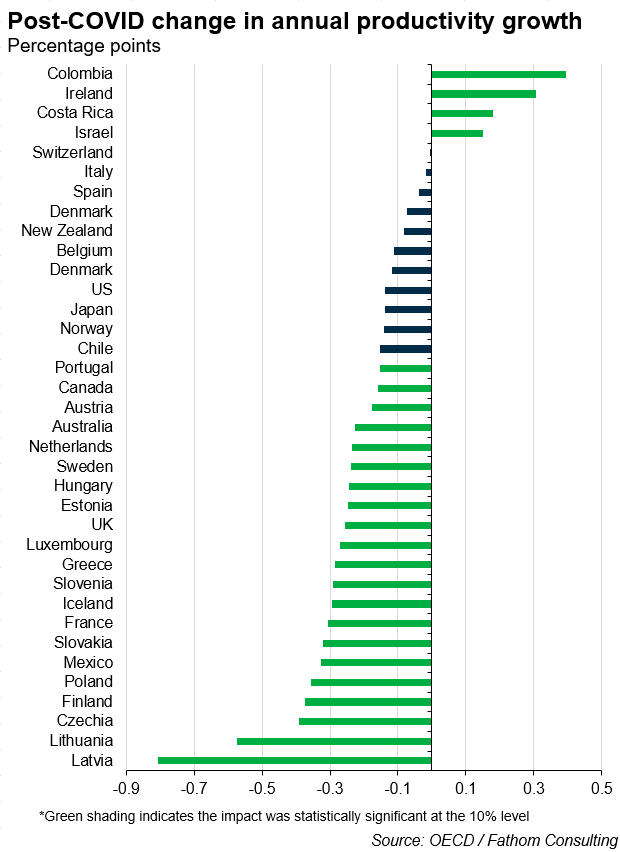
Our final chart suggests that those who believe working from home will raise productivity have some work to do. There is, of course, an important caveat. Simple visual inspection of a set of charts, combined with more sophisticated statistical tests, strongly suggests that trend productivity growth has slowed across the OECD economies since the pandemic. While we might conclude that the cause is related at least in part to the pandemic, we have little to no proof that it is related specifically to the practice of working from home. In 2022, Russia invaded Ukraine, leading to a reduction in the supply of energy, and a sharp spike in energy prices, particularly within Europe. It is likely that explains some of the decline in productivity growth, which appears to be more pronounced in Europe than elsewhere.
There has been a dramatic change in working practices. In the US, as we have seen, more than 60 years of change apparently occurred overnight. In that environment, teething troubles seem almost inevitable. Shirking is undoubtedly a risk, even if we see no evidence that it is taking place in the context of the Shapiro and Stiglitz model. Nevertheless, were it to occur, it could be addressed by more effective management strategies, rather than by enforcing a full-time return to the office. While I remain concerned that, for the time being, there may be significant barriers to communication when working from home, my hope is that these can be addressed. I am probably more in the Nicholas Bloom than the Jacob Rees Mogg camp, even if the full benefits of increased WFH will take some time to materialise.
More by this author
Patience may be a virtue, but it isn’t everything
Teaching the government how to budget
[1] The data are taken from ‘Why working from home will stick’ by Jose Barrero and others.
[2] The latest survey was conducted in late 2024/early 2025 and the 40 countries included a mix of developing and emerging markets located across the major continents. Individualism explained some 40% of the cross-country variation in the prevalence of WFH, with the stringency of lockdowns and population density the only other statistically significant drivers.
[3] Shapiro, C and Stiglitz, J (1984) ‘Equilibrium unemployment as a worker-discipline device’, the American Economic Review, 74(3), pp. 433-444. Joseph Stiglitz went on to win the Nobel Memorial Prize for Economic Sciences for his contribution to the economics of informational asymmetries, of which this was an early example.