
A sideways look at economics
The best scene in the award-winning South Korean film Parasite sees rainwater washing the expensive houses high on the hill before sluicing down through ever-lower levels of the city, collecting detritus all the way. Finally it reaches a filthy, toxic sump in the basement where the family at the centre of the action live. If that image feels familiar, that’s because it is. It featured in Fritz Lang’s Metropolis, in Akira Kurosawa’s High and Low, in Victor Hugo’s Les Misérables, and in Charles Dickens’ Bleak House and, in a different way, Our Mutual Friend, among others. Like Parasite, each of those works was created at a pivotal moment in the history of the country from which it sprang.
Metropolis was filmed during the Weimar Republic in Germany, a time of enormous churn and transition; Kurosawa made High and Low at the crest of the post-war miracle economy in Japan. Les Misérables was written during the mid-1800s, when the French revolution was decades old and France was trying to find a settlement that might last; Bleak House during the 1850s and Our Mutual Friend in the 1860s, when the British industrial revolution had just reached its peak and Britain was about to enter a period of relative decline (not yet complete, it seems). That image, of water as a medium for transferring waste from the top to the bottom of society, is a marker like the ‘eyes’ emoji. Look at this! South Korea is experiencing just such a moment now. We should pay attention.
South Korea has been the star performer in the global economy for three or four decades. It has risen from low, through middle and into high income over that period. The first of those transitions is commonplace, but the second is rare: the so-called ‘Middle-Income Trap’ is real. Most countries that reach middle income stay there, and those that leave do so in equal measures upwards and downwards. South Korea has made it to high income and has done so while becoming relatively ‘free’. You can’t be rich if you’re not free, unless you’re an oil exporter.
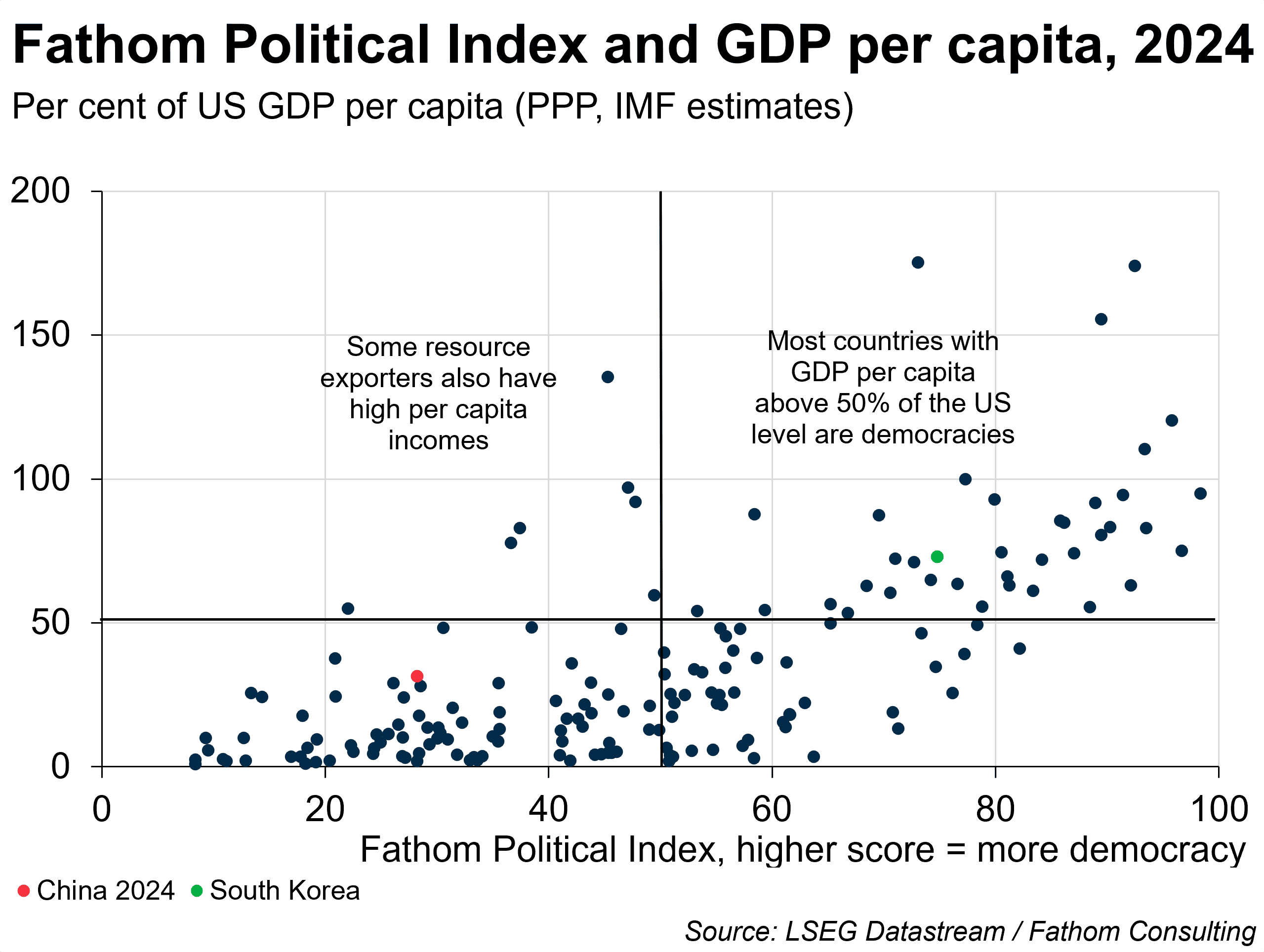
South Korea has made it into the top right quadrant, which is a fantastic achievement. One set of problems (rapid industrialisation, transition to higher levels of freedom) is over: welcome to the new set. Free people have a voice that must be heard, and films like Parasite are one expression of that voice.
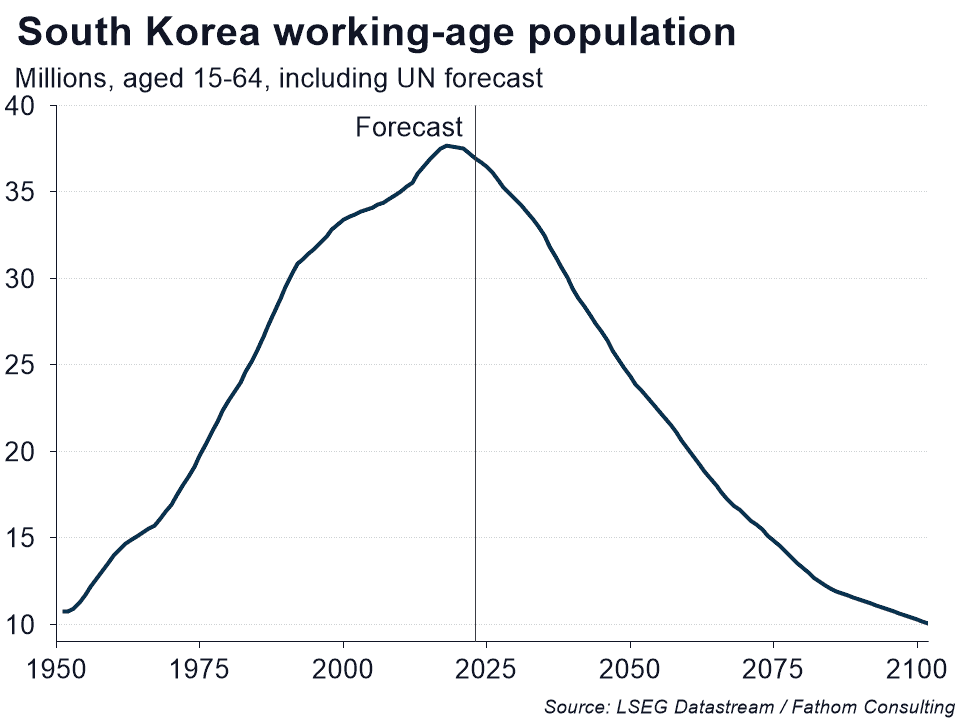
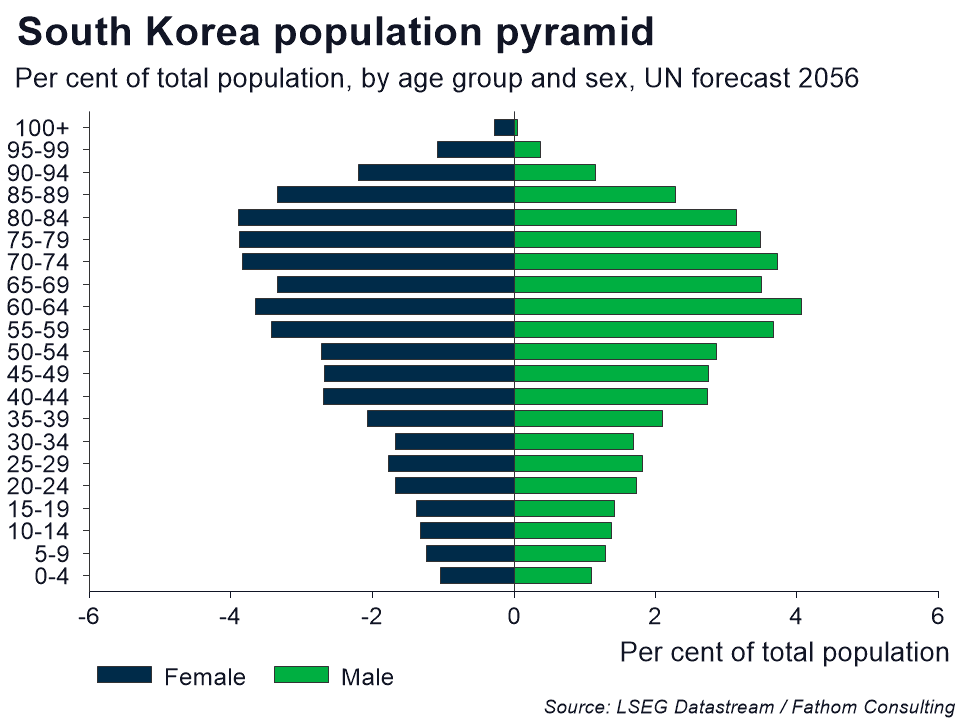
There are echoes of this transition in the South Korean economy and financial markets. On the socioeconomic side, South Korea is facing a demographic change more rapid than almost anywhere in the world. The South Korean population of working age peaked in 2017 at nearly 38 million and is set to fall to only 10 million by the end of the century, according to the UN: an almost 75% reduction. These are astounding projections, matching the decline of the Chinese population of working age that is coming over the same period. And the South Korean population pyramid will be almost inverted by 2056. The issues associated with ageing populations, common across all advanced economies, will be acutely and rapidly felt in South Korea.
On the face of it, South Korean equity markets do not appear to be exercised about the coming transition in the slightest. South Korean equities have outperformed global markets consistently (except for the last month or so) through 2026. Markets are juicing South Korean equities, and with reason: earnings expectations are absolutely stellar.
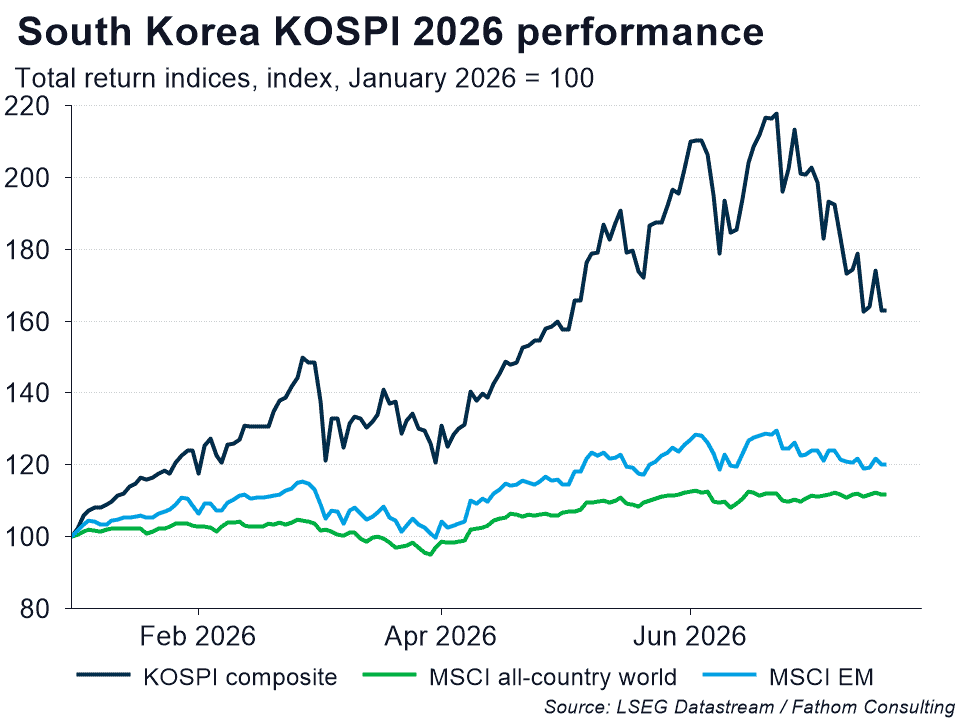
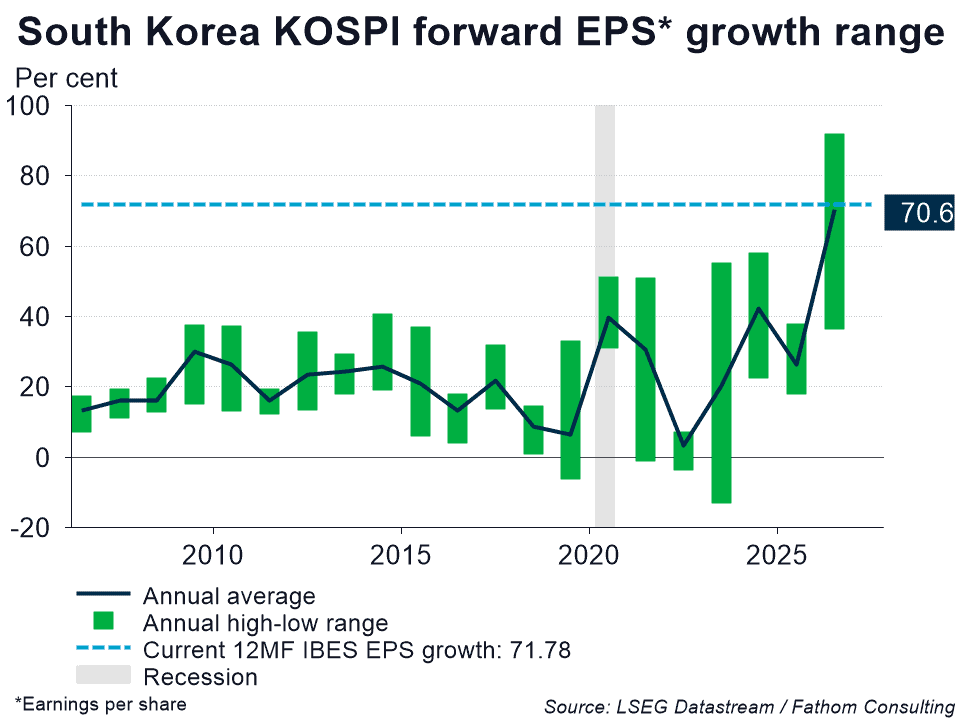
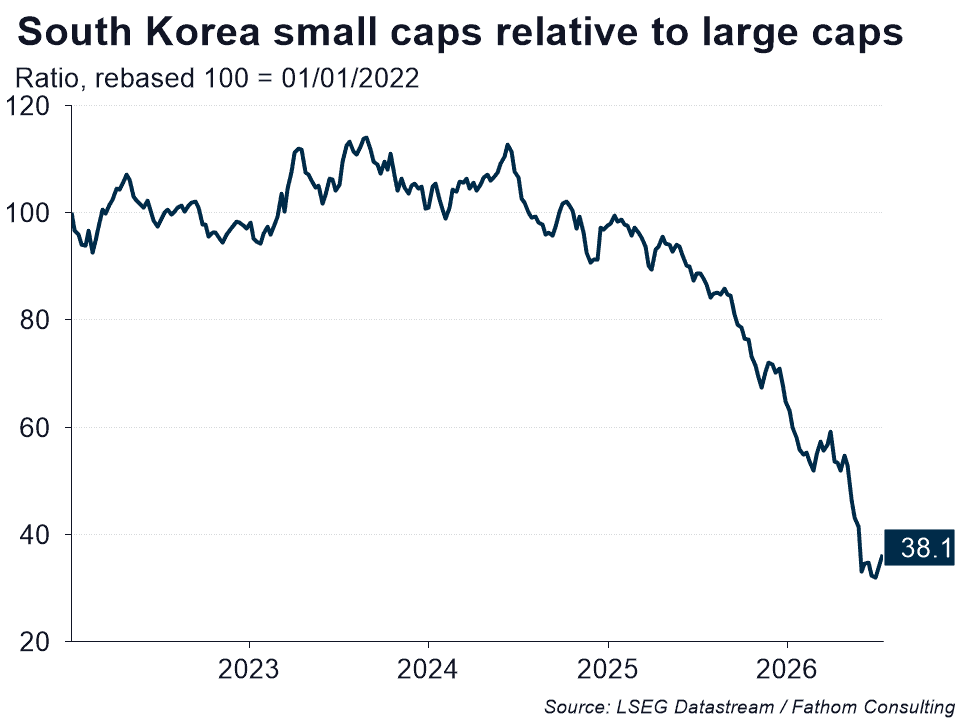
However, under the surface, you can see some of the same issues emerge. It’s all about two companies, Samsung and Hynix, and the earnings of those companies come from outside South Korea. The equity story is the story of the global tech (and specifically AI-related tech) boom, and South Korea is the world’s principal supplier of memory chips into this burgeoning global market. The ratio of market cap of small caps relative to large caps has collapsed by more than 70% since mid-2024. Markets are discriminating hard: South Korea provides essential equipment for the global tech sector, but the rest of the South Korean economy is, to put it politely, uninteresting.
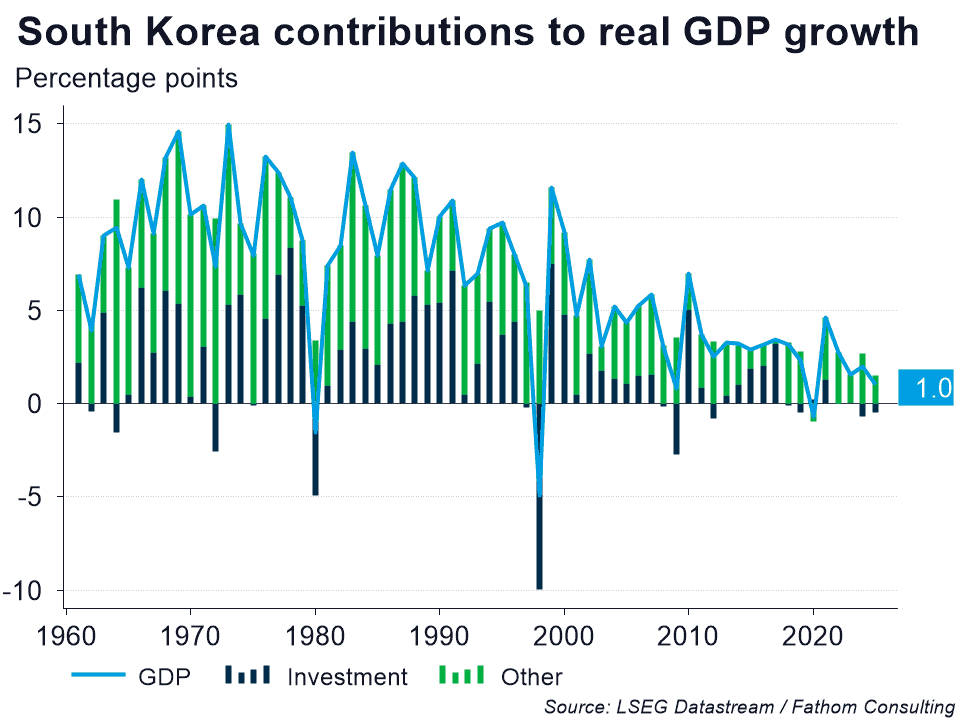
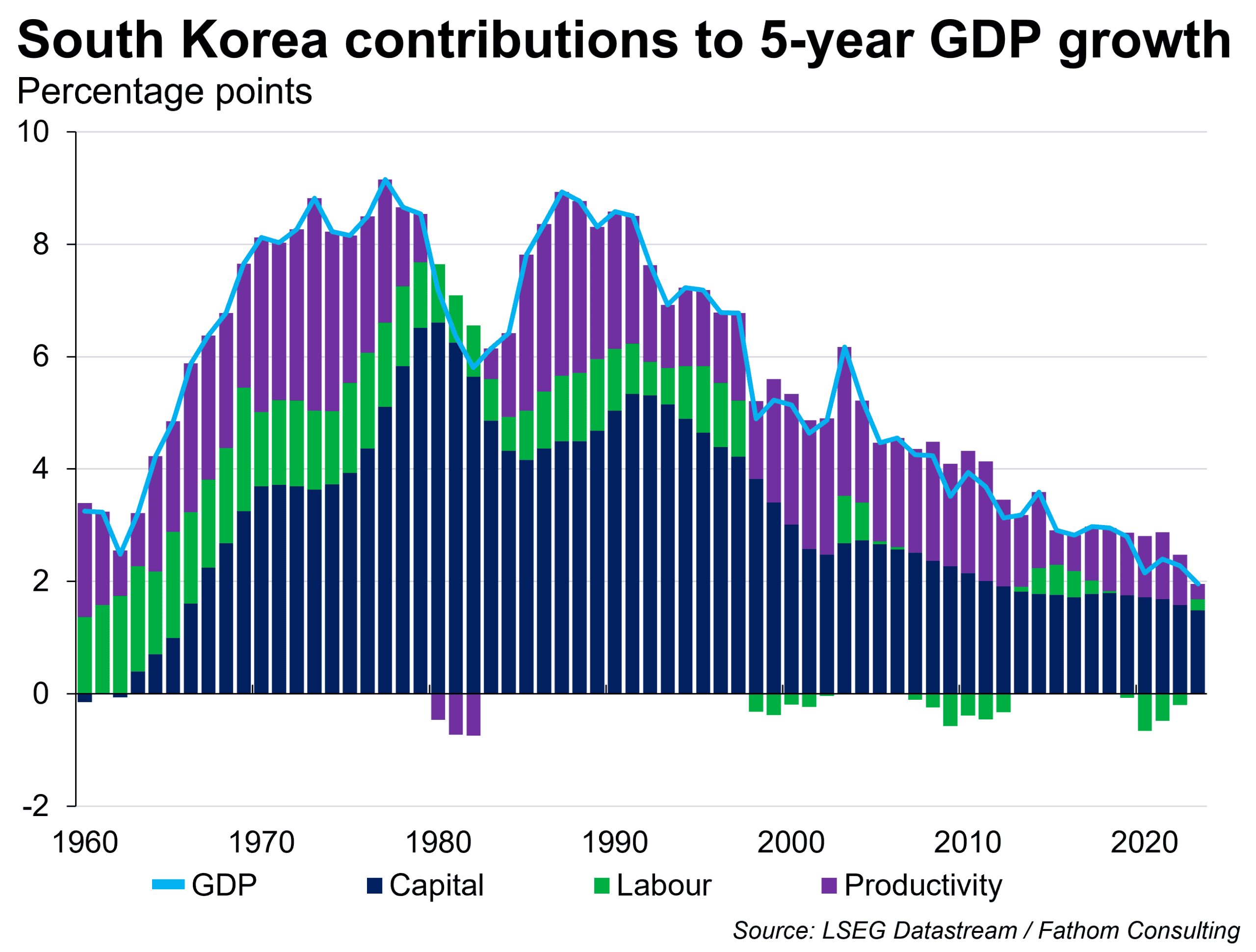
Markets are not wrong on this point. South Korea’s exceptional, investment-led growth is a thing of the past. The economy there is now looking at advanced-economy growth rates in expectation; given the demographic outlook, numbers between 0% and perhaps 2% a year might be the best that it can hope for. Back in the 1970s and 1980s, double-digit annual GDP growth was common; since the emerging Asian crisis of 1997/98, growth recovered to 5% or more until the Global Financial Crisis (GFC) of 2008/09. After that, growth slowed to around 4% until COVID. Since the pandemic it has fallen further, to the point where 2% in steady state would feel like a good outcome. Welcome to the world of advanced economies.
The chart below shows how the contributions to growth from investment and from other sources of demand have slowed consistently since the 1990s.
The next chart shows how the contributions to 5-year average growth have evolved. The bad news here: the green bars are set to be strongly negative for the remainder of the current century. With a reduction in labour comes a reduction in the marginal product of capital too: the contribution from fixed capital is therefore likely to be small or even negative, unless something radical changes. The saviour of South Korean growth, if there is to be one, must come from the purple bars, which measure the contribution from ‘total factor productivity’, which is the efficiency with which labour and capital are combined to create output. But the purple bars are also shrinking. South Korea, like the rest of the developed world, needs to find a new source of productivity growth that, in its case, has the potential to replace people in the workforce. It has this in common with China. Machines equipped with AI (robotics and the like) might be able to provide this. South Korea urgently needs to be at the leading edge of the shift towards intelligent machines, alongside China. Other countries where the demographic trends are less negative, like the USA, will probably specialise in developing AI that serves to enhance labour productivity and therefore increase the demand for human labour. China and South Korea will specialise in AI that replaces labour and therefore reduces demand for it.
Finally, one more item of bad news. South Korea’s two superstar companies are heavily exposed to the fragility of the global AI boom. There is a possible world in which the earnings expectations embedded in equity prices of companies involved in AI turn out to be justified, but it’s getting to be a very low-probability outcome. Much more likely there will be a shakeout, perhaps a very big one. If that were to happen, Samsung and Hynix would be massively affected. Take them out of the equation in South Korea and not much remains. Writing as the majority owner of a small company with outsized exposure to a few clients, I feel the discomfort associated with that kind of risk every day (and particularly at night). I have no doubt this will be exercising South Korean politicians right now. That would be a big enough problem on its own.
Unfortunately, it’s not the only problem. When growth is in or close to double digits, redistribution from rich to poor can be achieved without too much difficulty. As a result, the decades of stellar growth have led to an economy where measures of income inequality are relatively good. Even wealth inequality is fine, by the standards of other countries. But now, with growth closer to zero in prospect, distribution becomes much harder to achieve: you can’t make the poor better off without making the rich worse off in absolute terms. And the rich typically have a louder voice and a greater influence on the political settlement than the poor. Wealth inequality has widened sharply in recent years (even if it remains low by international standards), driven by the unequal patterns of home ownership that were captured in Parasite. The cracks are starting to show: you can see them in Parasite, in Squid Game, in the increasingly bitter and polarised political debate, and even in South Korea’s stance on foreign policy: on the fence between the major powers in the region, in a way that would have been unthinkable 20 years ago.
The rainstorm in Parasite could also be interpreted as a harsh visual representation of so-called ‘trickle-down’ economics, although in this case not so much a trickle as a flood. The trash and filth that washes down through the city: that’s part of how trickle-down operates. The other works referenced above also share this theme: Dickens has characters who live on the dust-heap, spending their lives picking through the rubbish to find items that have some value; other characters who sift through the flotsam and jetsam washed up by the Thames at the end of its journey through London. I was talking to a friend about writing this blog, and she said maybe there’s a movement in the opposite direction too: the poor souls who spend their lives sorting garbage are filtering that waste stream to recover items that can be sold to people further up the income distribution. A jewel, perhaps. Some gold. Occasionally, they might find something so valuable it has the capacity to change their lives, shifting them a few rungs up the ladder. And other items are useful to the garbage pickers themselves, and to others in a similar income group. It is horrible to think that some people make a living by filtering the trash that other people have thrown away. But where there is trash, there will be people who filter it, and I suppose that it’s better that the trash should be filtered than otherwise.
Parasite culminates in a bleak, violent climax (I won’t say ‘solution’) to the problems of inequality in high-income societies. It leaves the viewer with the question: which are the parasites? The emerging underclass in South Korea, scraping a living out of the scraps that fall from the tables of the rich? Or the rich, whose lifestyle is supported at all points by the efforts of those less well-off than themselves, including that underclass? The end of the film, the violent revolution, so to speak, is the least satisfactory part, in my opinion. If there’s one thing we know by now, it’s that that solution never works. Perhaps it’s intended to be prophetic, rather than prescriptive: what will happen, not what should happen.
Things that seemed easy a decade ago in South Korea seem harder now. Building and maintaining those beautiful, expensive houses at the top of the hill, along with the other accoutrements of high-income societies, comes at a cost, and that cost has to be borne somewhere, by someone. The usual arrangement is that, in the words of Thucydides, the strong do what they can, and the weak suffer what they must. The trash, the toxins, the negative externalities: they usually flow downhill, from strong to weak, from rich to poor. Can South Korea, the world’s star economy for 40 years, find a different way, perhaps a better one?
If you are interested in hearing more on this subject, please enquire here for a free presentation.
Further reading
Dynamism in China’s corporate sector
Korea’s jeonse housing bubble bursting
The charts and data featured in this blog are available to LSEG clients through Chartbook on Workspace. To learn more about accessing Fathom’s data, models and tools, get in touch with us here.