
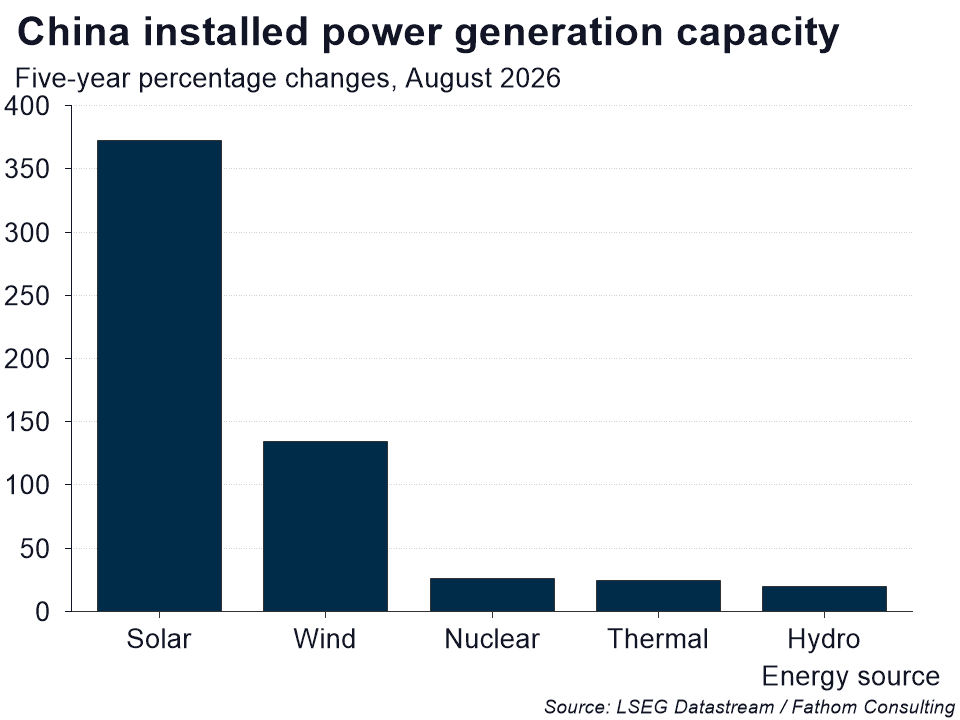
China’s total installed power generation capacity topped 4 terawatts (TW) in May 2026 and currently sits at 4.1 TW as of August, according to China Electricity Council data. China still heavily relies on thermal power generation, which accounts for about 39% of its total capacity and is comprised of mostly coal-fired and some natural gas power plants. However, the country has taken extensive measures to diversify its energy grid; wind and solar power generation now jointly make up almost half of China’s total capacity (up from 24% in 2021). China’s solar capacity has almost quadrupled in the last 5 years, underpinning the rate of innovation and the country’s dominance in the sector. This energy grid diversification, along with aggressive stockpiling of fossil fuels, has allowed China to weather the impact of the US-Iran war in 2026, and maintain strong export growth. Abundant access to cheap energy and land has also enabled China to build data centres at rapid speed as it races to catch up with the US. According to data from SemiAnalysis, China currently has around 24 gigawatts (GW) of data centre computing capacity, trailing America’s 56 GW. However, China aims to close this gap with 20 GW currently under construction and another 30 GW of announced projects, 12 GW more than the US has under construction or planned. And with over 2.7 TW more installed power generation capacity than in the US, it appears unlikely that energy will become a bottleneck in China’s AI infrastructure buildout.