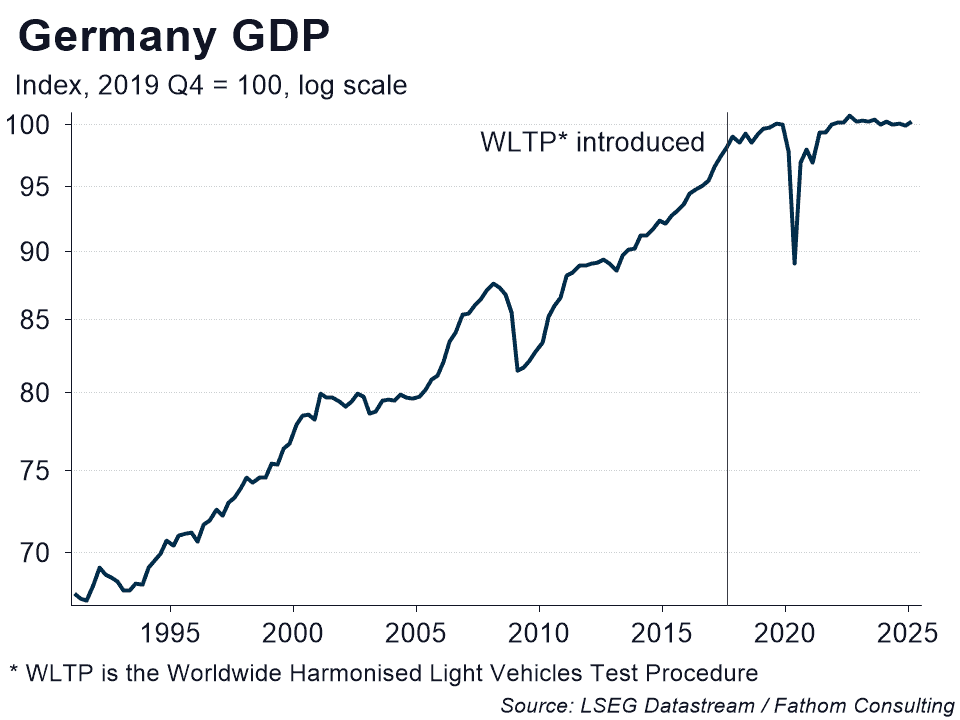
Germany’s decision to lift its long‑standing debt brake marks a major shift in fiscal policy, aimed at reviving an economy that has struggled for much of the past decade. Growth has been subdued, unemployment has drifted higher and the political pressure to deliver a stronger recovery has intensified. Against that backdrop, a sizeable fiscal expansion is being presented as the central plank of Germany’s new economic strategy.
In this research note, Fathom assesses whether that strategy is likely to succeed, and what risks it might entail, using its proprietary Financial Vulnerability Indicator (FVI). The FVI brings together a wide range of macroeconomic and financial data to provide an independent gauge of underlying fragilities in an economy’s households, corporate sector, banking system and sovereign balance sheet. Rather than focusing solely on near‑term growth, it asks whether the structure of the economy can safely absorb additional borrowing and leverage.
By applying the FVI framework to Germany, Fathom is able to quantify how vulnerable the country already is as it embarks on this fiscal experiment, and whether extra spending risks pushing vulnerabilities to levels historically associated with financial stress. The indicator helps to distinguish between a benign scenario, in which fiscal easing supports demand and raises potential growth, and a more troubling one, in which higher borrowing interacts with existing weaknesses in the financial system.
The analysis also considers how Germany’s vulnerability compares with that of its peers, and what that implies for the wider euro area if the expansion goes wrong. Throughout, the FVI provides an evidence‑based overlay to more traditional fiscal analysis, informing Fathom’s judgement about the sustainability, macroeconomic impact and market consequences of Germany’s planned fiscal expansion.