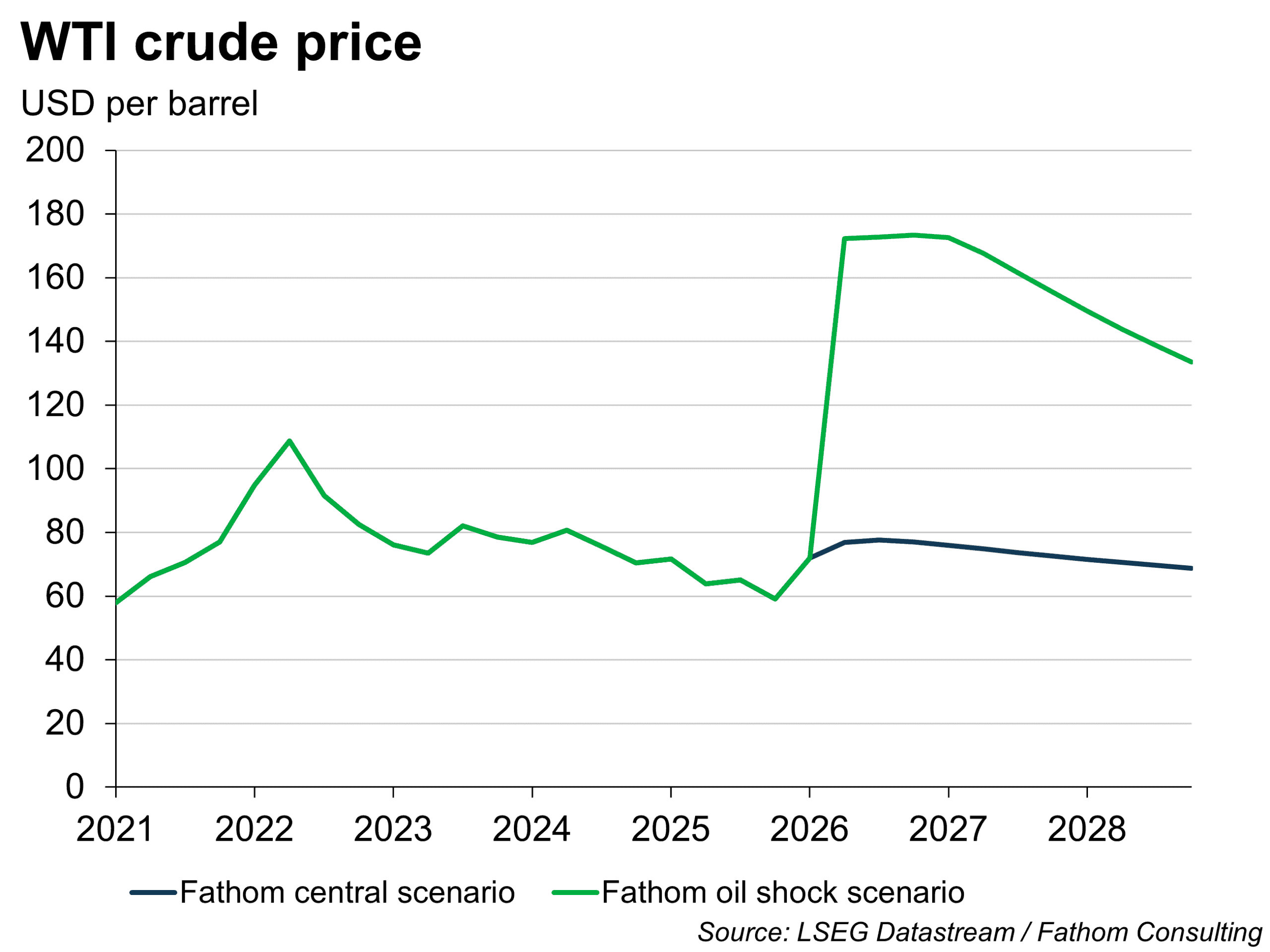
Tensions in the Middle East have raised a question that matters for policymakers, investors and corporates alike: what happens if the Strait of Hormuz, the world’s most important oil chokepoint, is blocked for a prolonged period? In this research note, we describe a detailed oil price shock scenario built around that risk, and assess what it would mean for global growth, inflation and financial markets.
Our analysis shows how a sustained disruption to crude and LNG flows through Hormuz could drive benchmark oil prices well above 170 dollars per barrel, far beyond recent trading ranges. Higher energy costs would feed quickly into headline inflation, squeeze real incomes and raise input costs for energy‑intensive sectors. Central banks would be forced to choose between tolerating a renewed inflation spike or tightening policy into a negative supply shock, increasing the risk of a synchronised global recession.
The oil price shock scenario was outlined in our Global Outlook, Spring 2026, published last week, although our central scenario still envisages oil prices around 70 dollars per barrel over the medium term and a continuation of moderate global growth. In other words, a Hormuz blockage remains a tail risk rather than our central case. However, recent events mean the balance of risks to growth and to equity markets has tilted to the downside.
By combining our macro modelling framework with a detailed assessment of physical energy flows and geopolitical risk, we quantify how large the hit to global activity could be under a severe supply shock, and which regions and sectors would bear the brunt.