
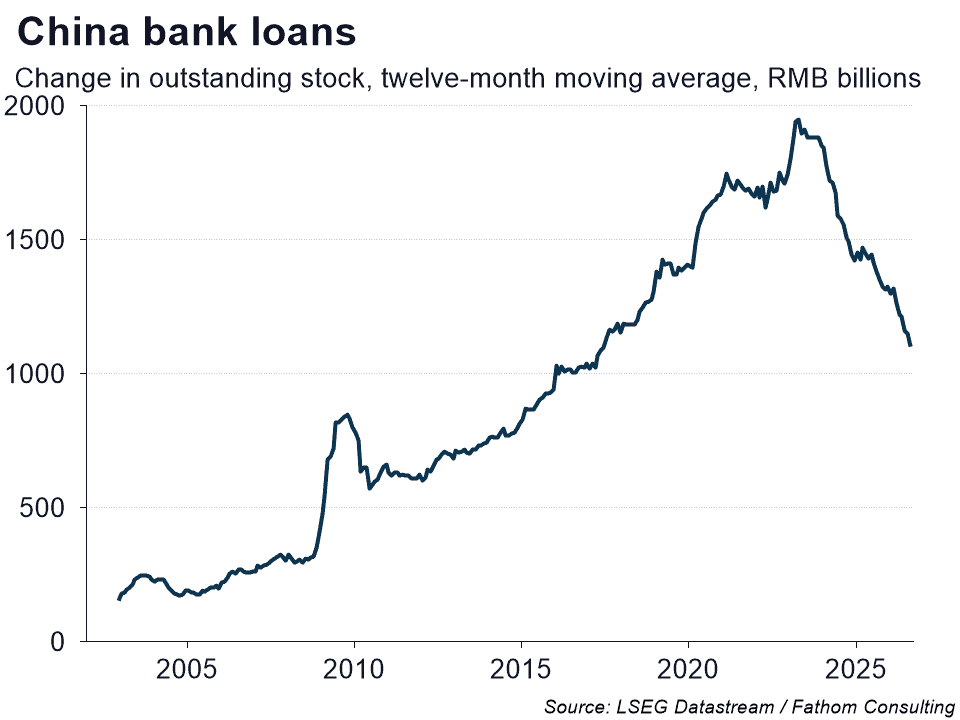
Last week’s macroeconomic statistical release in China followed the familiar track of weak and weakening domestic activity, combined with strong growth in exports. Fathom’s China Momentum Indicator (CMI) shows that growth has been disproportionately driven by net trade contributions over the past two years. Private consumption, meanwhile, has contributed negatively to the CMI for eight consecutive months. Continued weakness in consumer sentiment, and the most recent loan activity data would suggest consumption is unlikely to pick up any time soon: according to Piaofeng Information Network, households have reduced their outstanding loan amount by RMB1027 billion (USD151 billion). Looking to aggregate bank lending we see from the chart the same deleveraging tendency, with the annual average change in the total stock of bank loans declining since the onset of China’s property downturn. Most recent numbers showed a record contraction in loan issuance in July, and while August saw increased issuance, the total amount issued was lower than markets expected. Overall, there appears to be little willingness to use public spending to bridge the gaps, with extra funding from central government going towards repaying and restructuring debt in China’s local governments, rather than policies aimed at boosting depressed demand. Meanwhile, investment, outside of high-tech, export-facing sectors is subdued and, in some cases, even declining. Chinese growth will therefore continue to depend on foreign demand, at a time when there seems to be a rising appetite for protectionist measures in Europe, and downside risks to the global outlook: from oil supply disruptions and concerns about AI spending amongst others.