
Technology transfer, FDI and Europe’s cleantech catch-up
Is foreign direct investment helping Europe build the capabilities it needs to compete?
Europe’s economy is falling behind in the race to compete in industries of the future, especially clean technologies (cleantech). Amid weak growth, lacklustre productivity and fierce competition from Asian players, Europe remains reliant on inward foreign direct investment (FDI) to scale domestic cleantech production. Such investment could help support European capability-building and supply chain sovereignty, but the extent to which it does so is uncertain.
Using Fathom’s proprietary Capital Flows Tracker, this report examines cleantech greenfield investments into Europe from China, South Korea and Japan and assesses the evidence of technology transfer associated with these investments. With European policy on this issue evolving, notably through the proposed Industrial Accelerator Act (IAA), this report sets out seven policy recommendations to ensure that inbound FDI supports Europe’s objective of boosting domestic cleantech manufacturing capabilities.
Report at a glance
Fathom’s Capital Flows Tracker identifies €47.5 billion ($52 billion) of greenfield investment across 196 cleantech projects announced in Europe since 2015. Around 70% of this investment was announced in the past five years, with the bulk concentrated in batteries and EVs and the majority coming from Chinese firms. Combined, Hungary, Poland, the UK, Spain and Germany have received over 80% of this investment.
The report asks whether this investment is helping Europe build the skills, technology and production capabilities it needs, or simply creating assembly lines for foreign firms seeking access to the European market – and what policymakers can do to ensure investment translates into lasting European capabilities.
What we found:
- No formal commitment to transfer technology. Among the five largest deals in each of the five main recipient countries, there was no formal commitment by investors to transfer technology to Europe, even though more than 70% of these projects receive public support.
- The source of investment matters. Fathom’s modelling suggests Chinese greenfield investment does less to stimulate domestic investment in Europe (and may even have a negative effect), unlike investment from other sources which has a positive effect.
- The European Commission’s newly proposed Industrial Accelerator Act (IAA) is a positive first step to ensure greater value-added within Europe, but it is no silver bullet. The report argues that Europe should focus less on prescribing rules on how foreign technology is transferred and more on ensuring that the conditions are in place for capacity building to occur. This includes prioritising learning-by-doing and the development of domestic capabilities among European firms and workers.
€47.5 billion
of greenfield investment announcements
across
196
cleantech projects in Europe since 2015.
Insights
-
Crowding in or crowding out?
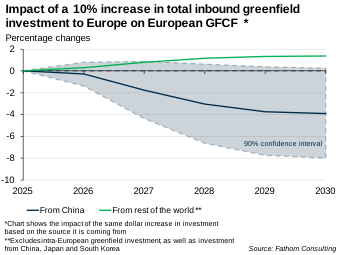
We found that Chinese greenfield investment has a weaker (and possibly even negative) impact on European domestic investment (GFCF) in the long run than investment from other sources. This was not the case with investment from South Korea or Japan.
-
Europe has become a key market for Asian cleantech investments

Since 2015, greenfield investments worth $52 billion from China, South Korea and Japan across 196 different cleantech projects have been announced in Europe. Most (70%) of this investment has occurred in the past five years and 60% comes from Chinese firms.
-
Fathom’s China wave theory
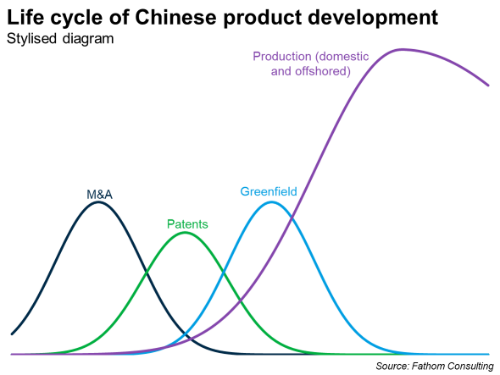
Fathom’s China wave theory explains how Chinese firms often use FDI to build their own domestic capabilities in strategically important sectors: from acquiring knowledge overseas, to building new factories and scaling production. China’s greenfield investment in Europe’s cleantech sector reflects the light blue wave in the chart above. Explore Fathom’s China wave theory .
-
Is Europe benefiting?
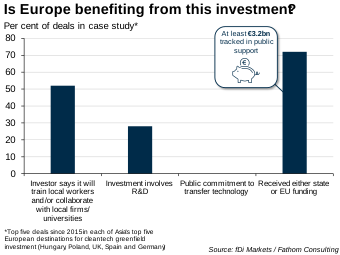
Among 25 major projects, there was no formal commitment to transfer technology to Europe, even though more than 70% of these received public support.
-
Where does Asian clean tech investment go?
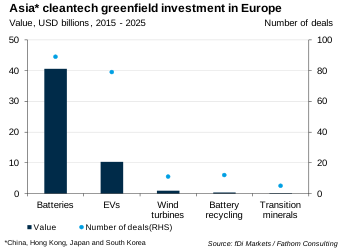
Investments in batteries account for most of Asian cleantech investments, followed by EV-related facilities.
Policy recommendations
The report sets out a series of recommendations for strengthening Europe’s capabilities in cleantech manufacturing.
Meet the team


Read the report
To read this report, please fill out the form below.