

A sideways look at economics
When I visited Canada in March 2025, the prevailing view was that the stance of the Trump administration would push Canada into a long, deep recession. Nothing of that sort has so far occurred: in fact, the economy is performing adequately. I recently wrote about the puzzle of the Canadian Loonie not moving in response to higher oil prices. Since then, oil prices have bumped around (they are now back up above $100pb) and the Loonie still hasn’t moved. I noted then that there was a sense of unfinished business: the current US administration had turned its attention towards Canada early on, before Iran took centre stage. Perhaps the surprising weakness of the Loonie reflected markets anticipating that the spotlight would come back to Canada in due course? Well, now it has. Beneath all the noise, though, there is another story: Canada’s economy is so-so, but its equity markets are booming. Is it just oil? Or could it be related to Canada’s forthcoming ‘associate membership’ of the EU?
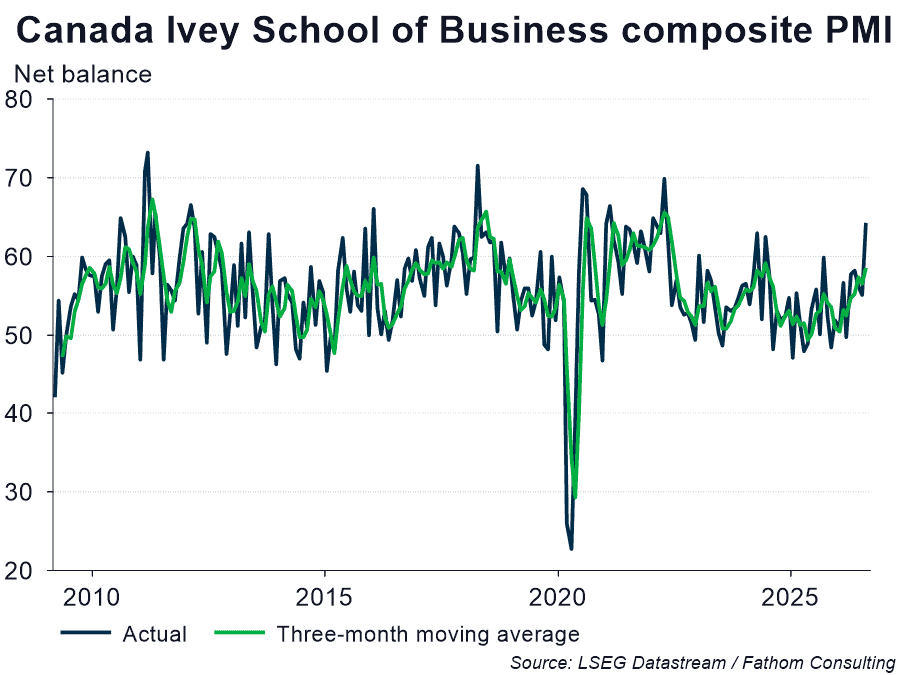
Businesses in Canada are feeling fine. The composite PMI has picked up sharply recently and indeed has only been higher than this on a handful of occasions over the last two decades. Its strength reflects strong employment, investment and inventories and, especially, higher prices paid: and it is manufacturing industry in particular that is doing well.
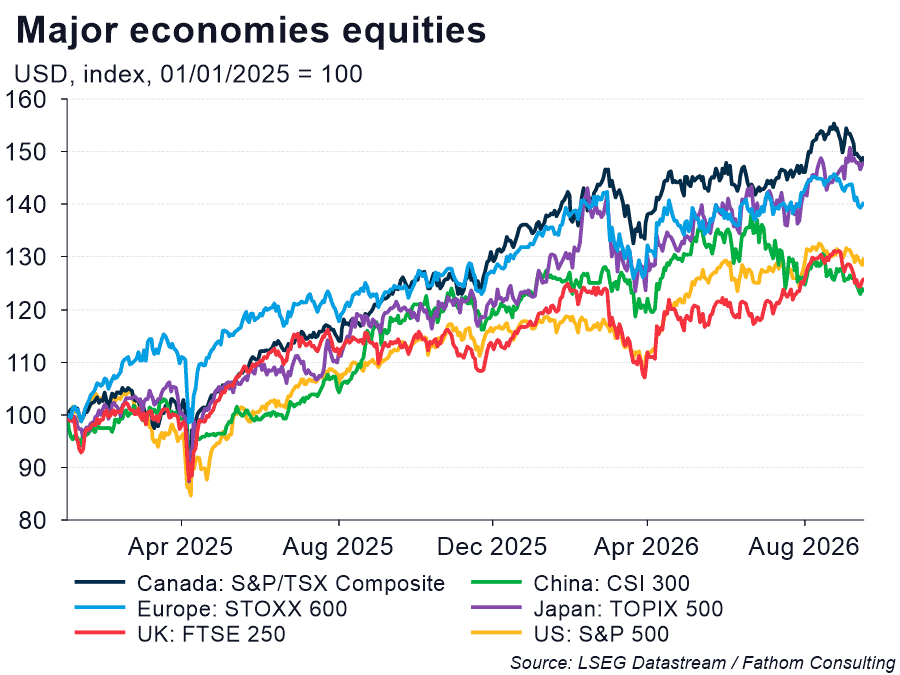
The same mood is present in equity markets. Canadian equities have put on 50% since the start of 2025, ahead of most of Canada’s peers, and ahead of the US by a comfortable margin. In the context of what is going on geopolitically, that is a remarkable performance.
Part of the explanation for high business optimism and booming equity prices is that Canadian firms have been achieving higher prices for their products, expressed in Canadian dollars. That is reflected in surging producer prices. Annual producer price inflation is higher than at any point since 1990 except for the COVID period. Producer prices are generally more volatile than consumer prices, and it is likely that much of that surge is accounted for by increases in the Canadian dollar price of exports, especially of oil and gas. So there is no reason to suppose that surging producer prices will mean surging consumer prices downstream: this is probably just exporters taking profits from an improvement in the terms of trade, arising as a result of higher oil prices.

The profitability of Canadian firms is underscored by the growth in earnings as well as in equity prices.

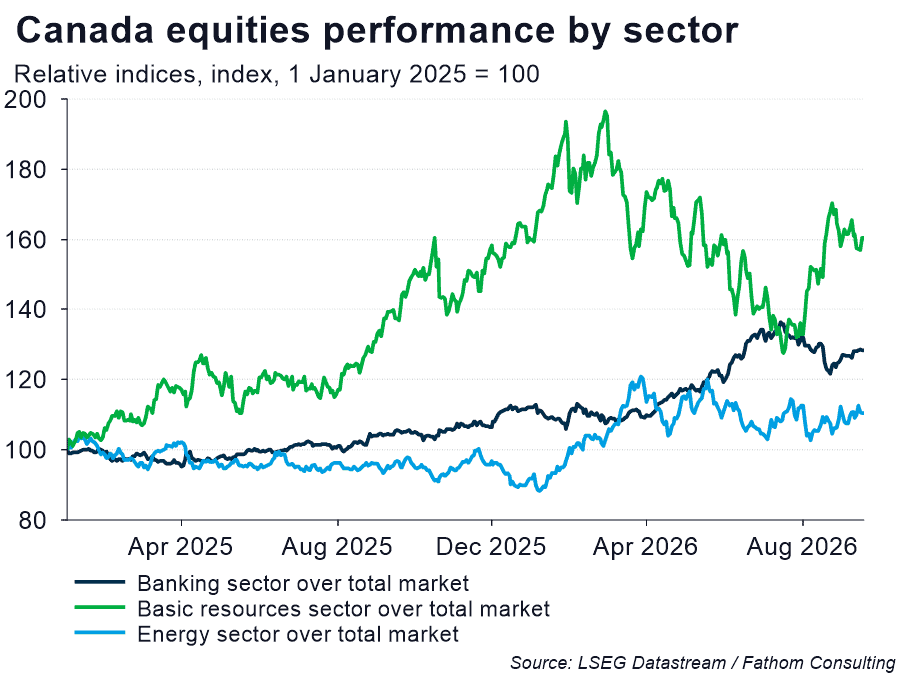
Most of this picture can be attributed to the continued disconnect between the Loonie and the price of oil. In the past, rising oil prices have driven the currency higher too, benefiting both the oil exporting firms, which enjoyed higher profitability, and the Canadian consumer, who enjoyed increased purchasing power thanks to a more valuable currency. With that link broken for now, this time around all the benefits are going to the exporting firms.

But the story is not just about oil: banking sector equities are also performing remarkably well. Until April of this year, the strong performance of banking equities was supported by strong earnings growth in that sector too. Since April, that relationship has broken down: banking equities have pulled away from banking earnings. There are probably many factors behind this disconnect but, among them, the surprising resilience of the Canadian economy as a whole has a part to play, effectively reducing the risk premia charged on banking sector assets.
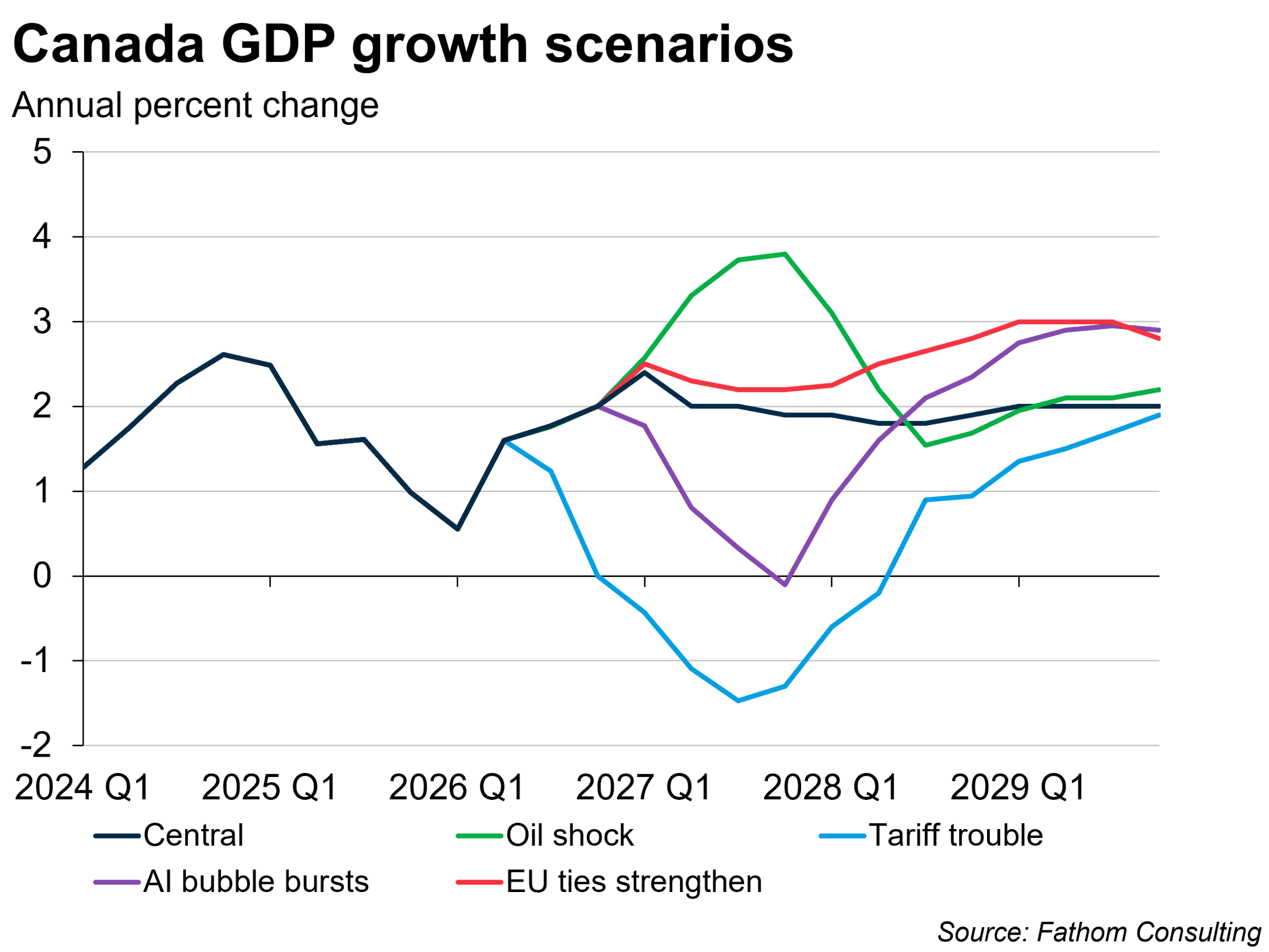
Our central scenario for Canada is therefore pretty good: Canada’s growth hovers around 2% for the forecast period. There are many risks around this scenario, of course. On the upside (for Canada), the crisis in Iran could escalate further, causing the Strait of Hormuz to close fully and global oil supplies to be reduced. That would drive oil prices above $130pb in our view, which would be bad for the world economy but good for Canada as a major oil exporter. On the downside for Canada, the AI bubble could burst, leading to collapsing equity prices, with potential impacts on the financial sector too. Or, most pressingly, the current trade war between the US and Canada could escalate further. That could easily push the Canadian economy into recession.
That risk is entangled with the other upside scenario: that ties between the EU and Canada strengthen further over the next few years, resulting in increased flows of trade, investment and people between the two regions, to the benefit of both. Such an outcome could be perceived by the US administration as damaging to the US, and that could prompt the kind of response that the pale blue line in the chart below envisages: punishment through tariffs. The central cases of all five scenarios are pictured in this chart.
If Canada can avoid trouble, its prospects look relatively good compared to most other developed economies. But trouble is probably coming: indeed, by seeking an upside with the EU, Canada is risking a sharp deterioration of relations with the US, still by far its largest trading partner for now. Mark Carney is certainly aware of these risks. At the moment, he appears to be navigating this difficult terrain successfully with his characteristic aplomb. We shall see how long that continues.
Register your interest here for a free opportunity to hear insights from Fathom’s latest Global Outlook, Autumn 2026, offering an independent assessment of the global economy and the risks shaping markets and geopolitics.
Further reading
Is this thing broken? The Loonie is not moving