

A sideways look at economics
A few months have passed since we were last obsessing about tariffs, during which time there have been a couple of other items dominating the news. Those items (the conflict in Iran, the new British PM) are a bit stale, so it seems it’s time to have another go with tariffs. Perhaps this season will be more interesting? We’ll see, but the early signs are not encouraging. Canada, the country probably most vulnerable to US tariffs, looks like it’s going to get plenty. And the UK, like Canada one of the US’s closest allies, looks like it’s going to get a few more. Net effect on the US current account position? Probably zero, once the dust has settled, as it was in Season 1.
Enough time has now elapsed for a cool analysis of the impact of the Trump administration’s introduction of tariffs on ‘Liberation Day’. Much was made at the time of the idea that they were one in the eye for those who supported globalisation: this was globalisation being rolled back. Has it played that way? So far, not in the least. The chart below shows the volume of global trade.
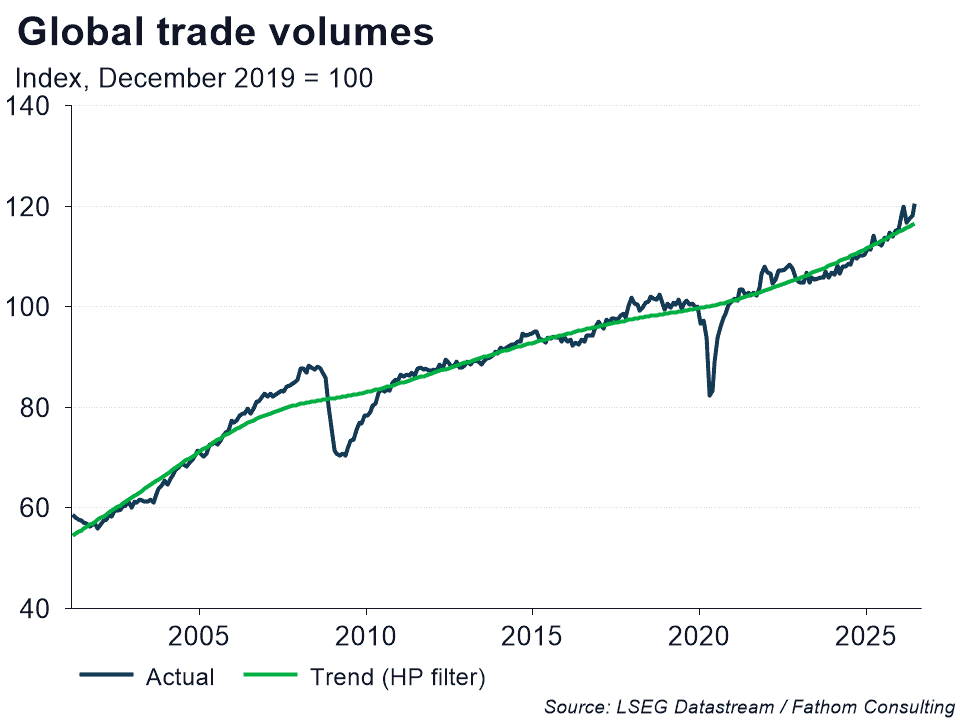
The rate of increase in the volume of global trade slowed dramatically after the global financial crisis (GFC) in 2008/09, but did not reverse. Since Liberation Day, that trend has picked up again. Not so much the rolling back of globalisation; more like its rebirth. The Trump administration probably does not care greatly about that picture: much more important is what is happening in the US itself. Let’s take a look.
The chart below shows the US trade balance. Prior to the introduction of tariffs on Liberation Day, but after the point at which it was clear that substantial tariffs were on the way, the US trade balance deteriorated sharply. That reflected US importers pulling forward their purchases before tariffs landed. After Liberation Day, the trade balance bounced back and overshot its earlier level. That reflected the fact that imports had already been pulled forward: roughly speaking, if you put a horizontal line through that picture from the middle of 2024 to date, you would expect the area below the line to be roughly equal to the area above the line if all that was happening was a change in the timing of imports.
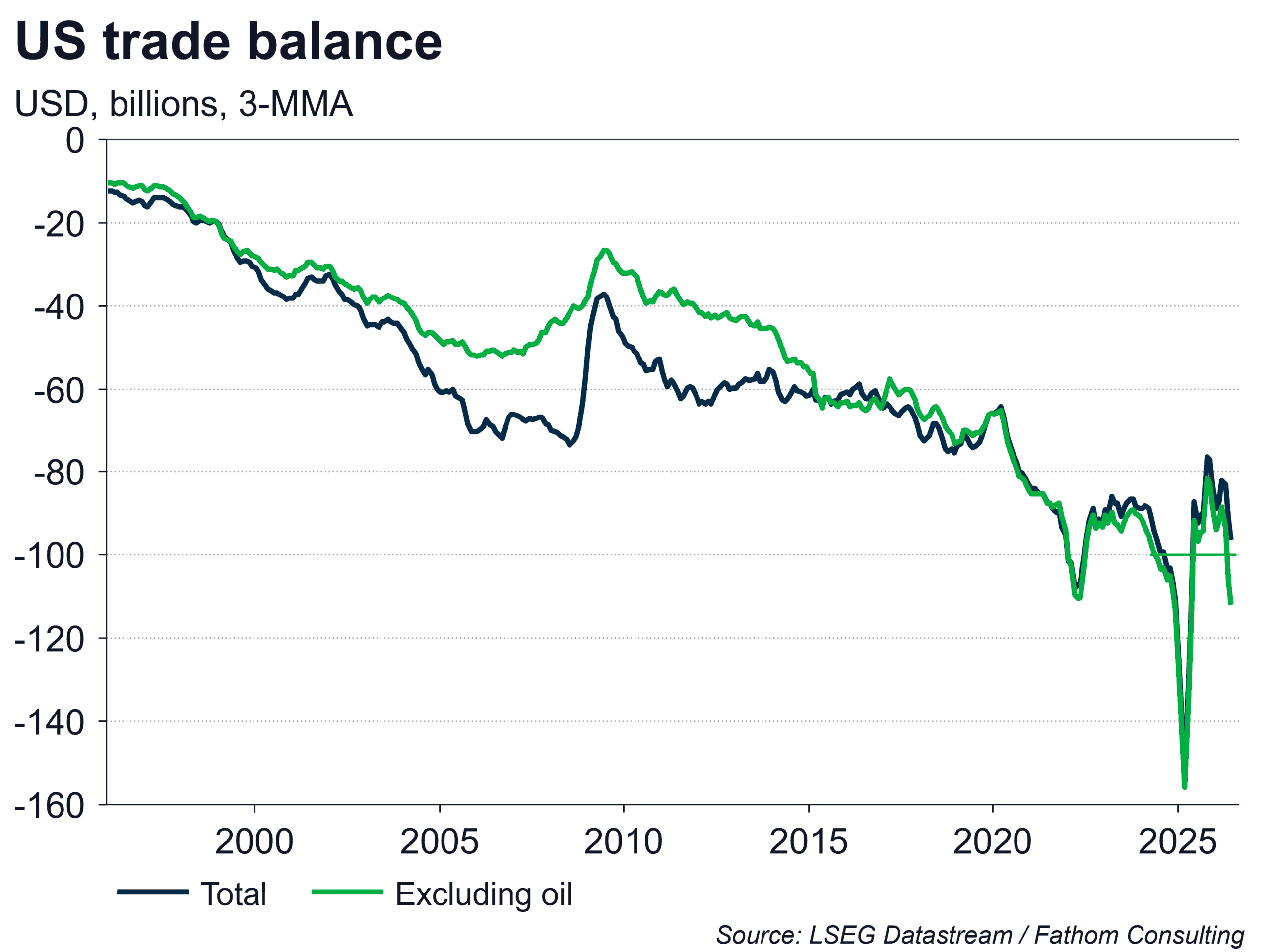
The difference between the total line and the line excluding oil shows that the US trade position has benefited from the fact that the US has become an oil exporter and that oil prices have risen recently (thanks to the conflict in Iran). But that story aside, the US trade position has not really changed at all as a result of the imposition of tariffs. That is not surprising. The balance of trade is part of the overall current account of the balance of payments. That overall balance is, by definition, equal to the difference between savings and investment in the country of interest. So, unless a new policy has the effect of either increasing US savings or decreasing investment in the US, it cannot have any impact on the current account position.
The kind of policy that would induce an increase in US savings would be higher interest rates, or a hike in taxes unaccompanied by increased government spending. Either of those, if they were material enough to affect the current account position significantly, would put the US economy at risk of recession. The kind of policy that would reduce investment in the US (it’s hard to see why that’s something any administration would want, but still) would be, again, higher interest rates, especially if that brought about a recession. In other words, a recession will reduce the current account deficit, but not much else will.
Season 1 of Trump’s Liberation Day tariffs took aim primarily at China. Here, there has been a clear impact, although quite how big an impact is in dispute: it depends on whose trade accounts you look at. The chart below shows the ‘mirror statistics’: US imports from China according to US statistics, and Chinese exports to the US according to Chinese statistics (and the corresponding pair for US exports to China/Chinese imports from the US). In principle, these two measures should be identical. In practice, they rarely are. Since Liberation Day, they tell quite different stories. China’s exports to the US have fallen since then on both measures, but by much more if you look at US statistics than if you look at Chinese statistics.
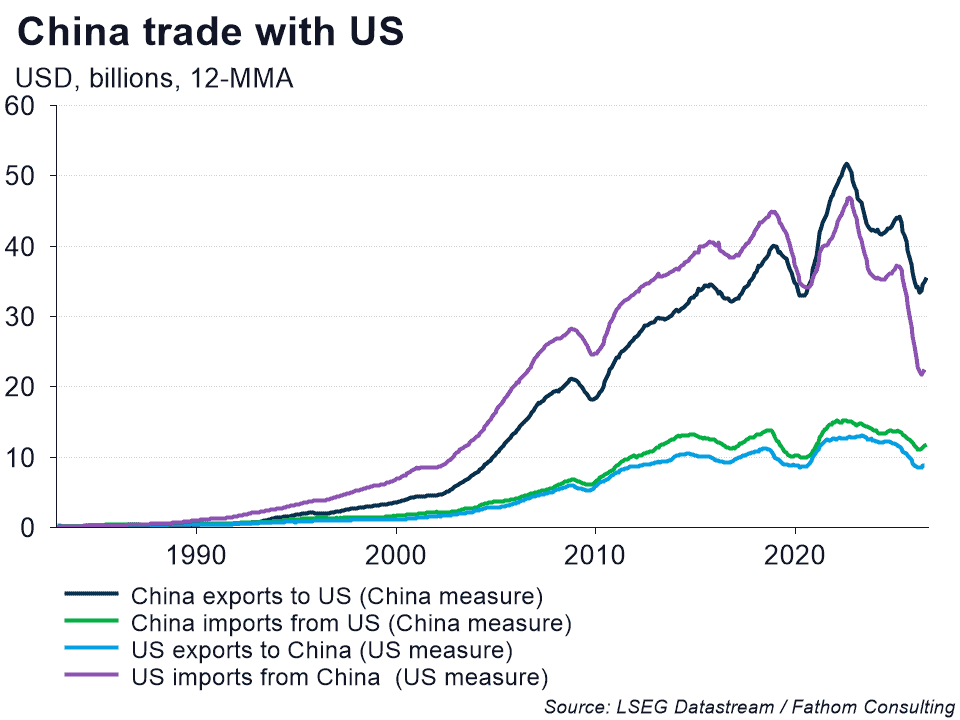
It is hard to be sure which of those measures is closer to the truth, but we do have some evidence to go on here. Fathom’s proprietary RiCArdo database of global trade flows reconciles the mirror statistics by making a choice of which ‘side’ to believe, a choice that is guided by the historic reliability of each side. A country is judged ‘reliable’ if its measures usually agree with those of another country, and ‘unreliable’ if they often disagree. China’s data is unreliable relative to that of the US on that basis, so the US data are probably closer to the truth than the Chinese data in the chart above. That implies a sharp reduction in US imports from China since Liberation Day.
Why has that not translated into a reduction in the US’s overall trade deficit? The answer is that US consumers and businesses have not stopped needing or buying the things they previously purchased from China: they have just bought those same things from somewhere else. That somewhere else is likely to be a more expensive provider of these goods than China (net of tariffs), even when it is really just ‘trans-shipping’ goods that originate in China (a current focus of the US administration): the process of arranging trans-shipment adds cost. It is possible that some of the goods previously imported from China are now being made in the US itself. Note, however, that if that were the case, it would tend to go hand-in-hand with increased investment in the US, and the consequence of that would be to increase the overall US current account deficit.
The logic of that argument holds except in circumstances where the US starts with a large amount of spare capacity. Then the increased US production need not be accompanied by higher investment (just use up the spare capacity). But, in that case, the spare capacity would need to be in exactly the same sectors where tariffs had been applied to Chinese imports. In any case, the current conjuncture is not one where the US has plentiful spare capacity, since it is enjoying strong growth and low unemployment. And such spare capacity as does exist is unlikely to be in the sectors where China has spent decades building up a position of global trade dominance.
Nevertheless, substantial tariffs aimed at China have changed things for China, and potentially for third countries who might eventually benefit from the re-routing of those trade flows. But China was Season 1. Season 2 looks like it’s going to be Canada, with a sub-plot of the UK (although the plot development is extremely hard to follow).
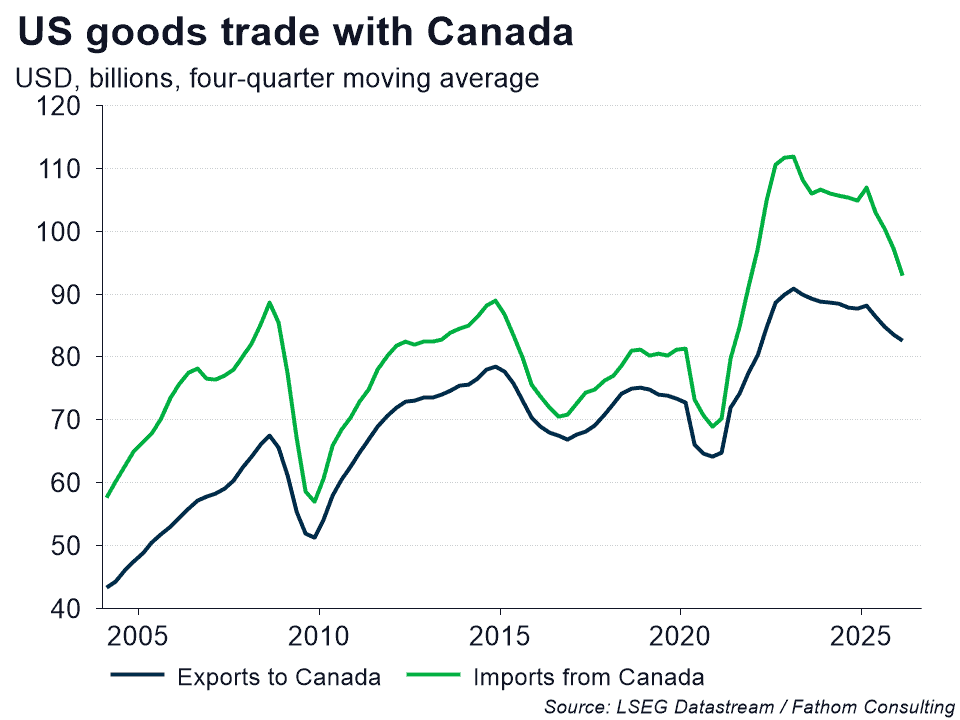
The chart below shows US goods trade with Canada. Imports fell sharply after the imposition of tariffs in 2025, and exports fell too, though by substantially less. The next round, if it comes, will probably have a similar effect. That is very bad news for Canada, and will put its economy under great pressure, notwithstanding Mark Carney’s assertion that Canada will fight back with reciprocal tariffs of its own. The impact on the US economy as a whole is likely to be slight, just because of the much larger size of that economy, though some sectors and some states might be disproportionately badly affected. The impact on the overall US trade position? Probably zero, for the reasons outlined above.
It is possible that, if the tariffs soon to be implemented, along with those already implemented, were held in place permanently, it could change the structure of the US economy, creating incentives for investment in the firms that manufacture the goods being subjected to tariffs relative to other firms operating in the sectors where the US currently specialises. That would be a desirable outcome for the current administration: the reindustrialisation of the US economy. It is not likely that tariffs on Canada (or the UK) will make much difference here, but those imposed on China potentially could. But, to reiterate, unless it meant lower investment in the US in the round, or higher savings there, it would still have no impact on the overall current account position. The characters will be different in Season 2, it seems, but the end result for the current account will not.
Further reading
Conscious uncoupling: China and the US
Spooky action at a distance: US and China
Who won the US-China trade war?
Considering scenarios for US tariffs