
A sideways look at economics
AI is very likely in a bubble, and that is now widely being discussed; but I remain hopeful that, once the bubble has burst, AI will change our world profoundly for the better. Usually, AI optimists cite hoped-for impacts on productivity, which is a valid point. Here I want to focus on two other aspects, both of which affect welfare, if not productivity as normally measured. First: what are the different forms of activity that humans should specialise in, given the comparative advantage of AI? Second, and relatedly, how should we think about the consumer surplus generated by AI?
What is the comparative advantage that AI is developing relative to humans? Let’s start with its most outstanding achievements to date. It is brilliant (and likely to become ever-more brilliant) at solving problems in closed formal systems like mathematics. The winner of the 2026 Fields Medal (the highest honour in mathematics), Jacob Tsimerman, recently quit academia to join OpenAI, stating that in future perhaps: “…most of the time currently spent by modern mathematical researchers will have to be spent on an activity that is altogether pretty different. Whether such an activity is viable as a professional endeavour is something I am unsure of, but strongly encourage others to think about.” What is he referring to?
Tsimerman grieves what he perceives as the loss of the way of life that he and other mathematicians had previously enjoyed: identifying important unsolved problems in mathematics and spending years, perhaps decades, in the focused, rigorous and creative research that is what it takes to solve them. AI can now, it seems, undertake that research in a tiny fraction of the time it would have taken a human, and that process is only likely to accelerate, to the point where it will far exceed the capacity of even the most brilliant mathematicians to keep up with the advances being made by AI. We might already have reached that point.
Terence Tao, another great mathematician, has argued that it is rarely the case that we need the proofs to these theorems: it’s much more usually the case that we need to undertake the thinking that gets us to those theorems and their proofs. The journey is the thing, not the destination. It will be a great loss, surely, if AI makes that human journey redundant.
I do not dispute that this will be a loss, and a serious one at that. It is possible that, like the game of chess, which has soared in popularity among humans since Kasparov was beaten by a computer back in 1997, humans will continue to engage in mathematics because of the journey, even though we know that AI will probably have got to the destination long before us. Possible, but unlikely in my opinion: chess is a game for most of us, a profession for just a few; mathematics is a profession for a brilliant few, and a game for almost none. More likely, the profession will evolve so that professional human mathematicians will become more like translators, so to speak: finding ways of digesting and communicating some of the bewildering array of AI advances to other humans. This feels like a less exalted role than that which Tsimerman, Tao and others have occupied until now, but it might be every bit as important for humanity, or more so.
AI has developed a comparative advantage relative to humans in analysing closed systems like mathematics, and its abilities are increasing rapidly. But the world is an open system, which cannot by any means be ‘solved’, neither in part nor as a whole, in the way that problems in mathematics can be solved. The open system that is the world is the natural domain of living beings, that interact directly with it and with each other, shaping and being shaped by it and by others.
I read a beautiful quote from Merleau Ponty recently, responding to the question: what is the point of a lion? It is not to maximise its own utility, or that of any other creature. Nor is it to avoid pain or suffering. Nor is it to continue its genetic line: nothing so instrumental. Nor is it to do what it must do, living a life that is predetermined in some way ‒ that is not a good description of how lions (or any living beings) actually behave: just look at them. The point of a lion, says Merleau Ponty, is to express as fully as it can the verb “to be”.
That’s the point of us, too, in my opinion. To the extent it can be put into words, our purpose is to be.
That’s also our comparative advantage relative to AI.
AI has no interaction with the world at all. AI’s natural domain is abstract representations of the world: words and numbers: a map of the world, not the world itself. Our natural domain, as humans, is both: maps and the world. We have become adept, like no other species, at abstract analysis, where language is the medium of that analysis. Over many millennia, we have developed a comparative advantage relative to other animals in the use of language and the abstract analysis that permits. AI now shares that aptitude with us. Since it has no aptitude for being in the world, its comparative advantage is abstraction, and ours is being in the world.
Working is one aspect of being in the world, but it’s only one. Back in 1930, JM Keynes argued that, by 2030, we would mostly be working around 15 hours a week, so profound would the impact of ‘automation’ have been on productivity. For 50 years after he said that, he was right on the money with this trajectory. But since the labour market reforms of the 1980s, the reduction in hours worked has slowed to a crawl and, in the UK, it still hovers around 32 hours per week on average. The chart shows average weekly hours worked for the working population in the UK. The blue line is the trend that Keynes pointed to in 1930.
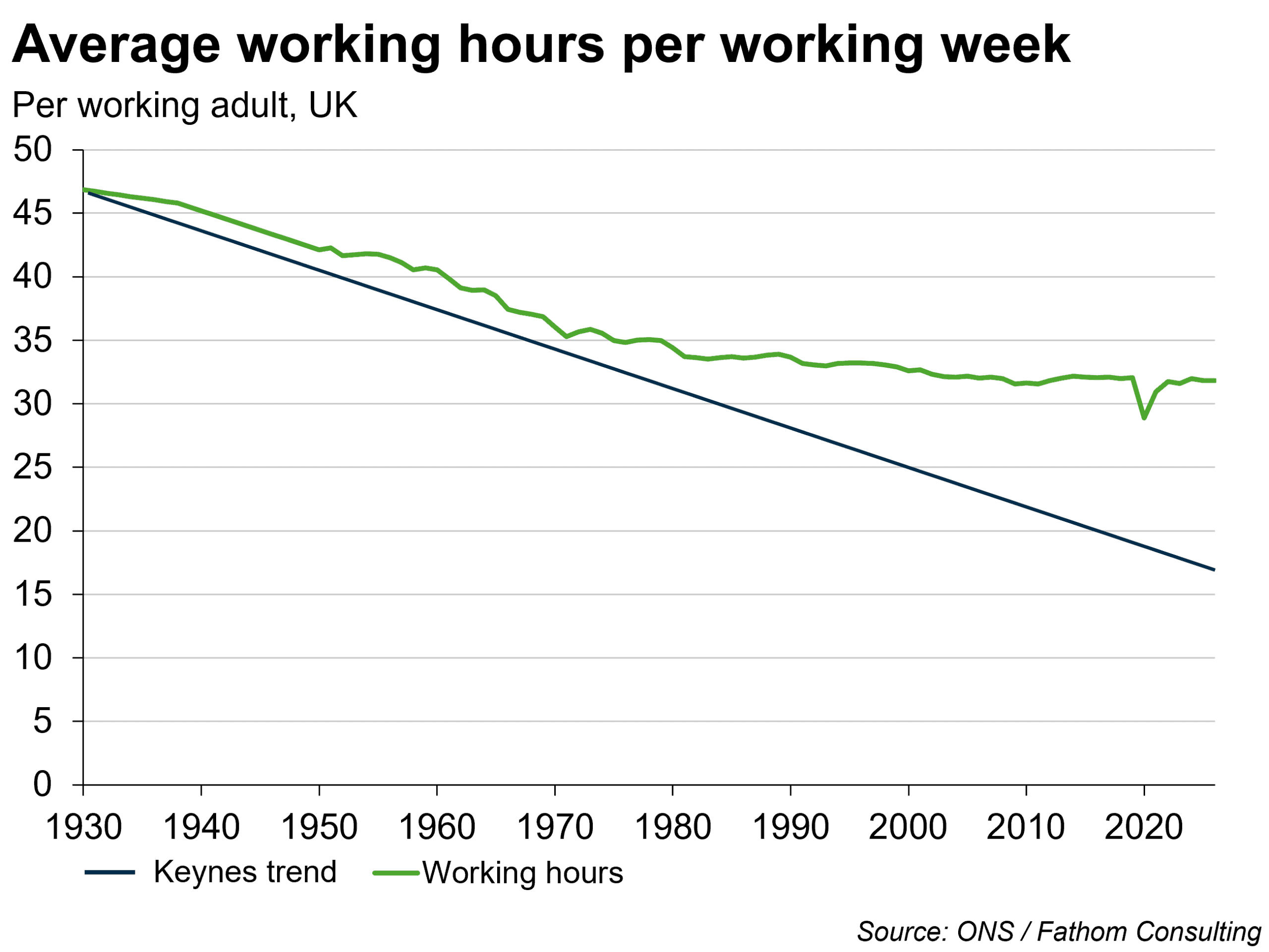
The kink in the trend in weekly hours worked that occurred during the 1980s coincided with the beginning of another trend, which is the declining labour share of income. When I was learning economics during the 1980s, the presumption was that the labour share of income would be roughly constant in the long run, as it had been for the preceding century. In fact, from that moment on, it has declined steadily, as the bargaining power of labour has diminished. Had the labour share not diminished, it is possible, even likely, that weekly hours worked would have continued falling; and perhaps Keynes’ forecast would have come through.
If AI is harnessed in support of labour productivity henceforth, driving up the real hourly wage (which is by far the best way to use it in countries like the US or the UK, where the working age population is not forecast to shrink dramatically, thanks in part to immigration), perhaps the game is back on. It is yet possible that Keynes will prove right: there are four years still to go. A substantial increase in the real hourly wage (and a corresponding recovery in the labour share of income) is just the sort of thing that would persuade many people to reduce their participation in the labour market.
Would that mean reflecting the comparative advantage of AI relative to humans? In my view, yes. AI is the latest form of automation that relieves humans of the need to do tedious and time-consuming tasks, in the same way that word processors, calculators, vacuum cleaners, weaving machines, and other technological advances all the way back to the wheel have done in the past. It’s awkward for those people who are currently paid to perform those rather tedious tasks (pace those mathematicians mentioned above, for whom it is a great deal more than awkward). The more interesting challenge of bringing the fruit of those (usually) tedious endeavours into the service of human understanding, remains for humans to do. Only humans can be human.
So point (1): I hope and believe that, once the bubble has burst, we will move to a scenario where humans can specialise in being human (interacting with each other and with the world), while machines specialise in doing things that help us. That will lead to higher real wages and voluntary reductions in hours worked, or else (as might already be happening in some professions) a re-jigging of what it means to work. Speaking for myself, ‘work’ as a concept that I would, money permitting, always choose ‘leisure’ over, is not a good description of what I spend most of my time doing. Work is where I interact with other people, mostly my friends, in interesting and goal-oriented discussions: I love it. I also love lying around in a sofa watching cricket on TV, or on a beach… but I wouldn’t choose to change the proportion of my life that I spend in those ways, no matter how much or how little ‘work’ paid me.
Point (2) is about the consumer surplus. Part of the reason why the bubble will burst (in my view) is that much of the benefit of AI will not be monetised. Instead it will manifest in the form of an increase in consumer welfare, thanks to the competitive provision of higher quality goods and services to consumers. This is a point made with characteristic punchiness by John Cochrane in a recent blog post. Consumers do not need to benefit from the bleeding edge of frontier technology (that’s for the military and for some business applications). Two or three steps behind the frontier will do fine. And that area is highly competitive, with the competition led by Chinese firms whose superpower is scaling already existing technologies for consumers the world over. The benefits of AI will mainly show up in better living standards for the consumer, not in the bank accounts of the suppliers of these new technologies, which is all to the greater good of humanity. But it won’t show up in GDP or in measured productivity.
Increased consumer welfare is another good reason why people will voluntarily reduce their participation in the labour force. Keynes’ projection still has time.
Register your interest for a free opportunity to hear insights from Fathom’s latest Global Outlook, an independent assessment of the global economy and the risks shaping markets and geopolitics.
Further reading
Automation: this time could be different