

A sideways look at economics
Anthropic has released a series of economic scenarios which lay out what alternative pathways for AI development might mean for the wider economy. They’re a good read, and have been widely covered in the press. Anthropic might be a multi-billion dollar company, but it certainly isn’t the first to produce such scenarios — let me tell you that Fathom was doing that four years ago! Despite the huge changes that have happened since our report, it’s interesting to see how right we called it.
In early 2022 (before Chat GPT was launched and before AI became ‘cool’), we began work on our first in-depth study of AI, commissioned by the Special Competitive Studies Project (SCSP). Titled Welcome to the Machine, the project was a detailed study of the US and China’s relative prowess in this emerging technology, and how their respective approaches to it would shape the future of techno-economic competition between the two. It was an interesting study (probably one of my favourites in my time at Fathom), and it came up with several key conclusions that have stood the test of time.
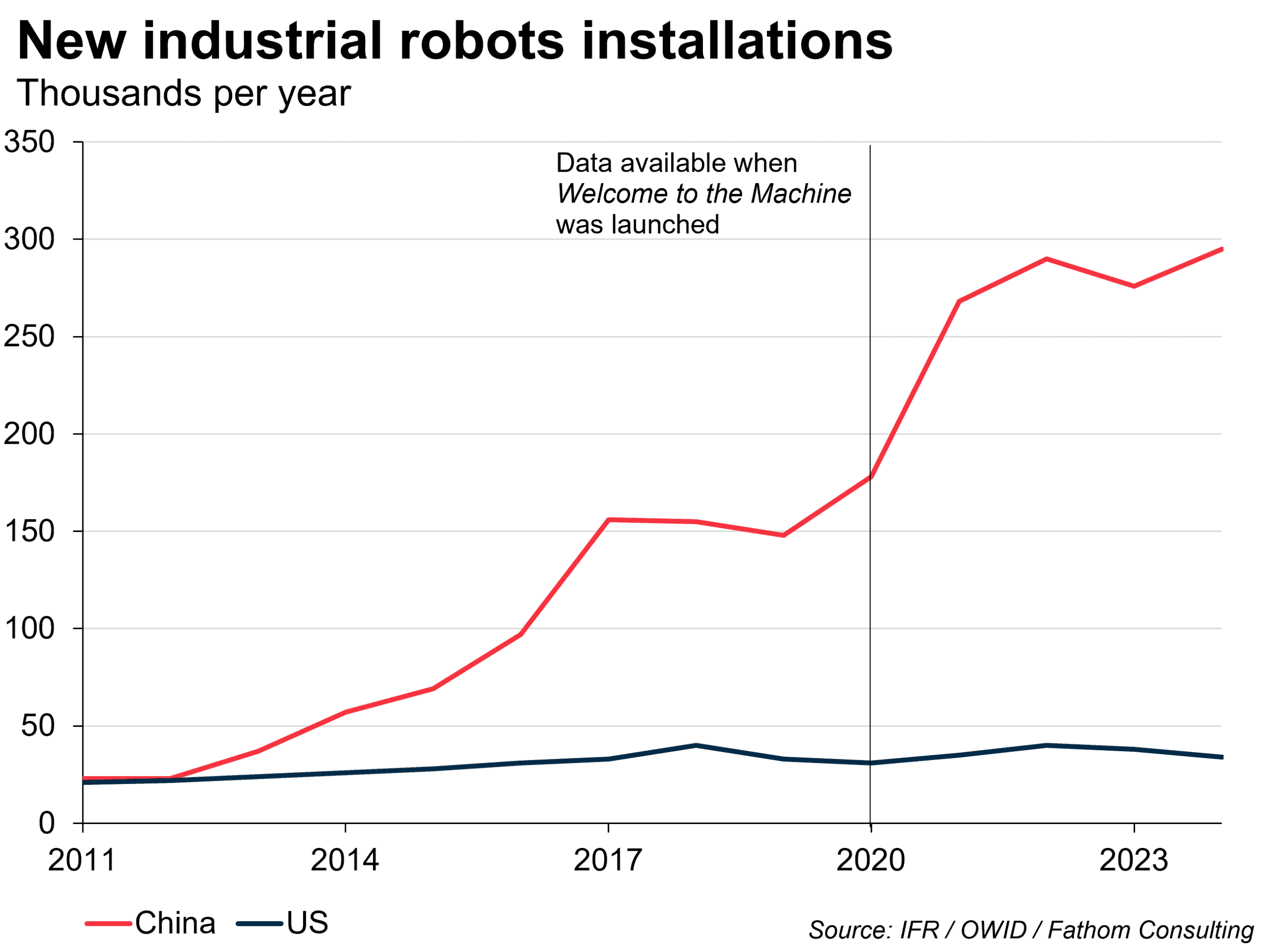
The main argument running through that study was that wide variations in economic circumstances across countries would drive them towards differing AI strategies, yielding different labour-market and productivity outcomes. Specifically, we argued that it made individual sense for the US and China to focus on differing ‘flavours’ of AI. Given its deteriorating demographics, we argued that China would benefit most from developing AI that replaced its dwindling workforce. We called this a ‘labour-replacing’ approach. It involved ramping up investment in technologies such as AI-powered robotics. Funnily enough, if you look at the chart below, you can see that’s just what’s happened.
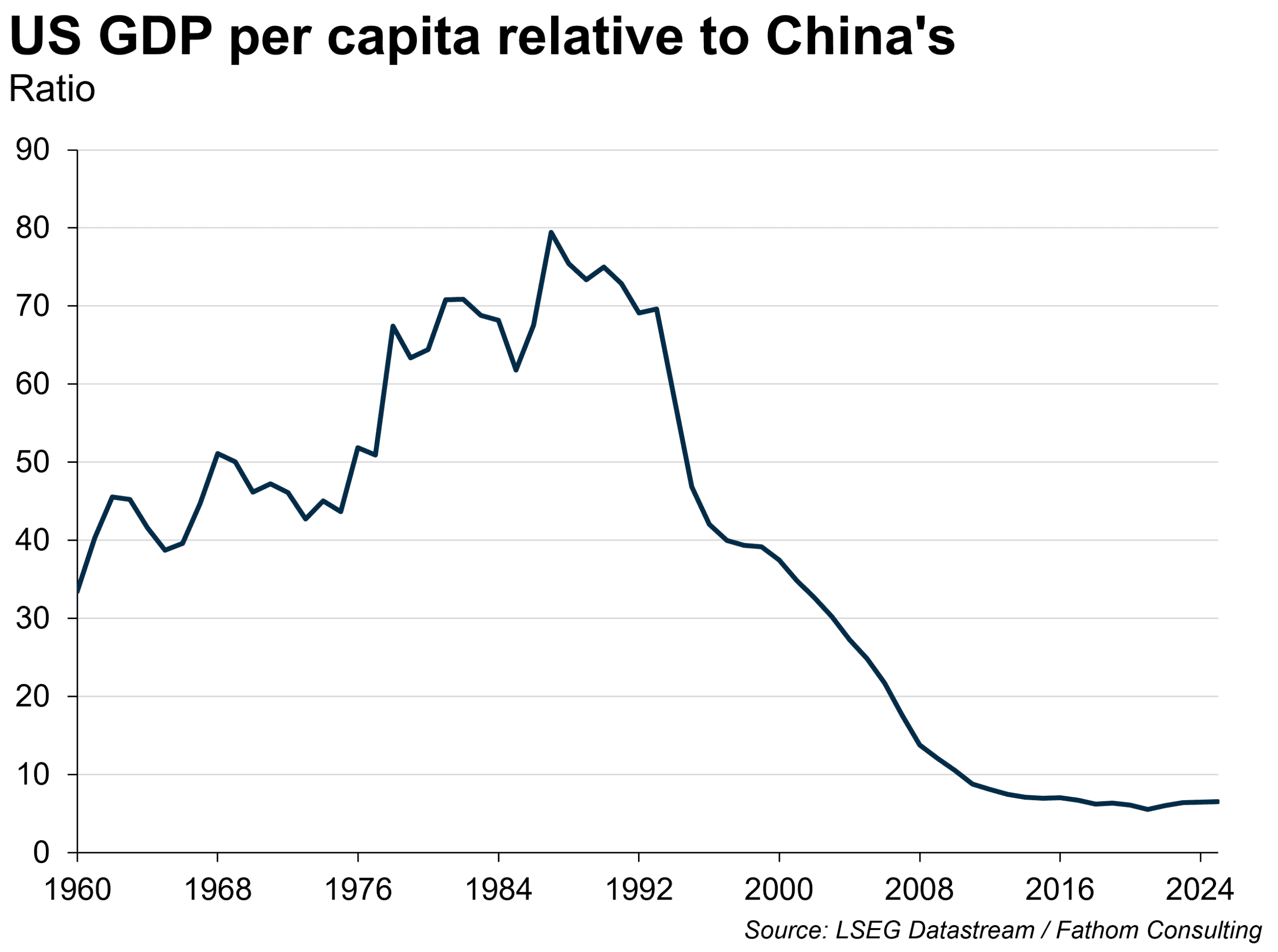
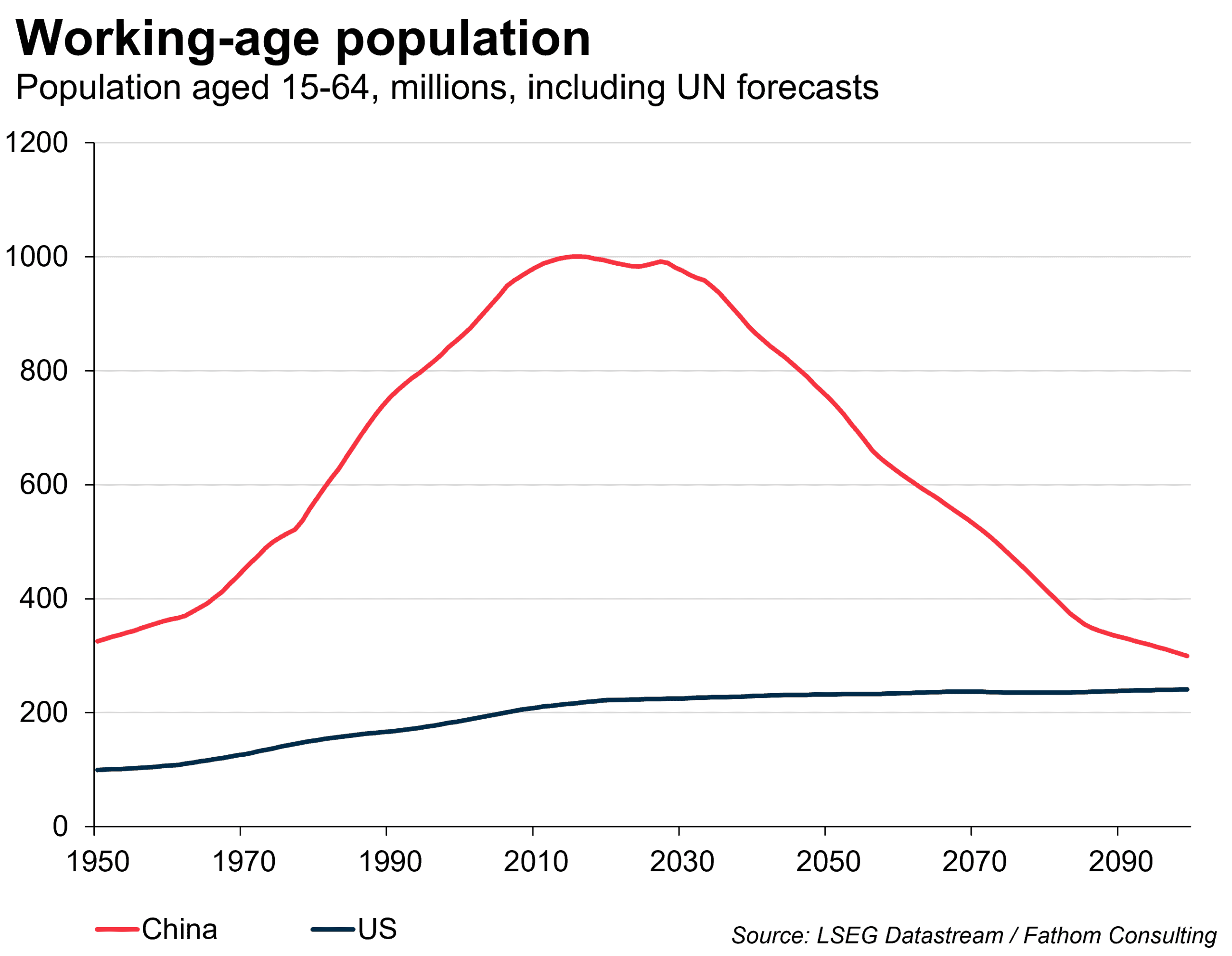
By contrast, we argued that the US was likely to adopt a more people-centric approach towards AI adoption. This makes sense if you view the country’s workforce as its greatest strength — it has far fewer people than China but output per head is more than six times higher in the US. Moreover, projections for the US working-age population are essentially flat, as opposed to the sharply declining trajectory of China’s potential labour force. Thus, AI that works with people rather than replaces them would clearly benefit the US more (we termed this the ‘labour-supporting’ strategy).
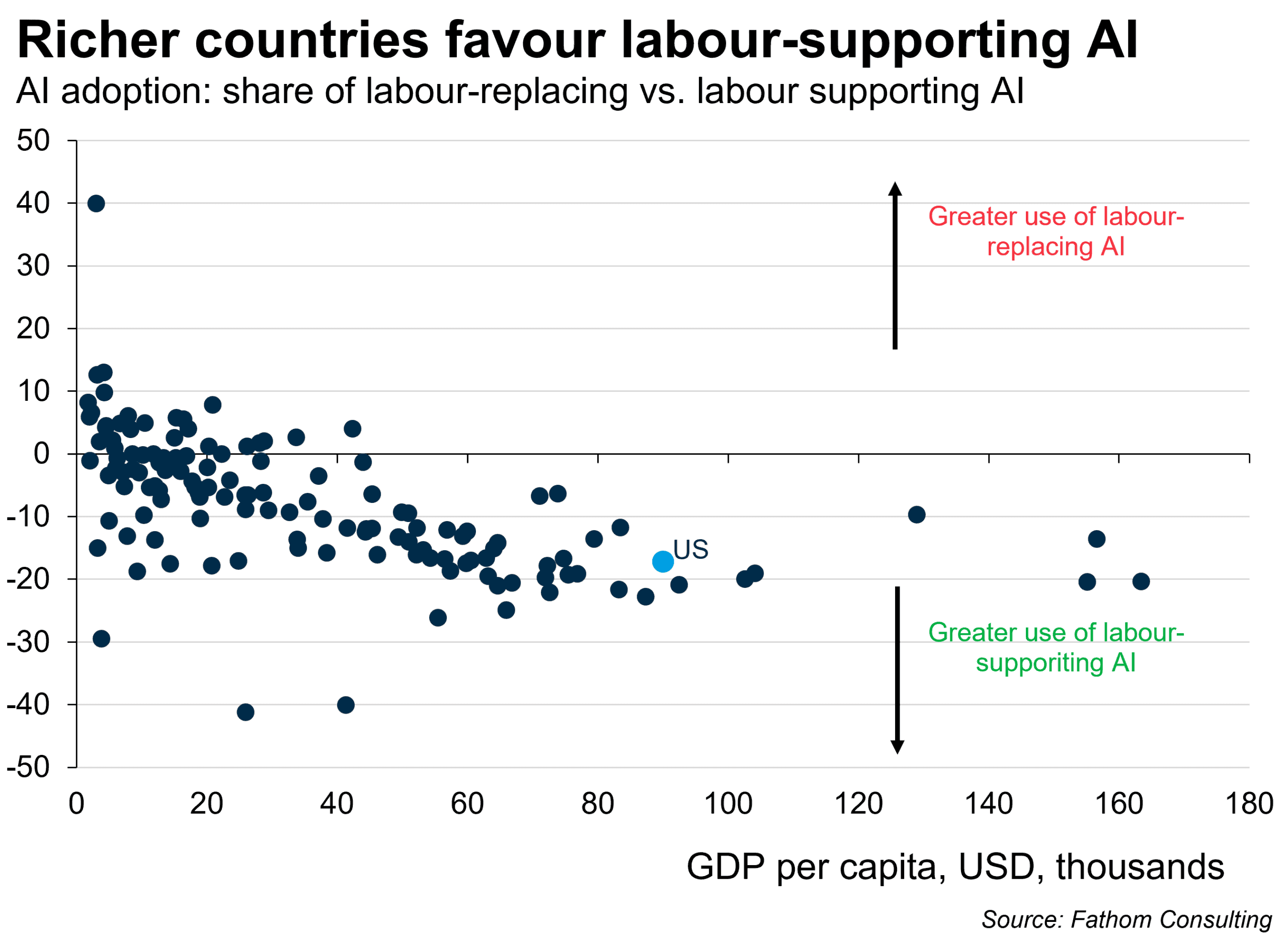
The chart below uses data on Anthropic usage to compare how AI is being used (i.e., whether in support of workers or to replace them) to the level of GDP per capita. As Fathom predicted in Welcome to the Machine, you can generally see a link between the flavour of AI being adopted and the relative productivity levels of countries.
However, there were three massive riders to our conclusion that the US should favour developing labour-supporting AI. First, if the two countries pursued wildly different strategies (i.e., if the US pursued labour-supporting technologies while China pursued labour-replacing AI), the US would fall significantly behind China in labour-replacing technology. Given the intense geoeconomic competition between the two, this seemed unlikely to be a credible path for the US.
Second, and as we argued in another project for the SCSP, American plans to onshore manufacturing production at scale would be limited by the lack of available workers (to a first approximation, the US economy is operating at full employment). Here’s what Treasury Secretary Scott Bessent said last year about reshoring:
“I think with AI, with automation, with so many of these factories going to be new ‒ they’re going to be smart factories ‒ I think we’ve got all the labor force we need.”
Sound like labour-replacing technology to you? Perhaps he read our report…
The third factor at play is worker preferences. Writing in 1930 Keynes posited that, employees might one day have sufficient income that further increases in hourly wages might cause them to opt to work fewer working hours and more leisure time. He even posited that the working week might be as short as 15 hours by 2030! As shown in the chart below, that process was underway in both the US and UK at least until the past few decades. A rational extension of this thinking would however suggest a resumption in that trend if labour-supporting AI increases hourly wage rates. If that proved to be the case, labour might start to become scarcer, offering further justification for simultaneously developing labour-replacing AI capabilities.
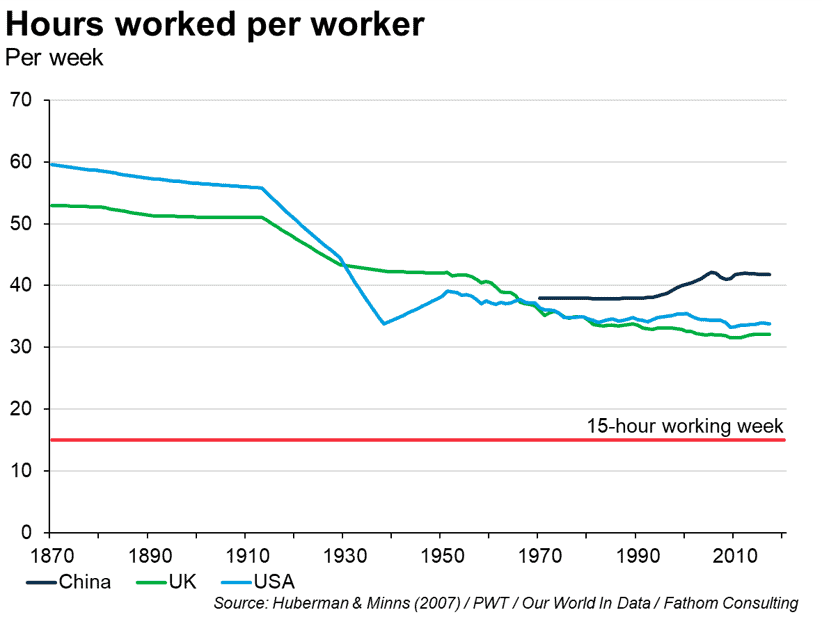
However, something interesting happened earlier this month. The ONS released updated labour-force data which change the shape of the chart above, revising away the plateau in the UK’s average hours data. (Note, that the chart above was taken from the original 2022 Fathom report.) Instead of remaining flat for the past 30 years or so, the latest data (green line in the chart below) now show a continued declining trend, with the biggest revisions coming in the post-GFC period. The most recent figure shows that the average working week has declined by 2 hours since 1997.
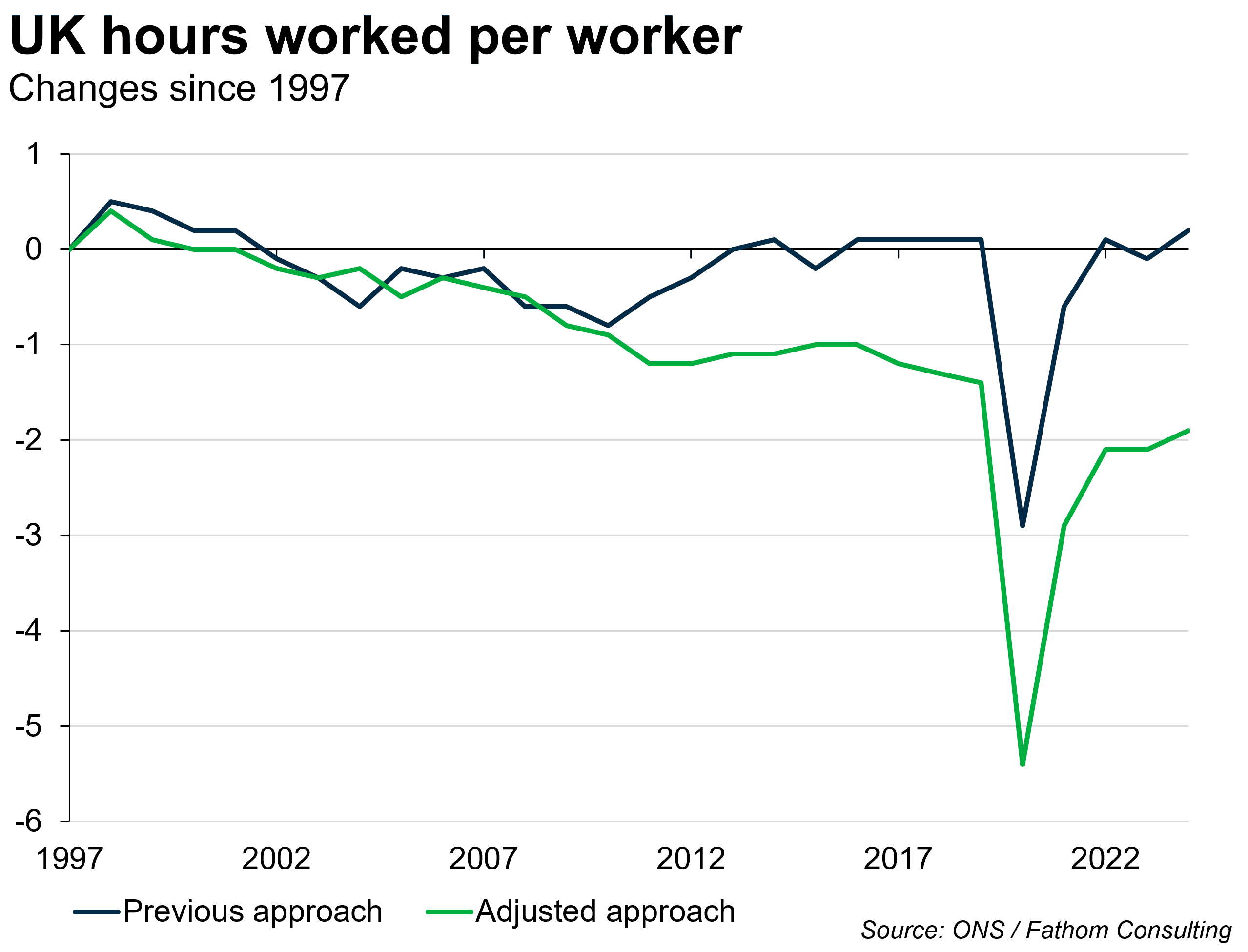
There’s an additional jump down in weekly hours post-COVID. We can’t argue that this is evidence that AI adoption has brought hours down (or even that it will persist in the long run), but it does also loosely coincide with the launch of ChatGPT. If it does prove to persist, and if it can be linked to the advent of LLM’s and rapid advances in AI, then it would imply a jump in labour productivity.
What does all this mean? Well, the key finding from Fathom’s report was that the US had a clear incentive to push forward with labour-supporting AI while China would be motivated to go in the opposite direction. So, I think my main takeaway is that our key findings were pretty much spot on in terms of the direction of travel (and I haven’t even mentioned the one about Nvidia being among the biggest winners from AI). That said, where we are now is very different from where we were four years ago. A huge amount of capital has flooded into the AI sector in recent years ‒ too much, in Fathom’s view. We have now entered bubble territory, although we need to be careful when bandying that word around. A financial market bubble doesn’t necessarily mean that the technology is flawed — the dotcom boom proved to be a bubble and yet it’s not as if the internet has gone anywhere! So while we urge caution from a financial market perspective, there’s at least one Fathomite that’s hoping that AI proves to be the real deal and that the promised land of Keynes’s 15-hour working week is just around the corner.
Further reading