

A sideways look at economics
History rarely repeats itself. But one thing that can be remarkably consistent is the way power hardens, through rules, obligations, and the institutions that administer them. Today’s debates on tariffs and defence spending have echoes of Greece in the fifth century before the Common Era (BCE) – not because our world resembles theirs, but because it shows how a security alliance can acquire a fiscal core, and how that fiscal core can quietly become a source of leverage.
In 490 BCE and again in 480-479 BCE, Persia launched two major invasion attempts, forcing mainland Greek city-states to fight for their survival. Athens emerged from that conflict not only as a major military superpower but as a naval one. When the immediate threat receded after the Greek victory at Plataea in 479 BCE, the security problem did not vanish: the risk of renewed Persian pressure remained plausible, especially for the eastern Aegean and Ionian cities most exposed to Persia.
It was in that setting that the Delian League was formed, a maritime alliance to sustain deterrence against Persia. Like NATO and the Western Alliance, its original purpose was collective security, based on shared threat perception. And its structure was, initially, cooperative: member city-states contributed ships, manpower, or money, and the common resources were held in a shared treasury on Delos, the symbolic centre of the alliance.
Security alliances need administration. Administration needs revenue. And once revenue becomes systematic, an alliance acquires a financial machinery that can outlive the emergency that created it.
The Delian League’s tribute was not ‘taxation’ in a modern accounting sense. It was the assessed contribution each member owed to sustain the coalition’s security, largely by financing the Athenian fleet. But because the assessment was formal and revisable, it was also more than a voluntary donation. Tribute created a standing obligation, and standing obligations created rules. In practice, tribute flowed to Athens, as the operating budget of the dominant naval power providing collective defence.
The threat from Persia subsided, loosening that fiscal rationale. But Athens went on consolidating administrative control, so that tribute ceased to be understood purely as war finance against Persia and became a general-purpose revenue stream. What began as funding for collective defence increasingly financed the wider architecture of Athenian power: naval dominance, strategic projects, and the maintenance of the system itself. Over time, Athens moved from administrator to rule-setter. The transfer of the League’s treasury from Delos to Athens, justified on security grounds, made that shift concrete.

The chart above summarises reconstructed estimates of annual tribute in talents of silver (roughly 26kg each). It is not a complete accounting record. The evidence is uneven, based on a range of often fragmentary sources, so the numbers should be read with care. What stands out in the chart is the large step-up in the baseline in the second half of the 430s BCE. The signal is clear: tribute was not a one-off wartime contribution. It was assessed, and it could be revised as circumstances changed. Over time, that reassessment process came increasingly under Athenian control, giving Athens discretion to tighten obligations when it judged that conditions required it. What began as crisis finance hardened into standing requirements.
How did that play out in practice?
A key test was how Athens would respond when members tried to leave the Delian League. Episodes such as the military subjugation of Naxos and Thasos when they attempted to secede in 469 and 465 BCE made clear that exit could be contested once the system became strategic.
Fifty years after the Persian invasions, the nature of the security threat had changed[1] and the League had metamorphosed into both revenue stream and the backbone of Athens’ naval power and credibility. Defections mattered, and restraint became difficult. As the thinking goes: if one defection is tolerated, others may follow. If enforcement looks selective, the rules start to look optional. The system acquires a harsh bias: it is often easier to tighten control than to loosen it, even when tightening brings reputational cost.
If that sounds distant from today, it should. But the tariff story becomes clearer once we focus on material shocks to baseline forms of payments. Placed side by side, the tariff chart below carries a faint echo of the tribute chart – not because tariffs are tribute, but because both show the same visual pattern: a step-up in the baseline that then persists.
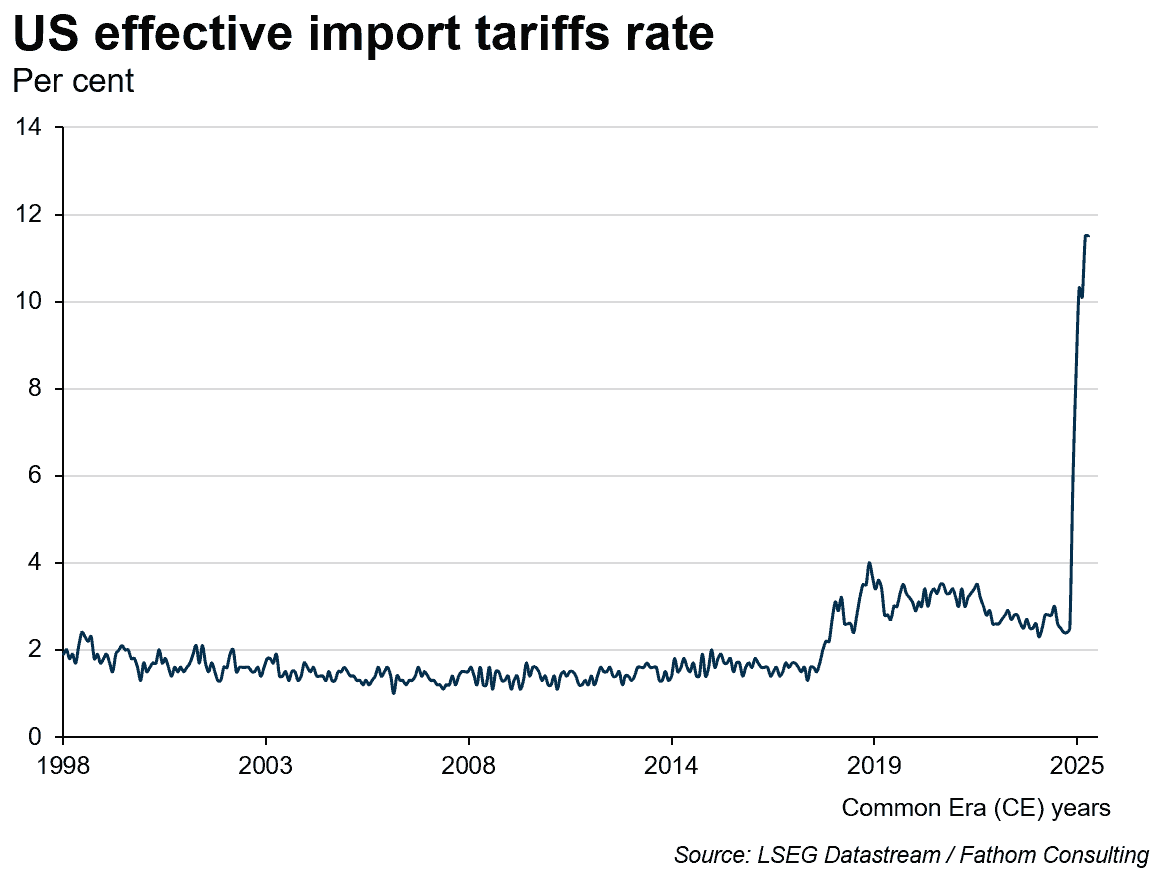
The two things are not equivalent. Tribute was a foreign payment into Athens’ system; tariffs are raised at the border, but the bill is likely to be largely borne at home in the US, either via importers or consumers. That is important. That changes the political economy: domestic costs can create domestic pressure to unwind, in a way that tribute extracted from abroad may not. However, there are similarities, not in who writes the cheque, but about how a policy instrument, once embedded, becomes hard to unwind. Exceptional measures can become routine, and once institutionalised, reversal becomes politically difficult because the instrument has now acquired multiple roles: leverage abroad, signalling at home, and strategic weight in a world defined by rivalry.
That is what makes today’s tariff data notable. The headline is not the latest change, but the new baseline. US tariff rates have shifted from episodic measures to standing foreign policy. That matters not only for trade flows, but for the implicit governance of access: who receives relief, on what terms, and subject to what conditions.
More by this author
Built to last, struggling to change
[1] The Peloponnesian War (431–404 BCE) was a prolonged conflict between Athens and Sparta, fought through shifting alliances across the whole of Mediterranean Sea. It is often viewed as the key contest over hegemony in classical Greece.