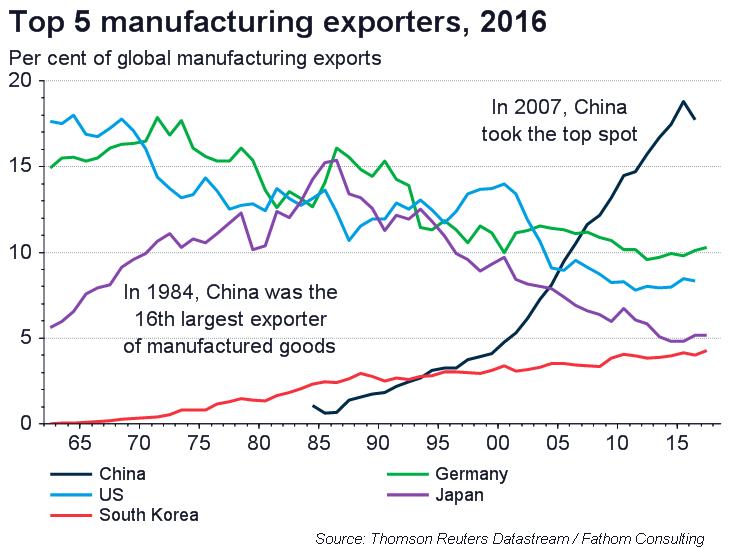
Our central forecast sees a global recession in or around 2020, driven by higher inflation, higher interest rates and sharp falls in equity prices. But there is another scenario, becoming increasingly likely, where inflation does not rise materially, for the same reason as it did not ahead of the financial crisis of 2008/2009: China. China then was distorting global growth by doing rapid industrialisation as a net exporter not – as it ‘should’ have been – a net importer. If it continues to distort in that way in future, inflation will not rise…
Our central forecast sees a global recession in or around 2020, driven by higher inflation, higher interest rates and sharp falls in equity prices. But there is another scenario, becoming increasingly likely, where inflation does not rise materially, for the same reason as it did not ahead of the financial crisis of 2008/2009: China. China then was distorting global growth by doing rapid industrialisation as a net exporter not — as
it ‘should’ have been — a net importer. If it continues to distort in that way in future, inflation will not rise, and another credit cycle (with its inevitable conclusion) will take root.
Current mainstream thinking in relation to net trade is as follows: the net trade position between any two countries, or for any one country relative to the rest of the world, is not a concept about which an ‘ought’ applies. To assess it in those terms is to make what is known in philosophy as a category mistake, like saying “grass ought to be pink”. It does not mean anything.
Net trade is the residual between two large flows, exports and imports (of goods and services). If a country’s exports exceed its imports (treating the other concepts included in the current account of the Balance of Payments as negligible, for now) then that country must have accumulated net assets abroad — in other words, the current account position is just the flipside of the capital account position. That net asset accumulation can take the form of increases in: official reserves; foreign government debt; cash on deposit in banks based abroad, or a host of other instruments.