

A sideways look at economics
With armed conflicts under way in Ukraine, Iran and Sudan, to name just three, it’s hard not to find one’s thoughts turning dark. I regularly try to remind myself of the fact that right now is the best time to be alive as a human being, in the history of the species; and this is your regular reminder too. And, even dwelling on the conflict risk, one good thing could come out of the proximity of war. It’s time Europe armed itself properly, and it looks as though that might be about to happen (I include the UK as part of Europe as it always was, just not part of the European Union). At least, that’s how markets are reading the situation. Good.
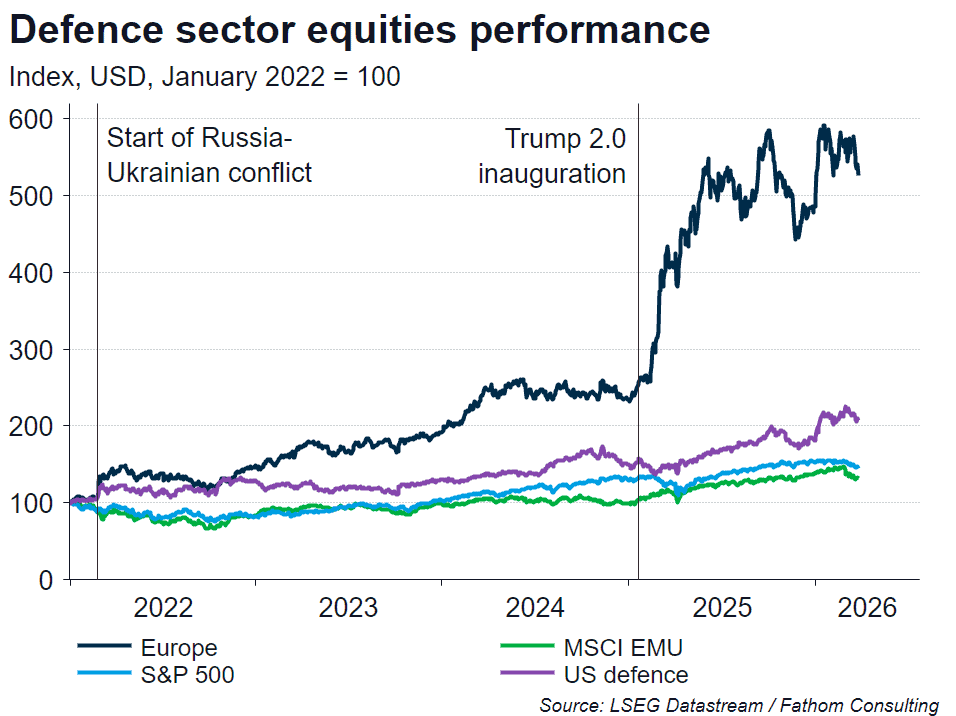
EU defence stocks have soared since the start of 2022 and have been one of the main drivers of EU equity outperformance over that period. The way EU defence stocks have outstripped their US counterparts has been stunning. The first step up occurred after Russia’s pointless and brutal invasion of Ukraine: there’s nothing like an active war on the eastern fringes of Europe to concentrate the mind. But the bigger step occurred after President Trump’s inauguration for his second term in office. Trump’s second term is being read by equity investors as a clear signal that European rearmament is coming, and in huge scale. That assessment is broadly correct, in my opinion, and not a moment too soon. And, just when I was starting to think maybe the sector was overbought, the conflict with Iran breaks out. There are obviously many ways this conflict could evolve, but the scenarios include these two: European powers are drawn into active participation; or they resist participation and the stresses within the NATO alliance increase even further. Either of those is good for European defence stocks.
Spending more money on defence is not normally something that economists would welcome. Military spending is often represented as ‘deadweight cost’, meaning it contributes nothing to the wider economy. It’s like the cost of doing business for a private company. Economists accept that it has to be done, but we’d generally prefer to keep it to a minimum.
I think that’s the wrong perspective in this particular case, and this is why.
First, Europe sheltered under the US defence umbrella after the second world war for very good reasons. The war had demonstrated two things: that the USSR was the only power on earth capable of defeating (conventionally) the full force of the German army on land, and it was a hostile power present in force in the heart of Europe; and that the western European powers could not be trusted with guns. It was reasoned that it was better to have a relatively benign power providing a Pax Americana for a while; and, in parallel, to build an entity that would bind the individual nations of Europe together so tightly that conflict between them would become vanishingly unlikely. That was the purpose of the European Union, and it succeeded triumphantly.
But the day must come when the umbrella is withdrawn. We knew it was coming. It’s a big, ugly world out there, and it’s much more comfortable to sip wine in the cool shade cast by the US umbrella. But that’s not how adults behave. Adults look after themselves. That day was always coming: now it’s here. Europe is finally facing its coming of age.
Second, not all defence spending is deadweight cost. Rearming Europe will require people: good. Unemployment is structurally high still in many European economies. If jobs in the armed forces were displacing other activities, there would be an economic cost (which would still be worth paying, in my opinion). But if the alternative is unemployment, it’s a no-brainer. It will also require much more military kit, from shells and bullets, through tanks and jets, to drones and missiles. And those things will need to be built in Europe, in the interests of national security. Again, good: this is part of the economic rebalancing towards manufacturing industry that would be helpful in supporting growth in the longer term. Europe needs an economic ecosystem that supports a mixed economy, especially if the world is about to split apart along geopolitical lines, as is more than possible. Finally, effective rearmament will require innovation at the technological frontier happening in Europe, at scale. Double points for this: serious amounts of money supporting frontier innovation in Europe is exactly the tonic we need to get productivity growth back up. Without a boost of this sort to productivity growth, Europe is destined for dependency and increasing irrelevance. This is one way we can avoid that path, and we should welcome it.
It might turn out that the US, in ten or twenty years’ time, looks back at this moment and asks itself: “Why did we do that?”. It might be that this is the moment that an armed, independent Europe is called into being, and it’s not clear to me that’s an outcome that the US will prefer. But it’s the right outcome, nevertheless, especially for Europe. Time for us to grow up.
More by this author