

A sideways look at economics
Eighty million chocolate eggs are estimated to be sold at Easter in the UK. According to Cadbury, the market is worth roughly £700 million. Not bad for something that’s hollow and won’t survive the Easter Weekend. But if you’ve been out hunting for the perfect egg in the supermarket this year, you’ve probably noticed two things.
First, chocolate prices have increased, largely due to poor cocoa harvests in West Africa. These poor harvests resulted from extreme weather and the spread of cocoa swollen shoot virus disease, particularly in Ghana and Côte d’Ivoire. These countries collectively produced around 57% of the world’s cocoa beans in 2021, but their share fell to approximately 46% by 2024, reflecting several years of weak harvests.[1]
These supply chain disruptions drove cocoa prices to record highs. My colleague Ingrid wrote about this topic back in March 2024, when prices were USD6416 per metric tonne. She noted that further increases in chocolate prices were likely, driven by climate change and increasingly unpredictable extreme weather. And she was right – cocoa prices continued climbing, reaching over USD10,800 per metric tonne by December 2024.
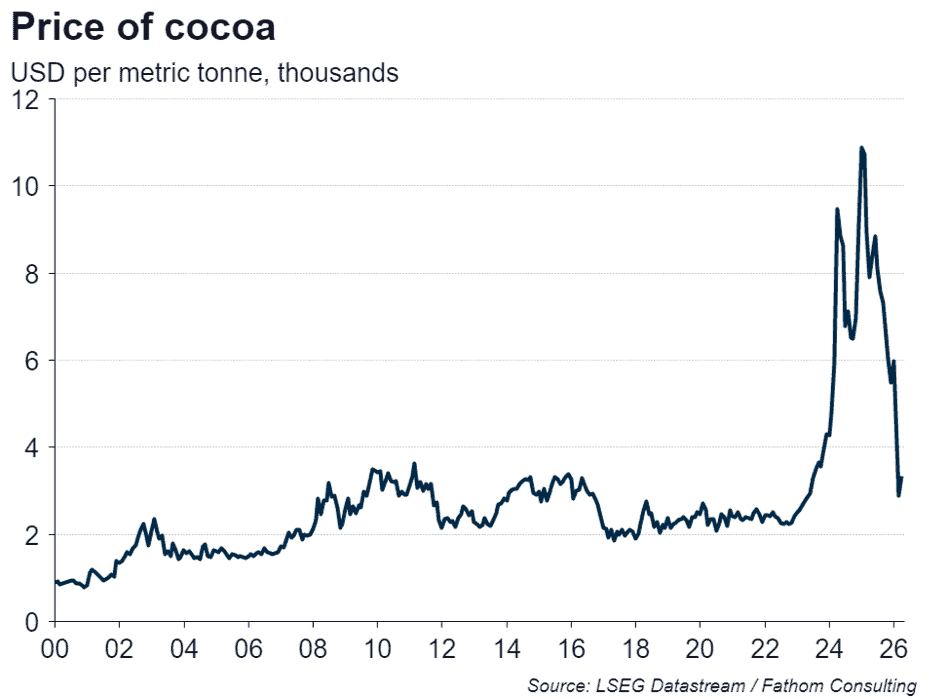
Cocoa, of course, is a key input in chocolate production; therefore, when prices spike, chocolate manufacturers experience increased costs. For example, a 95 gram Cadbury Dairy Milk bar contains 20% cocoa solids, the legal minimum to be branded as ‘milk chocolate’ in the UK.[2] Despite prices having fallen since their peak, prices remained more than double current levels until October last year. This is important because much of the chocolate currently on supermarket shelves will have been produced using inputs purchased when prices were significantly higher.[3] According to Which?, the UK’s consumer champion, annual chocolate price inflation was 9.7% in February, much higher than overall supermarket food and drink inflation at 3.9%.
The second observation is that chocolate eggs are getting smaller. This is the familiar story of shrinkflation: the price remains constant, but the quantity of the good received for that price is lower. This is less obvious than a price increase, but no less painful for consumers with a sweet tooth. According to Which?, price-per-gram increases on Easter eggs this year ranged from 25% to over 60%.
For example, a Galaxy milk chocolate extra-large egg at Asda fell from 252 grams in 2025 to 210 grams in 2026, while its price rose from £4.98 to £5.97 – equivalent to a 44% increase per 100 grams. A Maltesers milk chocolate egg at Tesco shrank from 231 grams to 194 grams and rose in price from £6 to £7, a 39% increase per 100 grams.
So chocolate is more expensive, and we’re getting less of it. Certainly not good for the chocoholics among us. One aspect Which?’s report didn’t address, but which left me wondering, is which chocolate brands are ‘overpricing’ their eggs the most. Let me explain what I mean by this.
Typically, consumers benefit from buying in bulk. For example, the price per 100 grams of flour in a 500 gram bag is usually higher than the equivalent price per 100 grams in a 2.5 kilogram bag of flour. The same logic generally applies to chocolate.
But what about seasonal goods, like Easter eggs at Easter or pumpkins at Halloween (you get my gist), for which demand is high for a relatively short period of the year. Does the same logic hold? To answer this, I pulled data from Tesco’s online store (other supermarkets are, of course, available). The chart below plots the Easter egg price per 100 grams on the vertical axis against the price per 100 grams of the smallest comparable non-seasonal chocolate item (bars, buttons, the usual) on the horizontal axis. For consistency, I focused on larger eggs, typically in the 170-250 gram range.

If an egg sits on the 45-degree line, it means consumers pay the same per gram as for a standard chocolate product. Above the line indicates a premium for the Easter version, with those furthest from the line charging the highest premium.
Every egg I looked at sits above the 45-degree line. So, no bargains here. The same chocolate is consistently more expensive when shaped as an egg, wrapped in foil and placed inside a cardboard box.
There is quite a bit of variation, though. Premium brands such as Lindt and Tony’s Chocolonely sit particularly high along both axes, reflecting their already elevated prices. (Speaking personally, and especially if my friends or family are reading, both are favourites of mine!) In Tony’s case, you could argue there’s an added altruistic benefit: its focus on fair-trade and improving conditions for cocoa farmers means you’re not just buying chocolate, but also supporting a different supply chain model.
Still, from a strictly price-per-gram perspective, Easter eggs are difficult to justify.
However, one important caveat is that the chart above doesn’t include promotional pricing. As a spokesperson for Tesco pointed out in response to Which?’s report, many of their Easter eggs are on offer, sometimes with discounts of up to 50%.
At this point, I reran the numbers, taking into account discounted prices via Tesco Clubcard offers.[4] While most eggs still sit above the 45-degree line, a few now fall below it, meaning they are actually cheaper per 100 grams than their non-seasonal equivalents. Aero comes out on top, with its discounted Easter egg priced at just 85% per 100 grams of a standard Aero chocolate bar.
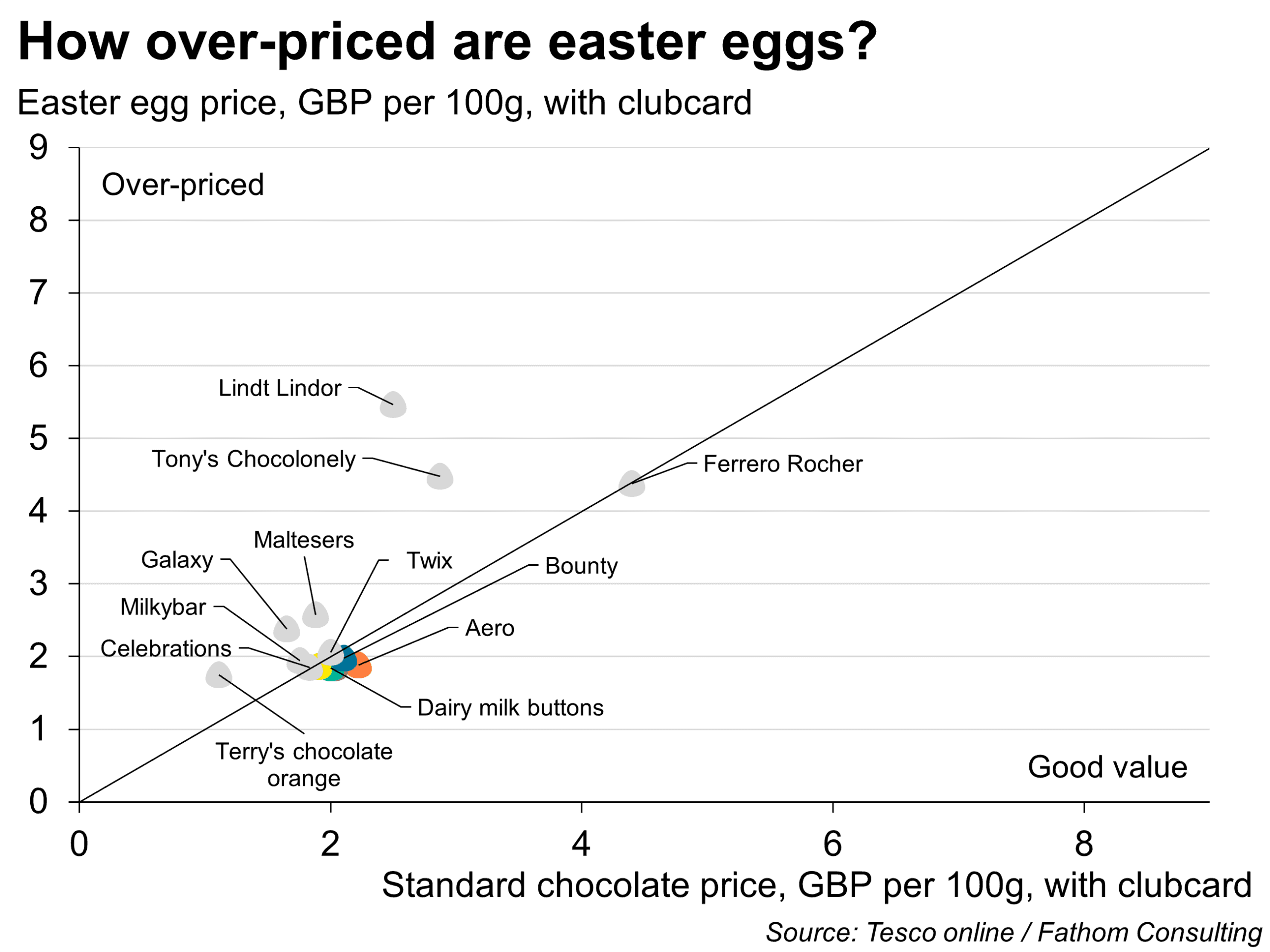
So, Easter eggs are becoming more expensive, partly because higher cocoa costs are translating into higher chocolate prices. And while in most cases you’re paying a premium for the shape, packaging and tradition, once promotional offers are factored in, chocolate eggs are not overpriced across the board. The bottom line? It’s probably worth checking the price per 100g before putting too many eggs in one basket!
More by this author
Chewing over some food economics
Coffee with a different kind of Perk
[1] https://ourworldindata.org/grapher/cocoa-beans-production-by-region
[2] https://www.legislation.gov.uk/uksi/2003/1659/schedule/1/made
[3] McVitie’s Club and Penguin bars changed their recipes last year in response to rising cocoa prices. They are now made with a ‘chocolate flavour’ coating using cocoa mass, rather than a standard chocolate coating, meaning they can no longer be labelled as ‘chocolate’. https://www.theguardian.com/business/2025/oct/18/chocolate-biscuit-club-penguin-mcvities-cocoa-prices
[4] For non-UK readers, the Tesco Clubcard is a free loyalty program from the British supermarket chain Tesco, first introduced in 1995. It offers members exclusive ‘Clubcard Prices’ discounts, points on purchases and rewards. The retailer claims over 20 million UK households use a Clubcard, with an annual saving of up to £375. https://www.theguardian.com/money/2025/oct/11/uk-supermarket-loyalty-cards-prices-rated-clubcard-nectar