

A sideways look at economics
It’s rare that a politician comes to power without being bound by some kind of manifesto. And yet, that’s exactly the position that the UK’s latest PM, Andy Burnham, finds himself in. Some may say that puts him in a bad position and that he lacks a mandate for change. For what it’s worth, I think that’s definitely true. But it also leaves him with a blank page from which to design policy. It’s been more than a decade since he last held a position in national government so he’s unencumbered by past commitments and past mistakes. If he’s reading this, and I hope he is, then here’s the main piece of advice that I would give him, to use that freedom to change policy. (Spoiler: it might not be popular with the voters.)
In the long run, UK public finances are a mess. Consider the chart below. It shows a projection for the UK’s net debt position over a horizon of fifty years. Scary, right? And, what’s crazy is that this isn’t the work of some lunatic, tin-hat forecaster that resides in the dark corners of the internet. Rather, it comes from the Office for Budgetary Responsibility (OBR), the UK’s official budgetary watchdog.
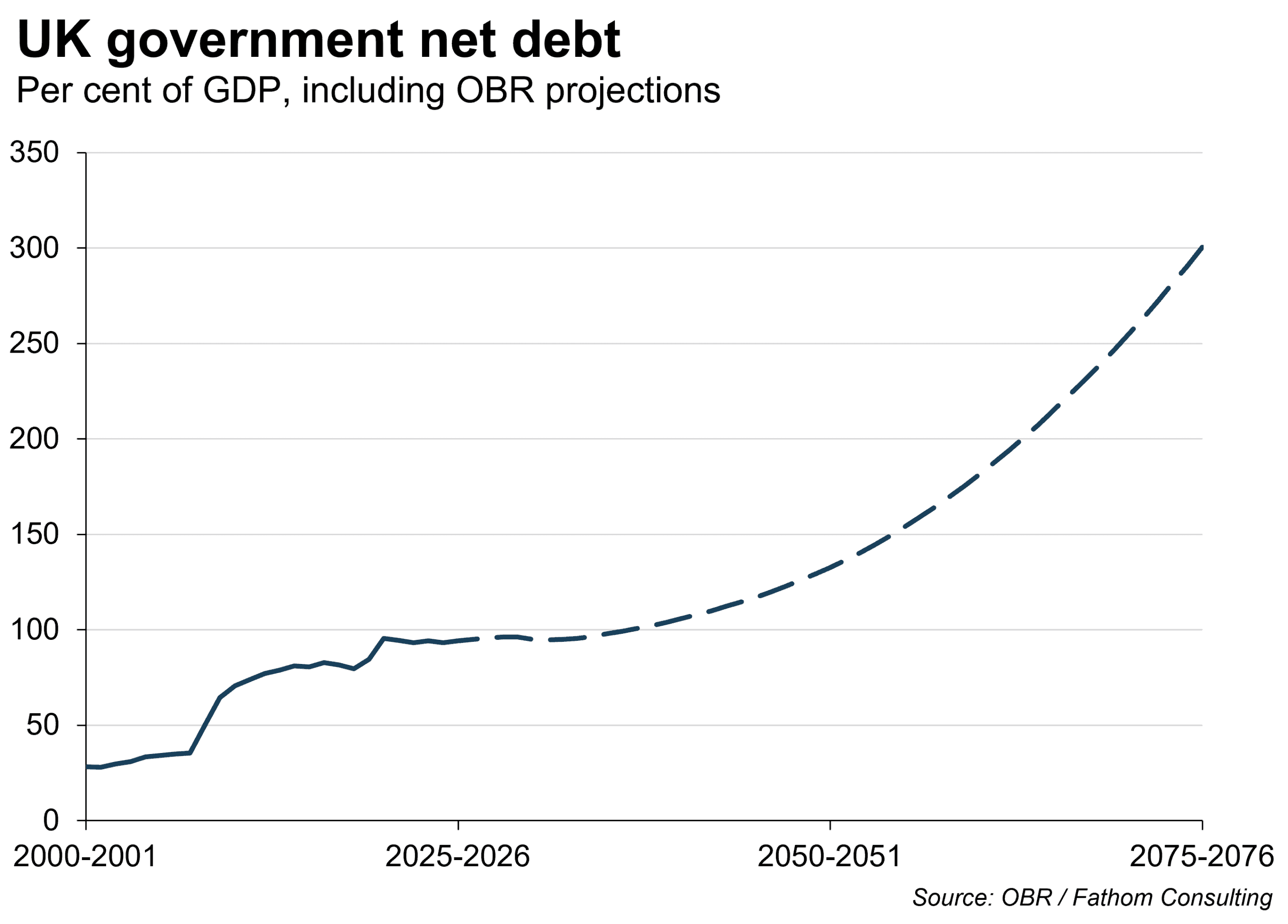
Now, to be clear, this projection of an explosive path for debt won’t come to pass ‒ the UK will either go bust or be forced to adapt fiscal policy to avoid that outcome. But the institutional setup of the OBR requires it to base its long-term projections on assumptions of unchanged policy beyond the next few years, as I’ll explain shortly. Those assumptions see spiralling costs but only a limited increase in revenue. If those assumptions were realised it would be a recipe for disaster. A recipe, it must be said, which is of the UK’s own making.
On the spending side, the UK’s ‘triple lock’ is at the heart of the problem. This policy guarantees that the state pension will be ‘uprated’ (i.e., rise) by either average earnings, headline CPI inflation, or 2.5%, whichever is highest. A simple calculation shows that the government’s annual nominal pension liability is already about £20 billion per year higher under the triple lock system than if pension payments had been linked solely to average wages since 2011-12. Actual pension spending has of course risen by more than this, owing to the natural ageing of the UK population, and in total has effectively doubled from around £75 billion to more than £150 billion. To date, no Chancellor or PM (John Healey and Andy Burnham included) has shown any inclination to remove the triple lock.
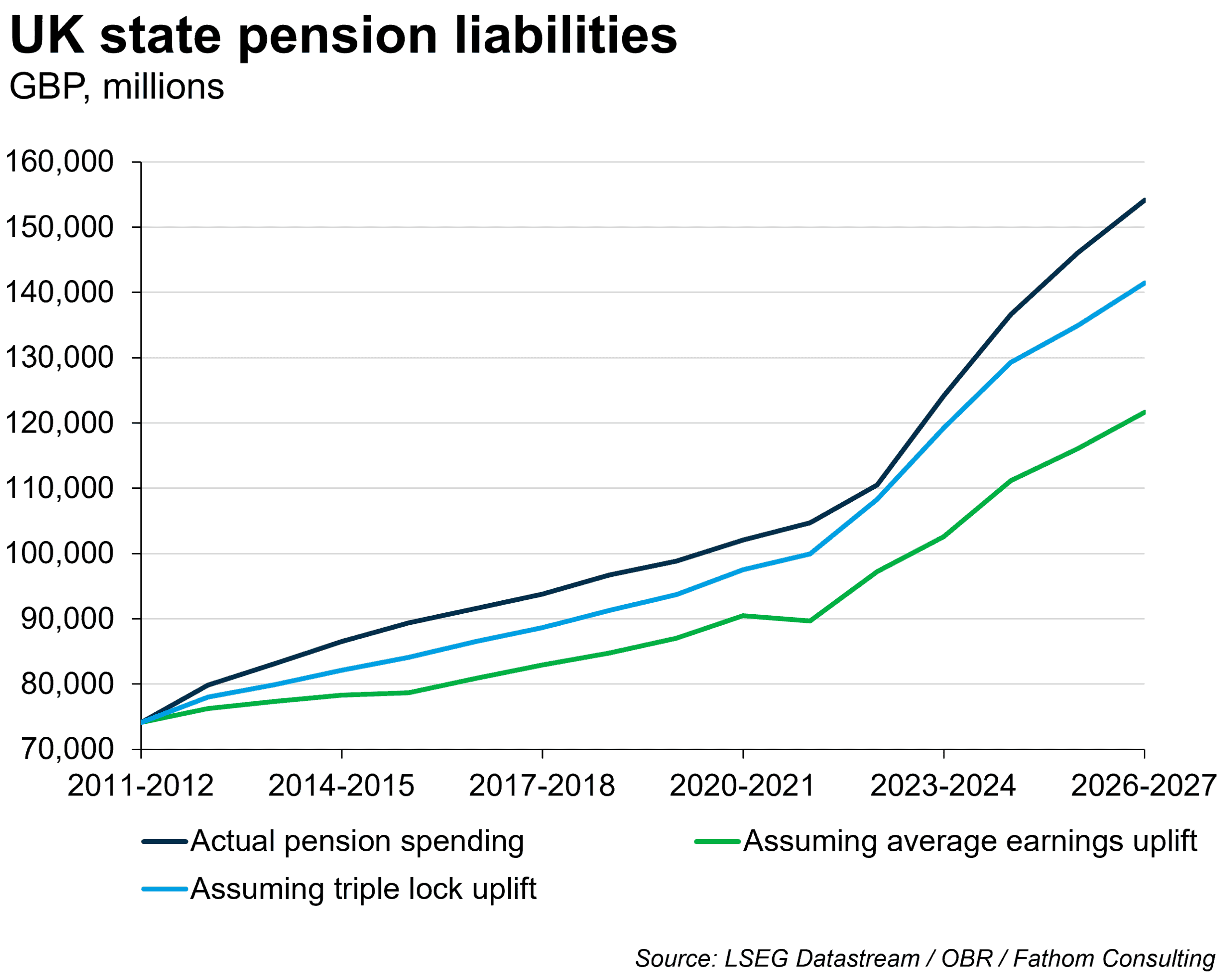
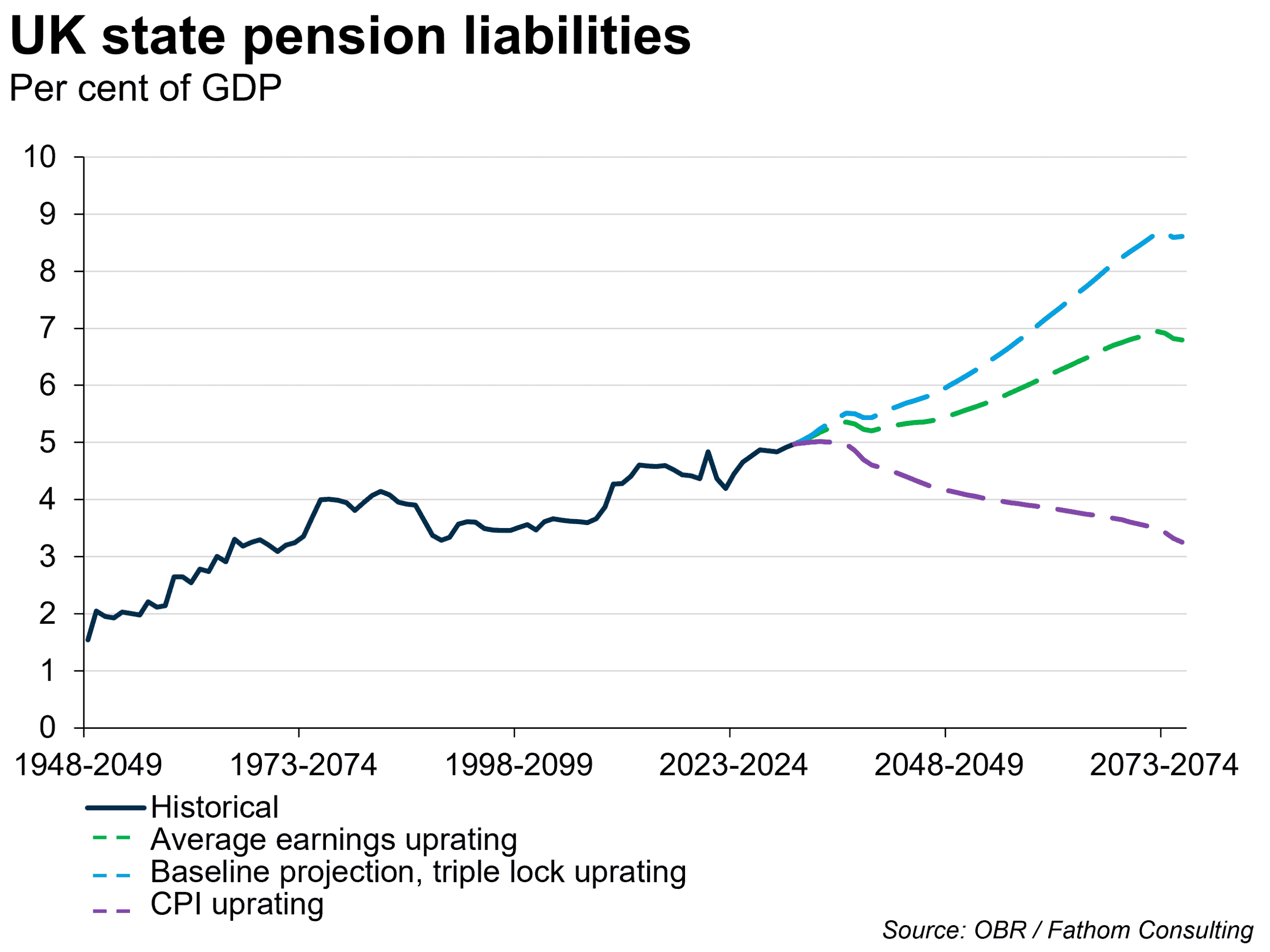
While undoubtedly well-intentioned at the time of its creation, the policy is now quite clearly unsustainable. Indeed, the baseline projection in the latest OBR outlook shows that maintaining the triple lock could see the annual state-pension liability approach 9% of UK GDP by 2075 (roughly double what it is now). Every pound of that extra spending will need to be funded. And that funding, it seems, will come through tax.
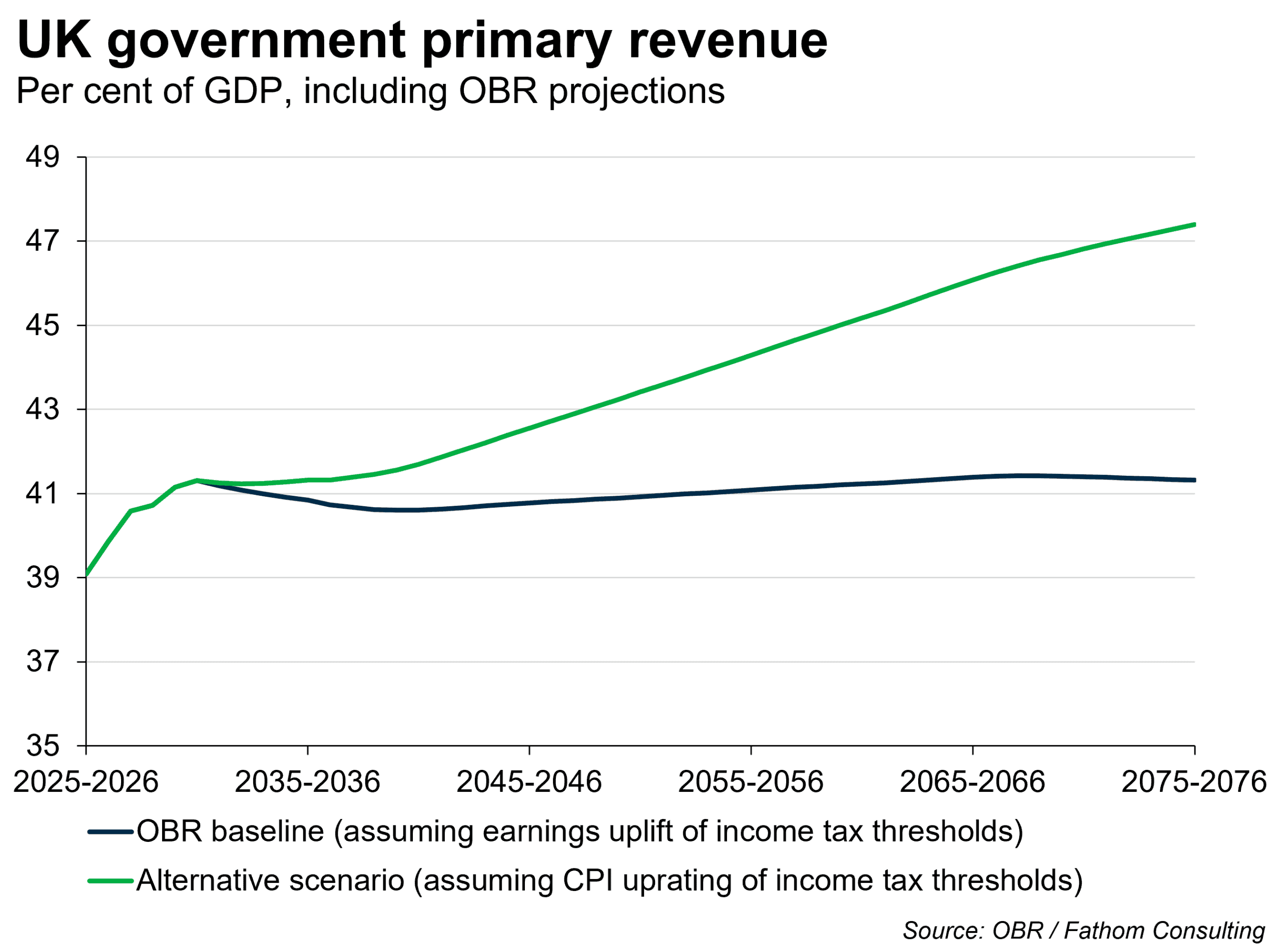
The good news is that the government has (at least on paper) a solution for this. The bad news is what that solution entails. The OBR’s latest projections also include a variety of projections for government revenue, which vary according to how the Treasury might choose to set income tax thresholds. Included within these is a projection in which income tax thresholds rise in line with CPI inflation. If that were to persist out to 2075-2076, the UK’s total tax take would be expected to rise by around eight percentage points. (This is because wages tend to rise by more than inflation.) Such an increase in tax revenue would be sufficient to cover the costs of the triple lock, and enough to prevent UK net debt spiralling to excessive levels. But it would be achieved through the UK recording its highest ever tax receipts.
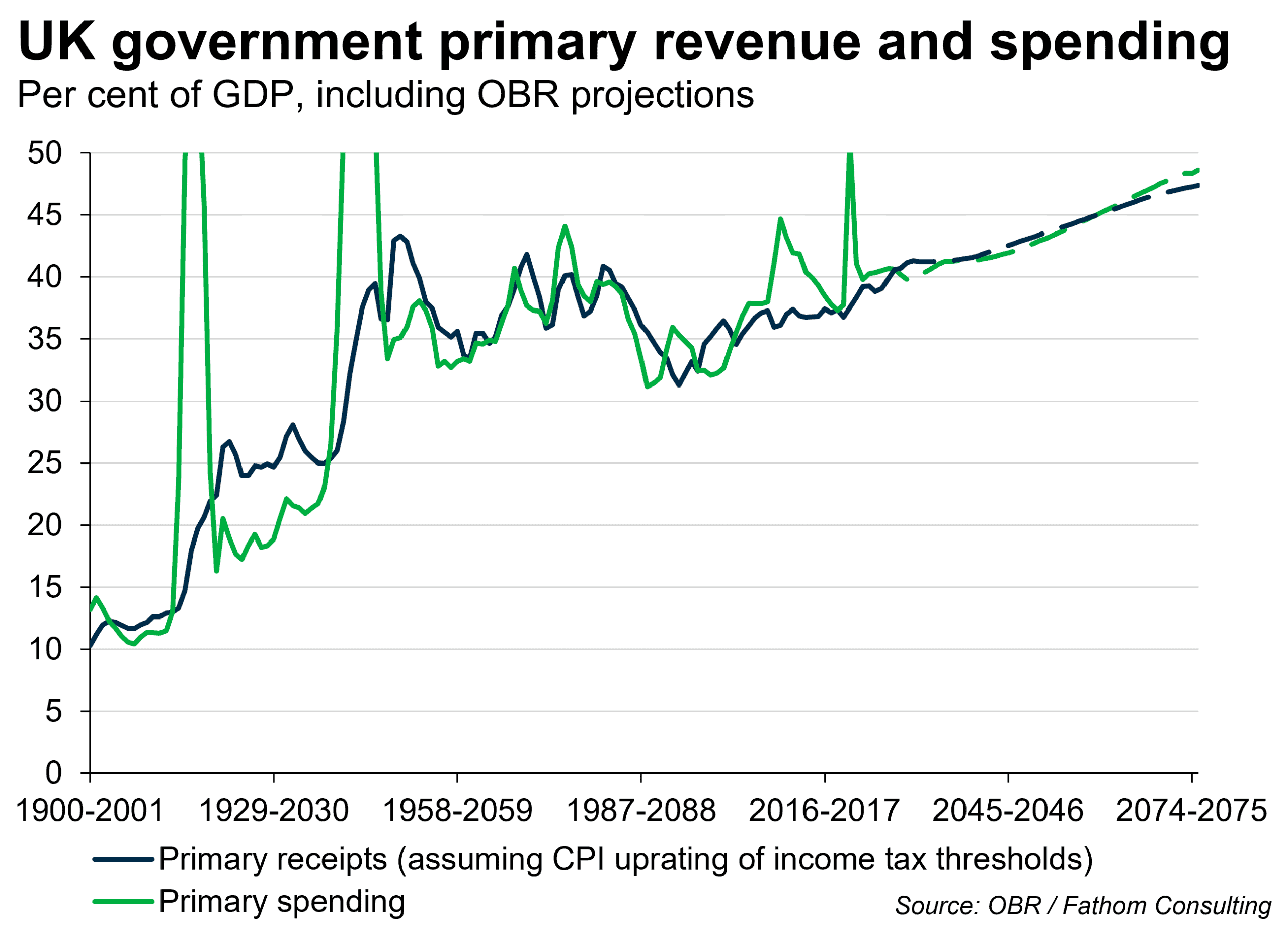
However, the OBR’s baseline assumes that income tax thresholds will rise in line with average earnings (not CPI) in the late 2030s and beyond. (In part they assume this because CPI-bounded thresholds would imply that, by 2075, two-thirds of the income distribution would be paying 40%+ marginal tax rates.) It is this more pessimistic assumption that yields the explosive path for net debt.
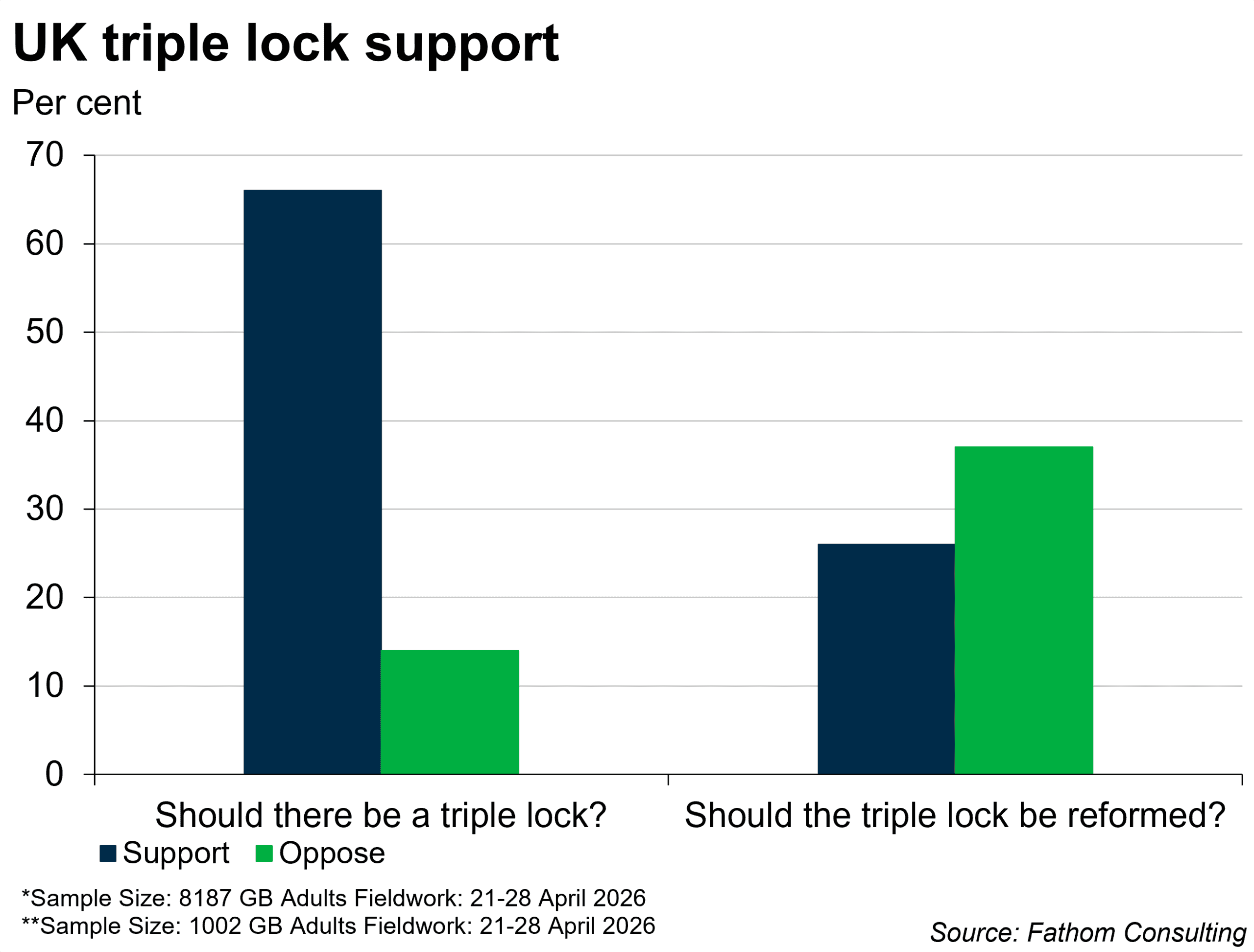
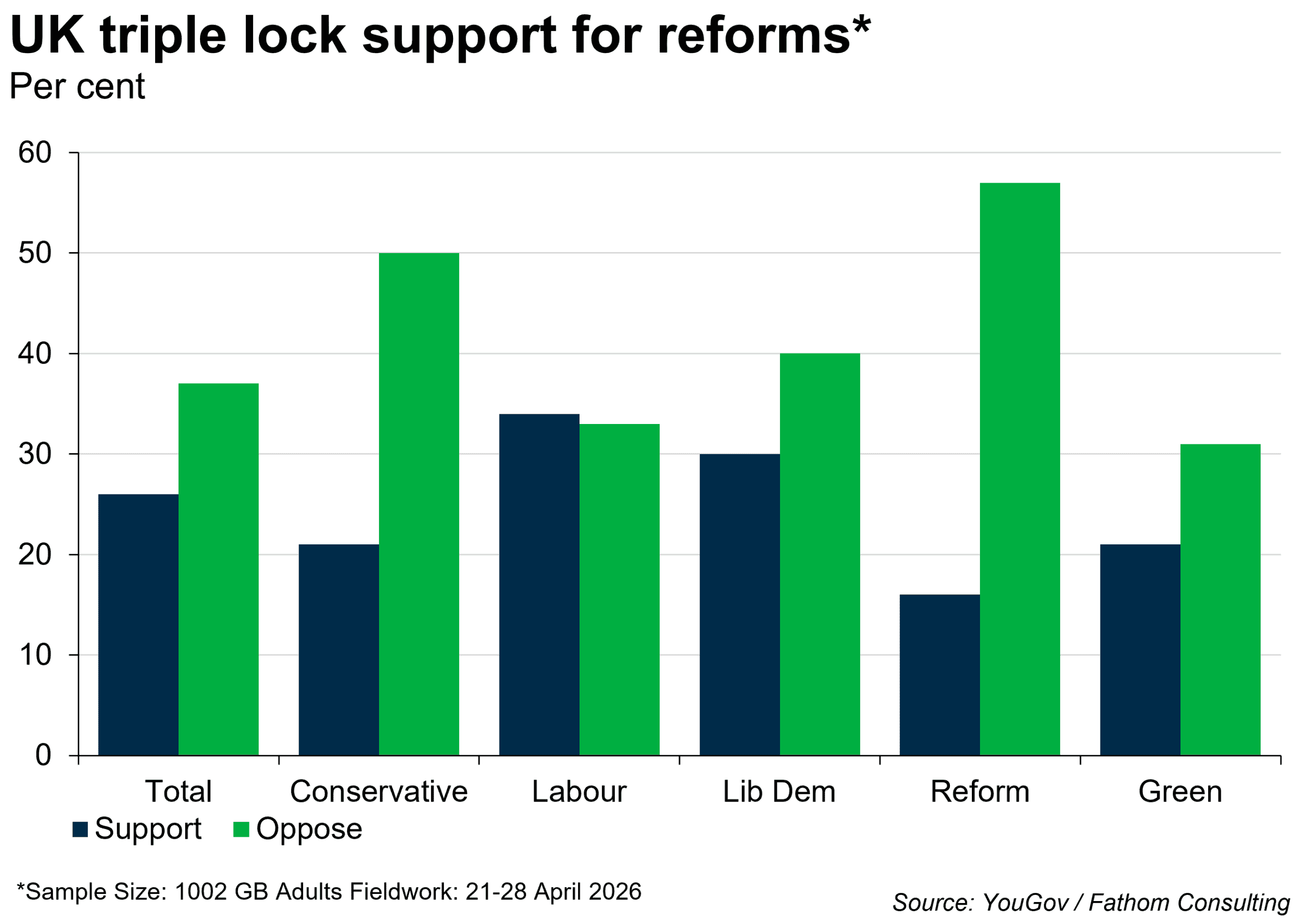
Clearly, something in UK public finances has to give. Either the UK government will need to commit to being a high(er) tax economy, or it will have to find ways to cut spending. On the triple lock specifically, polls show that there is continued support for it to remain (especially among pensioners). That said, the public seem more split on the question of whether the policy needs reform, with Labour voters narrowly in favour of some kind of change.
Ultimately, reforming the triple lock is a necessity (and so are many other measures of fiscal restraint). There’s a long history of pensions being pegged, be that to earnings, inflation or some other arbitrary rate, but the current format is clearly building up long-term issues for the UK. If I were Prime Minister for a day I would scrap the triple lock and peg total state-pension spending to nominal GDP growth. It wouldn’t be popular, and I bet I’d be chased out of office. But I’d also bet that my successor wouldn’t repeal it. Of course, I’m not Prime Minister. So it’s over to you, Andy.
We explore issues like these through our Global Outlook Service, providing clients with independent, data-driven analysis of the global economy, geopolitics and financial markets. Through regular research and tailored briefings, we help organisations understand emerging risks, identify opportunities and make better-informed strategic decisions. To find out more, enquire here
Further reading
Can the government solve UK’s productivity problem?
Get over it already: Brexit, a ten-year audit
Idea that Britain cannot afford to arm itself is dangerous nonsense