

A sideways look at economics
I was stuffing an election leaflet through a letterbox in my council ward this week when a burly man stopped to chat. He told me he was a Reform voter, and pointed out his house down the street, decorated with Union Jack bunting. He complained that Reform was painted as a racist party, and said that as his adopted brother was Black he could not be a racist. We agreed it was important to listen to other people’s viewpoints. As he left, he turned back. “Of course, there’s another thing we have in common,” he said. “The electoral system – it’s a disgrace. All it does is preserve the hegemony of the two main parties. And for Starmer to get a massive majority with only a third of the vote is bloody ridiculous.” I had to agree: the first-past-the-post (FPTP) voting system in use at Westminster is starting to look like it is no longer fit for purpose. So is politics broken? Do we need to reform our voting system?
The FPTP system has been in place in the UK for a very long time. Indeed, we invented it, and imposed it on our former colonies, many of whom still use it. Its simplicity is one of its strengths: every voter chooses one candidate, and the winner is the candidate who gets the most votes, no matter how many votes were cast or how they were shared out. The arguments in favour of it are that it maintains a local link between each MP and the voters who put them in parliament, and that it often produces single-party governments which are said to make for greater stability.
In an ideal world, every voter’s voice would have equal weight. FPTP clearly does not do this – votes cast for losing candidates have no weight at all. What is more, until fairly recently the vast majority of parliamentary seats never changed hands, and the balance of power was held instead by the voters in 50 or 60 key “swing” seats – making the votes of the rest of the country irrelevant. But until now most people have accepted that the system was good enough to reflect the will of the people.
The reason that people like my new Reform acquaintance are starting to question FPTP is because the political landscape has grown more diverse. The system evolved at a time when there were only two parties to choose between (Whigs and Tories), and so long as the voters have a binary choice it works pretty well. But once the political landscape becomes more fragmented, FPTP produces election results that are increasingly distorted, as I’ll go on to show.
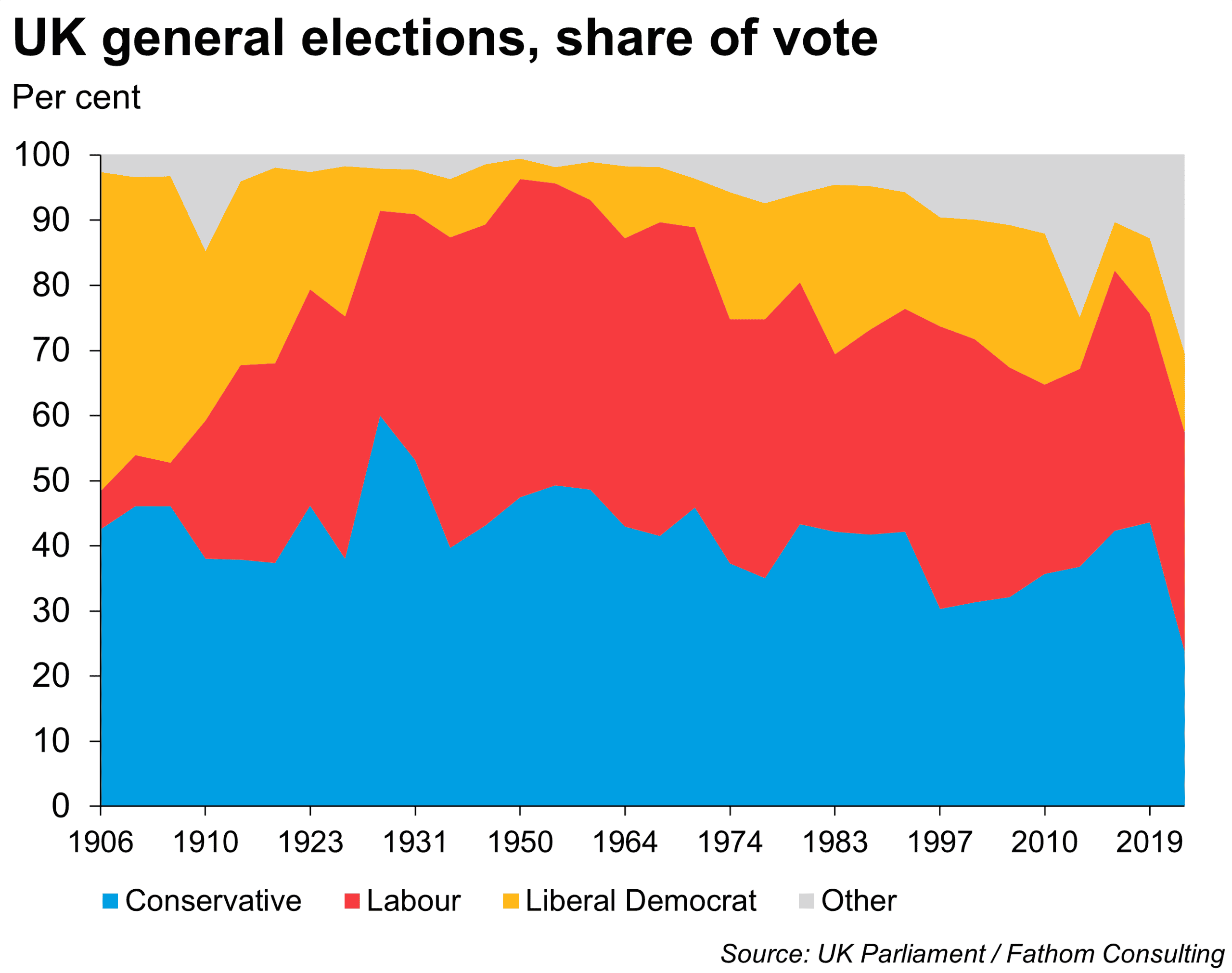
So all was well in the period 1945‒1970, when the Conservatives and Labour together received around 90% of the vote in general elections, and the FPTP system split the House of Commons between them. A third party (then, the Liberals) would take a handful of seats. Since the 1970s, however, as the chart above shows, there has been an accelerating decline in Labour and Tory support, and a rise in support for other parties.[1] But despite their ever larger share of the national vote, smaller parties have in general won few or no MPs, because the FPTP system is set up in such a way as to favour only the winning party. The major parties have exploited this in their campaigns, describing a vote for anyone but themselves as “a wasted vote”.
Unusually, FPTP failed to deliver an overall majority in 2010, and Britain had to form a coalition government. There was then a brief reversion to a binary red-blue voting pattern in the 2010s, as voters responded to the parliamentary crisis set off by the Brexit referendum. But the trend away from the two main parties now appears to have returned, with just 57% of voters supporting either Labour or the Tories at the 2024 general election. And if current polling were to be reflected at the next general election, due in 2029, Labour and the Conservatives would receive less than 40%, according to the Pollcheck website.
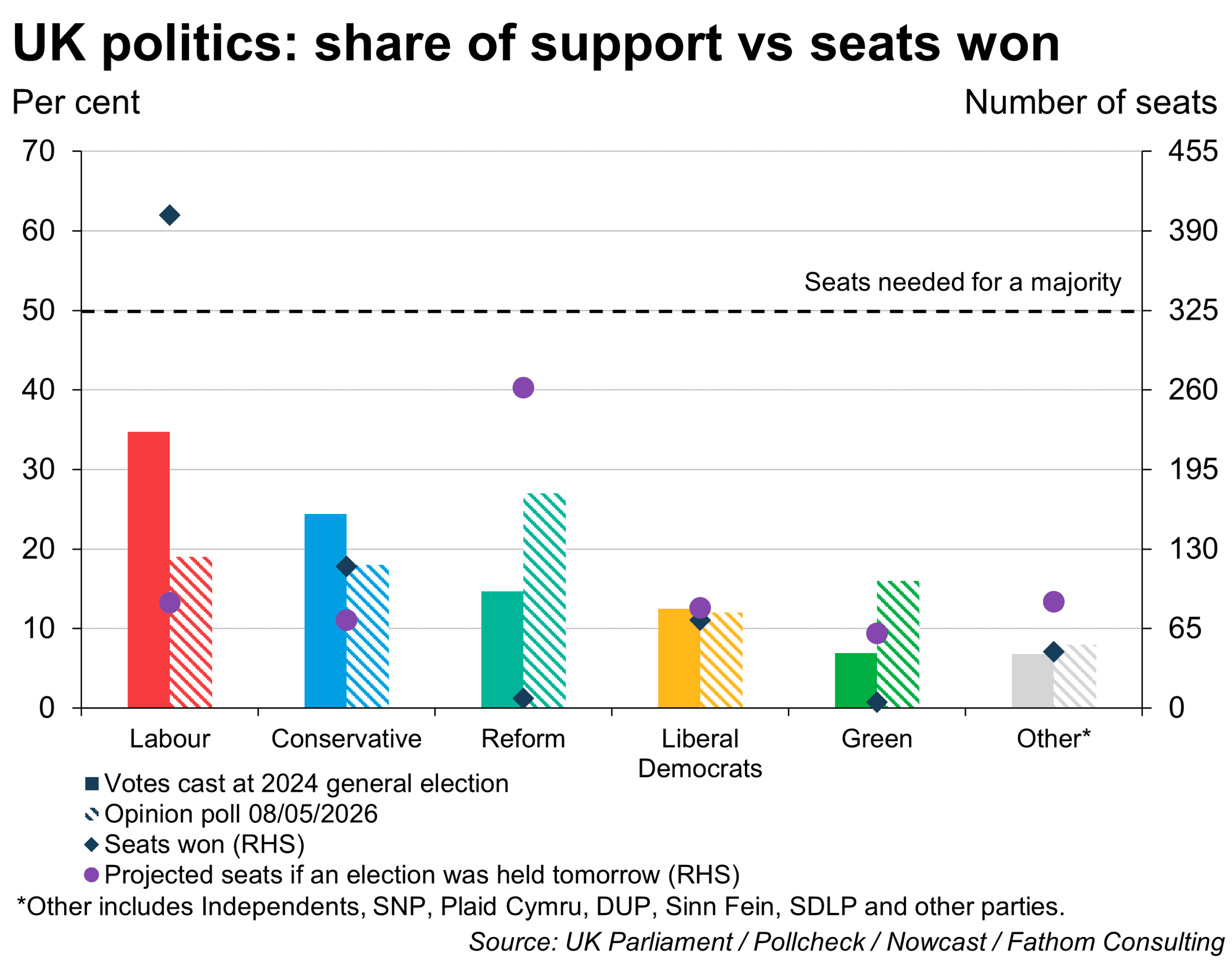
This gradual draining away of support at the ballot box has not been reflected in the makeup of parliament. For some time, the FPTP system has been producing UK governments elected on an ever smaller share of the vote. In 1970. [2] Harold Wilson’s Labour party got 43% of the vote and lost the election, taking 288 seats to the Conservatives’ 330. In 1997, Tony Blair’s Labour party also got 43% of the vote, but won a landslide victory, taking 418 parliamentary seats. And in 2024, the UK’s most distorted election result of modern times, Keir Starmer’s Labour won a landslide victory almost as large as Mr Blair’s, with 411 MPs (about 63% of all parliamentary seats) but on less than 34% of the vote. Labour actually received fewer votes in 2024 than in 2019, but doubled its number of MPs. In this way, what was once seen as one of FPTP’s greatest strengths – the thumb it placed on the scales in favour of the winning party, in order to deliver stable, majority governments – has now become one of its major weaknesses. Under the FPTP system, in a time of greater diversity of parties and views, governments have been getting less representative. And so, election by election, the legitimacy of the governments we elect and their right to wield powers over our lives have by small degrees been undermined.
All this has happened at a time when trust in politicians has been falling sharply, and people have been growing apathetic and disillusioned about voting. In 1950, a record high of 83.9% of the electorate went to their polling station to mark X on the ballot paper, and throughout the second half of the 20th century the average turnout was around 75%. No turnout has been above 70% in the 21st Century, and in 2024, it was a mere 59.7%. When I have asked people why they don’t plan to vote, anecdotally one of the most common answers has been: “There is no point, what difference would it make?” Correlation is not causality, but the rise of ‘minor’ parties to represent nearly half of the vote certainly adds strength to the argument that the FPTP system increasingly means that people feel their vote is worthless and so not worth casting. The other, even more common, answer from non-voters is: “Politicians are all the same, they are all corrupt” – which suggests a degree of alienation from UK politics that ought to be worrying.[3]
The failings of FPTP encourage voters who know their own party has no chance of winning locally to vote tactically, where keeping out the people you hate is more important than supporting the policies you approve of. It has also produced undemocratic electoral skulduggery such as party ‘no compete’ pacts, which deny voters a full range of choice.
Like the old anecdote about boiling a frog, the problems developing in UK politics have happened so slowly that for a long time they have been easy to ignore.[4] But the point is approaching when it may no longer seem silly to talk about UK politics breaking. The last ten years have seen a succession of governments with apparently comfortable majorities seeming to implode, putting a dent in the old maxim that FPTP delivers stability. At the least, as my Reform acquaintance said, we should take a fresh look at the way we have always done things and ask whether a different system, one that was better at representing a diversity of views, could serve us better. You can understand why he might feel aggrieved. If his party had received the same proportion of MPs as it received votes in 2024 (14%), it would have had 91 MPs. Instead it had five.
But all that may be about to change. Taking a snapshot of the current state of the polls with the Pollcheck 7-poll moving average, at the time of writing Reform was in the lead on 26.6%, and had been in front for the previous 370 days. Labour was second on 18.6%, and the Conservatives third on 18.4%; the Green party was fourth on 15.7% and the Lib Dems fifth on 11.6%. The Nowcast website suggests the likely split in the House of Commons if there was a general election tomorrow. Reform would be the biggest winners and the largest parliamentary party, with 262 MPs – its 26.6% of the vote translated by FPTP into more than 40% of the parliamentary seats. Labour would be the second largest party, with 86 MPs, and the Lib Dems third with 82. The Conservatives would be on 72 and the Greens on 61. With 37% of the vote, the old major parties together would receive 24% of the seats.
Objectively this outcome would clearly be unfair, but no more unfair than any other recent election results. It would not deliver strong stable government as no party would have an overall majority – indeed it’s hard to see a result like that ending in anything other than another election the same year. Voting system reform might be the answer, but the Catch 22 paradox is that no party that wins an election on FPTP is ever likely to put its weight behind changing it. If and when Reform does achieve an overall majority, its supporters’ interest in voting reform is likely to quickly wane.
Further reading
Global Outlook: Spring 2026 preview
Idea that Britain cannot afford to arm itself is dangerous nonsense
UK Update: MPC retains a bias to loosen
[1] It is interesting to speculate what triggered the rise of voter dissatisfaction with the two main parties. Is it just coincidence that in the 1970s Britain’s economy was sideswiped by soaring oil prices, over which the governments of the day had no control?
[2] The year when 18-year-olds got the vote, and when party affiliations were written on the ballot paper for the first time.
[3] Various scandals, including cash for questions, parliamentary expenses and the awarding of COVID contracts, appear to have contributed to this view.
[4] Neither of the main parties backed the 2011 referendum on changing the voting system, and the idea was resoundingly rejected by 67.9% to 32.1%.