

A sideways look at economics
Many of my friends and family were surprised when I told them a year ago that I’d be working in an economics consultancy. “I thought you wanted to do something creative?” was the usual response. Fair point – and honestly, the same question crossed my mind. How would I find my place in a company producing such complex, analytical and rigorous work, when my strengths leaned more towards the arts and creative ways of thinking? But now, eleven months later, I’ve come to realise that creative work isn’t confined to ‘traditional’ creative industries; it weaves its way through virtually everything. Often though its value isn’t fully recognised.
According to The House of Commons Library, creative industries are defined as “industries rooted in individual creativity, skill and talent that generate economic value through the development and use of intellectual property”.[1] This definition spans film, music, publishing, architecture, gaming and design ‒ the usual suspects. What the definition fails to capture is the creative work woven into the fabric of the wider economy. Before an industry qualifies as ‘creative’, the UK government requires the proportion of creative jobs (known as the ‘creative intensity’) to exceed a specific threshold,[2] which means that a lot of work we’d intuitively recognise as creative simply doesn’t fall within the definition.
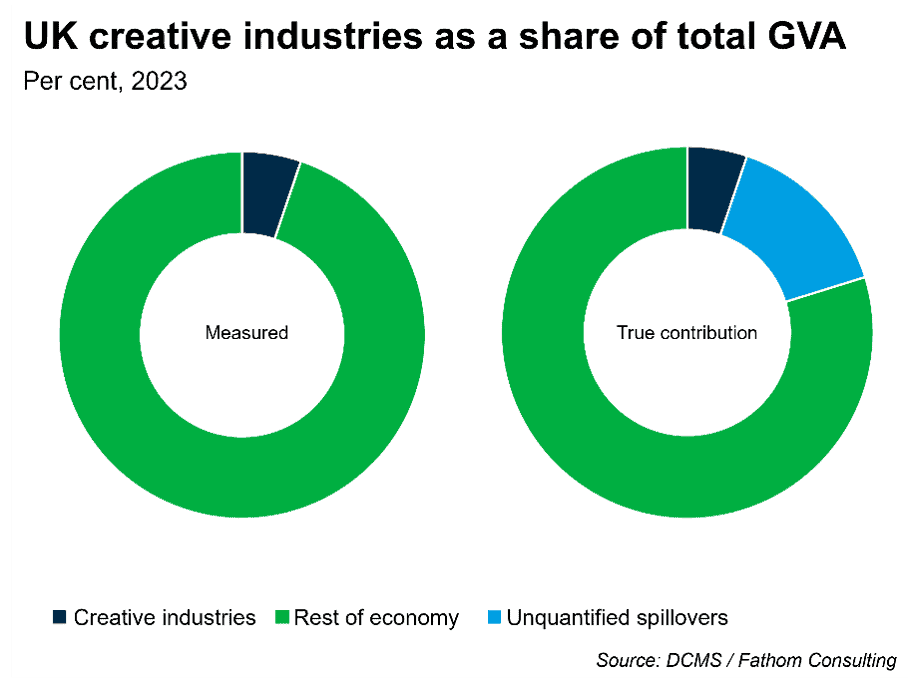
To put this in context, in 2023, the creative industries contributed £124 billion in GVA to the UK economy, which equates to around 5.2% of the total.[3] This, however, only tells part of the story. It measures the creative industries as a sector without accounting for the spillovers that flow into the wider economy. A city’s design scene and cultural identity raise property values and drive tourism; but the real estate and hospitality sectors receive credit for those gains. A games studio that develops a physics simulation might then see this technology commercialised within defence, architecture and industrial training, only for the R&D value to be counted under those sectors instead. In 2023, DCMS commissioned Frontier Economics to quantify knowledge spillovers from the UK creative industries. While the data available made a precise figure impossible, the research confirmed that the gap between measured and true contribution was significant.
A similar mismatch applies when creative work is driven by passion rather than payment. Today, a vast ecosystem exists online of amateur and hobbyist creators. Platforms like YouTube and TikTok have become major sources of vocational training where tradespeople learn new techniques, programmers pick up coding languages, and designers master creative tools. Much of this knowledge is shared freely, simply because people enjoy their hobbies and want to create content for others. Now that AI is starting to reconfigure our economy, the value of this unpaid content has taken on a different commercial significance. What many people don’t realise is where AI systems obtain much of their training data. Take Reddit as an example: for decades, users have posted ideas, advice, debates, and personal experiences to help one another learn and connect. But now, this vast archive of human knowledge has become a major training source for large language models such as ChatGPT.[4] This means that decades of unpaid creativity by ordinary users have directly fed into AI products valued in the hundreds of billions of dollars.
Even within the creative industries, standard accounting frequently fails to capture the economic value of creative work. Many creative industries produce value in intangible, internally generated ways. A film studio builds a franchise, a musician builds a brand, and a fashion house builds a legacy. However, International Accounting Standard 38 explicitly prohibits the capitalisation of internally generated brands.[5] This means a brand that is acquired by an investor appears as an asset, while one built from scratch does not. Rather counterintuitive, no? The picture isn’t much clearer for other intangibles, such as intellectual property. Capitalisation is theoretically permitted, but it is rarely achieved in practice. By the time a creative project clears the research phase and meets the capitalisation criteria, the work is largely done. Costs have been expensed through the profit and loss accounts, but nothing in the accounts links these costs to their eventual payoff, months or years down the line. Consequently, creative assets are chronically undervalued by capital markets until they are sold and become part of an asset portfolio.
Now, returning to the beginning, if someone asked me today “I thought you wanted to do something creative?” – my answer would be simple: I am. Although my company is not classified as part of the creative industry, my work does rely on creativity to generate value. Throughout my time as a Marketing Assistant, I’ve drawn heavily on my creative abilities ‒ designing social content, brainstorming campaign strategies and planning events. It’s not just about making things look good, but also about having to be original and find new solutions. Furthermore, creativity within this company extends far beyond marketing. Every day, the Fathom team uses creative thinking in different ways: some create clear visuals to demonstrate data; others push the boundaries of model design and coding. As an independent company, original thinking is not just encouraged but a necessity if we want to stand out and survive.
So, is creativity undervalued in Britain? The evidence says yes. We have one of the world’s leading creative economies and still treat creativity as a nice-to-have, not the asset it is. What the numbers reveal is a major economic opportunity that Britain has yet to fully embrace. Schools could stop treating creative subjects as the permissive option. Industry training could be taken as seriously as it is in finance or law. Start-up loans could back a creative business plan the same way they’d back a tech one. And we could start promoting creativity not as a quirky national trait, but as one of our biggest exports. None of this requires Britain to become more creative. It requires us to start valuing what we already have.

More from Thank Fathom It’s Friday
What’s happening in Japan? Kaizen it ain’t.
[1] https://commonslibrary.parliament.uk/research-briefings/cdp-2025-0017/
[2] https://www.gov.uk/government/publications/dcms-sectors-economic-estimates-methodology/dcms-sector-economic-estimates-methodology
[3] https://lordslibrary.parliament.uk/creative-industries-growth-jobs-and-productivity/#heading-3
[4] https://openai.com/index/openai-and-reddit-partnership/
[5] https://lordslibrary.parliament.uk/creative-industries-growth-jobs-and-productivity/#heading-3