

A sideways look at economics
Cassandra’s tragedy was that her prophecy of doom (that Troy would fall to the Greeks) was correct, but she was destined to be ignored. Nobody wants to be Cassandra. The trick for would-be prophets, if there is one, is to vary the heavy toll of doom with the lighter notes of good news when there is any. At Fathom, we try to do that, and generally succeed. And it’s worth recalling that, in the history of the species, the best time to be born as a human being is today. But the note of doom is always tolling in the background, deep-toned like a great bell, warning of disaster: AI bubble; Iran; Ukraine; Taiwan; climate change. The warning I want to focus on here is r-g. If you listen carefully, you can hear it now, underneath the clamour about tax cuts, flying cars and the rest. There it is again: doom, doom, doom.
Andy Haldane, formerly chief economist at the Bank of England, wrote a piece in the Financial Times last week warning prime minister Andy Burnham that the UK was at risk of a fiscal crisis. He was right; and it’s not just the UK that should be concerned. Fiscal sustainability depends on the fundamental strength of the economy; the ratio of government debt to GDP; the public sector borrowing requirement and the prevailing and expected cost of government borrowing. And the key to all of that is r-g[1].
If government debt is stable or falling as a share of GDP, then a fiscal crisis is unlikely. If it is rising but expected to stabilise in the near future, a crisis is also unlikely. Importantly, both these scenarios depend on the prevailing interest rate paid on government debt, ‘r’, being less than the nominal growth rate the economy is expected to achieve: ‘g’. If r<g then the government can borrow heavily now and continue to do so in future. The worst that will happen is that government debt as a share of GDP will gradually approach a higher level, but it will stabilise at that level. If r<g, the government has free rein: borrow and spend! No matter how much you borrow, the debt ratio will eventually stabilise.
The difficulty is that both r and g depend, in part, on how much the government has borrowed.
Once government debt gets ‘too’ high, investors might seek a higher return to compensate them for the risk they might perceive of a government default. The exception (and the reason for all the ‘might’s in the previous sentence) is Japan, where government debt peaked at almost 250% of GDP, but investors remained happy to finance the next tranche at extremely low or zero interest rates. Japan shows that the intuitive relationship between debt and the cost of borrowing does not always hold: indeed, it hasn’t held there for at least 30 years, and arguably still does not.
Furthermore, where Japan has gone the rest of us have followed. Increasing government debt ratios right across the developed world have gone hand in hand with ever-decreasing yields on government debt. At least, until COVID.
There is a relationship between the debt ratio and r, but it is more complicated than intuition suggests. First of all, if r falls for reasons not associated with default risk (such as the impact of China’s accession to the WTO), that will encourage governments to borrow more: the direction of causation can run from r to debt accumulation. But, focusing just on the causal flow from debt to r, it turns out that r tends to increase when the debt-to-GDP ratio rises materially above its long-run trend (and falls when it falls below that trend). It is as though investors have already priced in not just the starting debt ratio, but a linear extrapolation of that debt ratio. It’s only if the ratio exceeds that expectation that markets react by asking for a higher interest rate on the next tranche. This relationship can be shown to work across many countries ‒ importantly, including Japan. And it is central to Fathom’s estimate of sovereign risk that is embedded in our Financial Vulnerability Indicator.
At the same time, the rate of growth of the economy, g, tends to fall as government debt increases as a share of GDP. There are several reasons why. On the demand side, as debt/GDP increases, so does the cost of servicing that debt as a share of GDP, and some proportion of the debt-servicing costs flows abroad to the foreign holders of that debt. In effect, this is like imports increasing as a share of GDP over time, but without the benefits in terms of utility that imports provide. These negative effects on aggregate demand can persist long after the positive impact of a fiscal stimulus (the original cause of an increase in government debt), if any, has faded. On the supply side, higher government debt tends to accompany an increasing public-sector share of the economy, which tends to reduce private incentives to invest and innovate. The exception, and the reason for all those ‘tend’s in that sentence, are the Nordic countries, where a high tax wedge and a correspondingly large public sector do not appear to have reduced average per-capita growth rates. Indeed, those countries look good by comparison with other advanced economies, with the possible exception of the US.
There is a relationship between high government debt and g, but it is not as simple as intuition might suggest. It matters greatly what the increase in government debt is used to finance. When government spending crowds out private investment (which can occur via interest rates or other mechanisms), that will generally result in a reduction in g. But when it crowds in private investment (for example by internalising the positive externalities that arise from R&D spending) it can result in an increase in g.
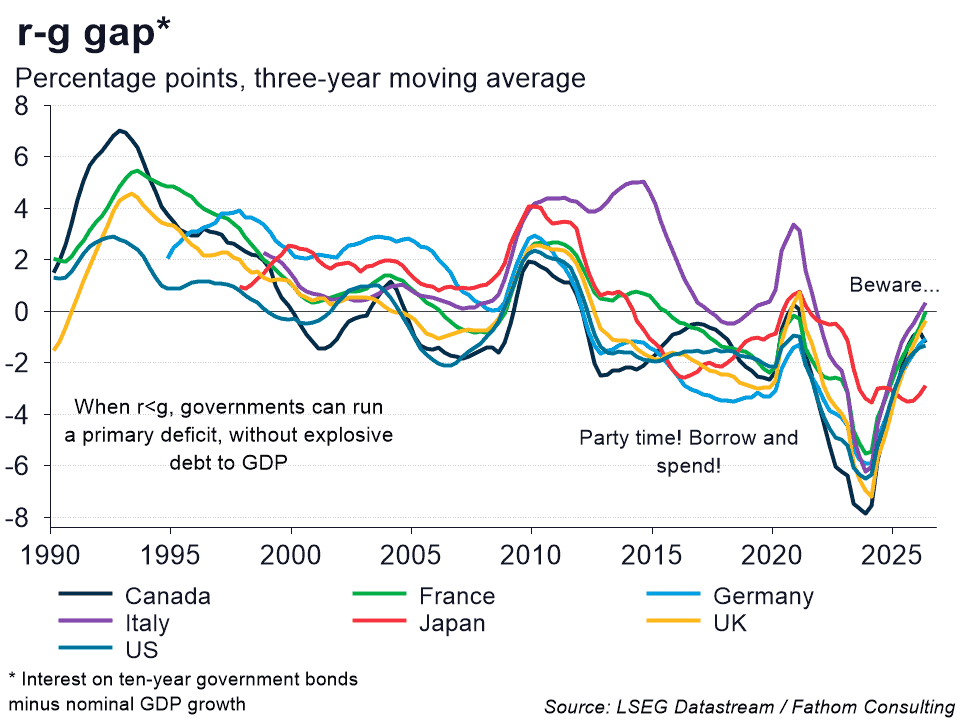
So where do we stand in terms of r-g? The bell of doom is tolling rather loudly: r fell far below g during COVID, thanks in part to unprecedented monetary and fiscal stimulus, the response to the sharpest recession of all time, with ramifications for better or worse (mostly worse, but that’s a topic for another day) that are still being felt today; but it has bounced back nearly everywhere since then, as the chart below shows (and Japan will likely follow suit in due course).
According to Fathom’s FVI, the factors that contribute to sovereign risk include:
- the budget balance as a share of GDP
- the current account balance as a share of GDP
- exports of fuels as a share of total exports
- the volatility of the exchange rate
- GDP growth
- the ten-year government bond yield
- government debt excesses (the debt-to-GDP ratio divided by its long-run trend)
- official reserves as a share of GDP
- the growth in global industrial production (a measure of the global business cycle)
- the risk of contagion through government bond markets
Importantly, each of these factors compounds the others. The impact of a high government debt excess will be small if all the other factors are registering low or zero contributions to risk, for example; but it will be large if the reverse is true.
Two of the factors in that list are r and g, the bond yield and the growth rate. The FVI is designed to register very low risk (substantially below the base frequency of crisis) most of the time, but to jump to much higher risk (substantially above the base frequency of crisis) in circumstances when many or all of the factors compound each other.
In the case of the UK, for example, the risk of crisis is very low right now, even though bond yields are relatively high. That is because growth is relatively strong, fuel exports are low, the exchange rate is relatively stable, government debt excesses are low, the global business cycle is strong, reserves are OK, and the risk of contagion from global bond markets is about average. But it would not take much to change that picture. A different evaluation of the UK’s centrality in bond markets (which changes every quarter), combined with a slowdown in growth domestically and globally and a deterioration in the UK budget and current account balances (all of which are reasonably likely in the year ahead), could combine to cause UK sovereign risk to jump sharply. Similar considerations apply in France, the US and right across the G7.
The key is whether the government observes the fiscal prudence that’s appropriate when r>g, as it soon will be.
When r<g, it’s party time for the government: the punchbowl is full and there’s a free bar, too. For the UK, Canada, the US and Germany, r has been less than g since about 2005, except for the interruption of the 2008 financial crisis. Japan and France joined the party after the financial crisis, and Italy showed up just as the party was ending, during COVID.
Now, though, the guests are drifting off, the punchbowl is empty and the barstaff are collecting glasses. As soon as r>g, which will probably be soon in most countries, a totally different mood will prevail. Ready for the hangover, everyone? Remember: Cassandra was right.
We will be monitoring these risks carefully. Today’s UK budget has changed little: a tedious affair with little news, delivered with a characteristic worthiness but lack of flair by the new chancellor, John Healey. It could have been worse, but that’s about the best that can be said about it. The uncomfortable arithmetic of r-g is coming for this government, as for many others.
PS: If I were the UK Chancellor, I would
(a) ditch the investment rule that says the government debt-to-GDP ratio should be falling by the end of the parliament: as a constraint on investment it is totally arbitrary and self-defeating
(b) rip up the tax code in its entirety and task a small group in the Treasury to redraft it to fit the whole thing on one side of A4, with fiscal neutrality
(c) ensure that defence spending, with a heavy focus on dual-use R&D, got to 3.5% of GDP by 2030 and 5% by 2035: other spending or borrowing commitments have to make way
(d) do something radical to address the ludicrous proliferation of disability payments.
But that’s just me.
Register your interest for a free opportunity to hear insights from Fathom’s latest Global Outlook, an independent assessment of the global economy and the risks shaping markets and geopolitics.
Further reading
UK Update: revisions to our UK forecasts
French bonds: a Frexit warning
Global Outlook, Autumn 2025: fiscal policy under high interest rates
The UK loses its magic money tree
[1]. See pp 168-9 of the Office for Budget Responsibility’s Economic and Fiscal Outlook, October 2026.