

A sideways look at economics
Saudi Arabia is an oil economy that wants to maximise the value of its oil wealth while diversifying away from oil; seeking employment opportunities for a cohort of young Saudi nationals when most jobs have usually gone to immigrant labour; governed by a highly traditional, patriarchal political elite that wants to modernise without changing its fundamental character. These objectives sound unachievable because they are so confusing. But the early signs are positive, remarkably enough. Saudi seems to be finding a way to live with high levels of apparent contradiction, including in such fundamentals as how the size of the economy is measured.
All measures of GDP are equal, but some are more equal than others. In most countries, the statistical discrepancy between the income and the output measures of GDP tends to be small and of interest only to official statisticians and Grade A geeks like me. Not so in Saudi Arabia (or other major commodity exporters). In principle, the income that domestic residents accrue must be the same as the value of the output those residents produce, and that equality should continue to hold once both concepts have been deflated appropriately. In practice that’s hardly ever true, and, in Saudi Arabia, the discrepancy can be huge and of fundamental importance to our understanding of that economy. The chart below shows that Gross Domestic Income, in real terms, can change by 10% or 15% more or less than Gross Domestic Product in real terms, depending on what is happening to the price of oil. Which measure is correct? They both are.
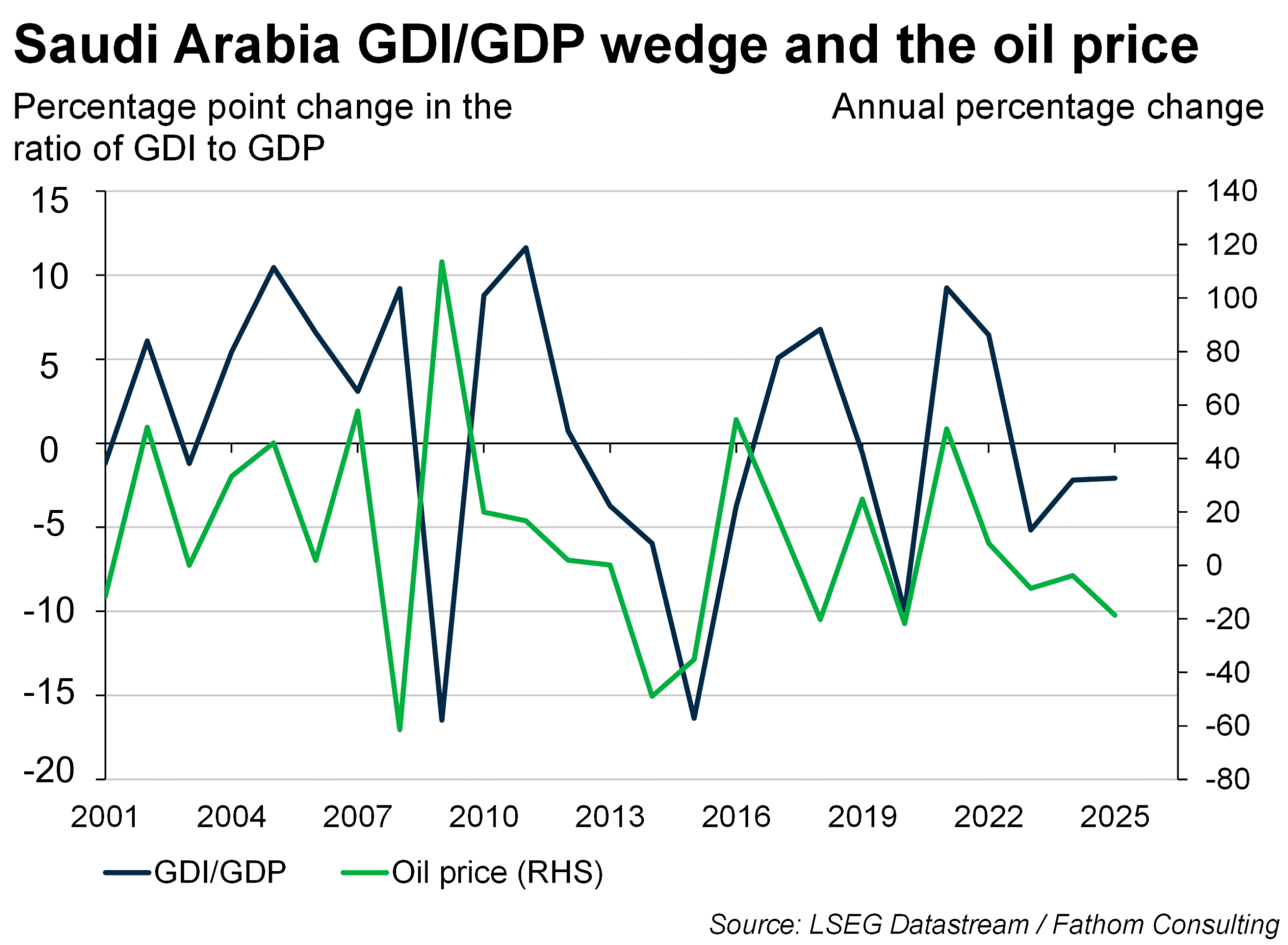
Oil prices can increase because of a positive shock to global demand for oil or because of a negative shock to the global supply of oil. In either case, the value of Saudi Arabian oil exports is likely to rise roughly in proportion with the change in price (except in circumstances such as those that currently prevail, where there are physical constraints on the shipments of oil). But the number of barrels of oil pumped out of the ground may change very little: in the face of a demand shock, it might increase slightly; in the face of a supply shock, the initial impact could be negative as global demand for oil traces out the downwards sloping (though very inelastic) demand curve. Real Gross Domestic Product will essentially count the number of barrels of oil produced, and so will tend to change very little. But real Gross Domestic Income will count the revenue generated by the sale of those barrels and deflate it by an income deflator. In principle, those two exercises should yield the same result; in practice, they do not. Neither one is more ‘correct’ than the other. It’s a bit akin to the ‘adding up’ problem in global trade: global exports must in principle equal global imports, since we have no trade account with Mars (that I’m aware of), but in practice they differ ‒ sometimes by a great deal. That difference can only arise because of measurement error, which will be present in both exports and imports. Which is the correct measure? Both, or neither.
We just have to live with the discrepancy. That’s something that Saudi Arabia appears, so far, to be doing rather well.
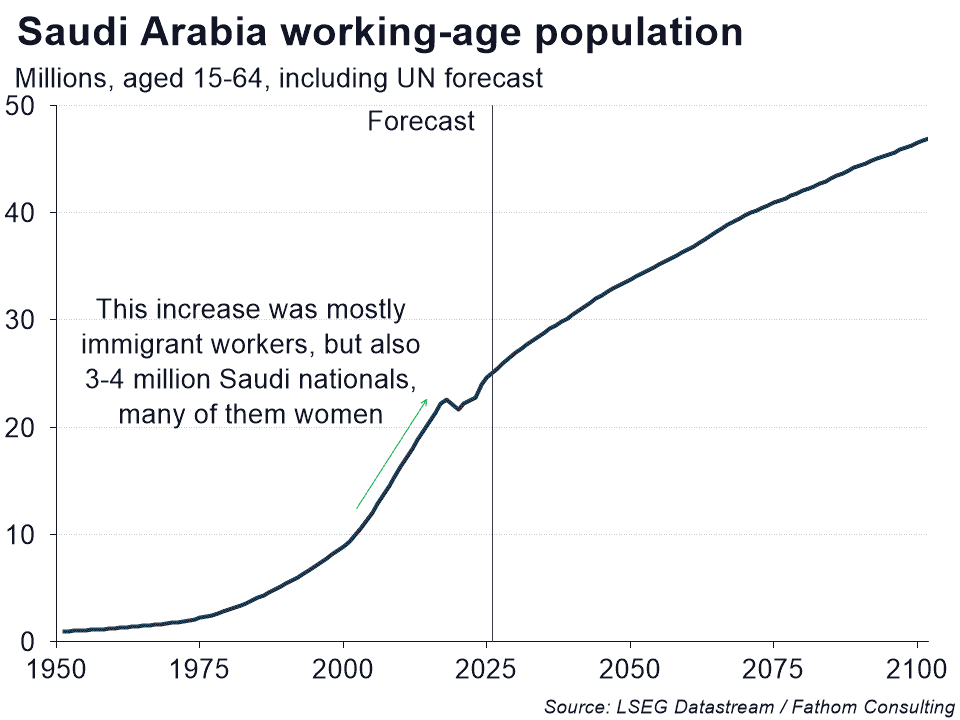
For example, in 2000, the Saudi population of working age was around 10 million. By 2025, it had risen to nearly 25 million. Changes of that magnitude, over such a short period of time, present huge challenges.
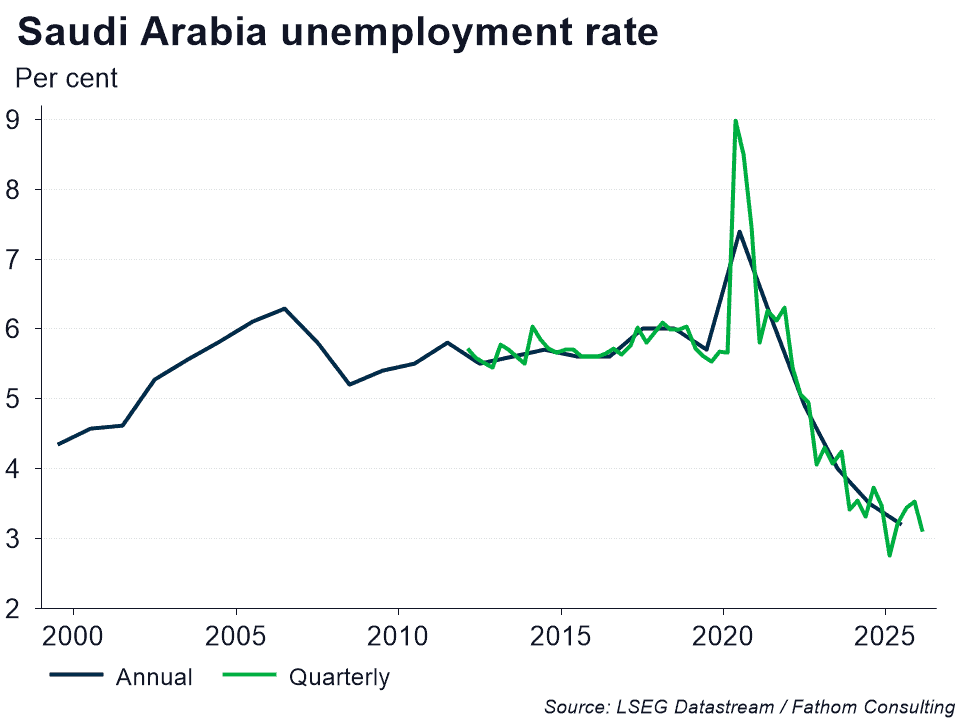
In the face of such changes, I would expect to see big increases in unemployment, at least temporarily. Not so in Saudi Arabia: unemployment increased somewhat during COVID (as it did in many countries). But otherwise, the picture is extremely and increasingly benign. If anything, the unemployment rate is rather too low for comfort (though statements like that are just one reason why economists tend not to be invited to parties).
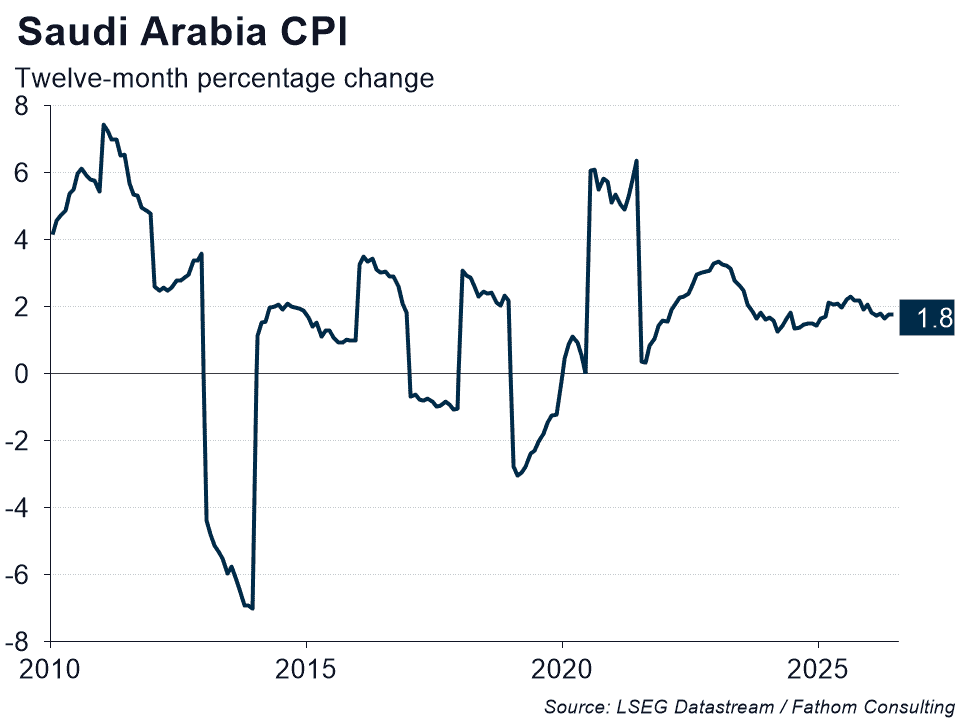
If unemployment is ‘too low’, it’s certainly not showing up yet in measures of inflation, which are as unremarkable as the most conservative central banker could wish.
The bump in the working-age population demands attention. Looking at the Saudi population pyramid, we can see immediately where it comes from: working-age males.
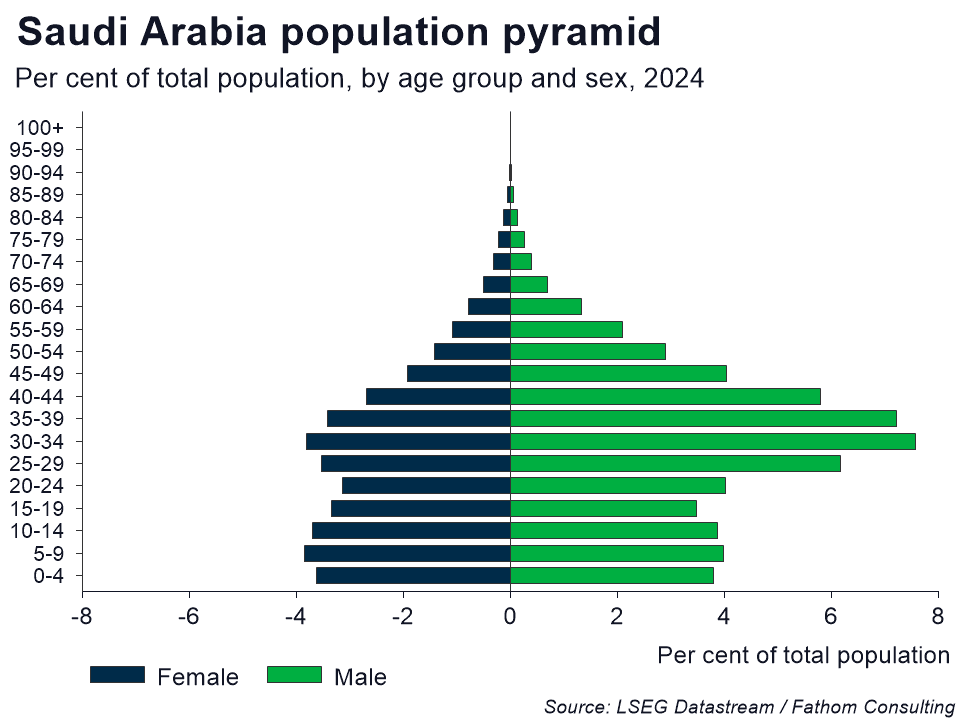
It is not the case that Saudi Arabian people give birth to an unusually high proportion of boys. That rightwards bump is imported labour, particularly prevalent in the working-age population: Saudi brings in large numbers of immigrants from countries like Egypt and Pakistan, disproportionately male, to take up temporary residence while working there. That immigrant male population now accounts for over 40% of the total population of Saudi Arabia: around 15 million people, the vast majority of whom are employed. Stripping out those people from the pyramid above would yield roughly symmetrical male and female age cohorts, in a pyramid structure that is very encouraging by international standards: many economies (such as South Korea, discussed in last week’s TFIF) have an almost inverted pyramid, with declining fertility rates and increasing elderly population.
Saudi Arabia has always provided employment for immigrant workers. But the outstanding achievement in recent years is to have found opportunities for young Saudi nationals too. Unemployment among Saudi nationals is much higher than among the immigrant population, since immigrants come to take up jobs. But the unemployment rate for Saudi nationals, though high, has been falling consistently for several years.
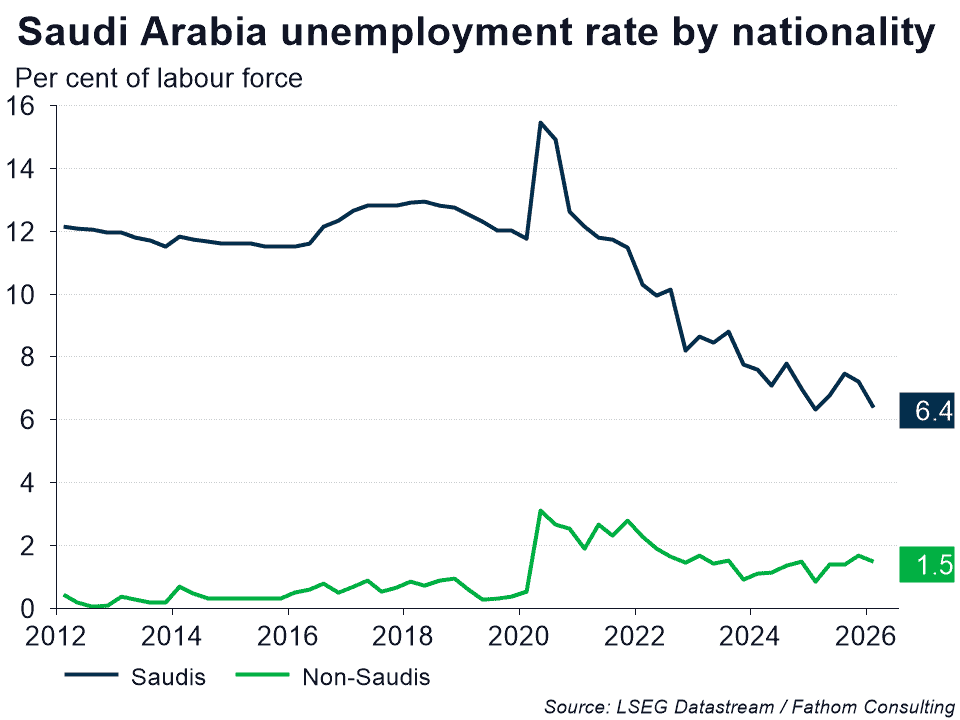
That reduction in unemployment among Saudi nationals is a salutary achievement. The growth in the working-age population over the last 25 years exceeds the influx of immigrant labour over that period by three to four million. And yet, unemployment among the Saudi national workforce has fallen. How has that been achieved?
There are many factors behind it, including a swathe of policy initiatives, some of which have just got under way. But the big one that I want to draw attention to here is another (to me) surprising development. Female participation in the Saudi labour force (and remember that the unemployment rate is the proportion of those participating in the labour market that is unemployed), though still low by international standards at around 36%, has almost doubled in recent years, partly thanks to a relaxation of regulations that previously prevented female participation, and partly thanks to a variety of incentives that created demand for specifically female labour. Saudi Arabia remains a strongly patriarchal society but, under the radar, it is the increasing role of women in the workforce that accounts for much if not most of the increase in employment of Saudi nationals.
So the story for Saudi Arabia is this. There has been a dramatic influx of foreign nationals, mostly men, to take up employment opportunities that have arisen as Saudi Arabia has sought to diversify its economy away from almost complete reliance on oil. Alongside that, there has been a big increase in female participation in the labour market, responding to regulatory changes and incentives. But how successful has the diversification effort been?
The answer, viewed through the lens of export markets: not very. The chart below shows how the ‘revealed comparative advantage’ (RCA) of Saudi Arabia has changed across the principal categories of trade between 2010 and 2024. The units are changes in z-scores. A z-score of 1 indicates that the country concerned specialises in this category of trade to the same degree as the world does on average. Anything above 1 indicates a higher-than-usual relative specialism. The chart shows changes in those scores, which capture the degree to which Saudi Arabia’s specialisms have changed over the period. The stand-out categories are towards the bottom of the chart: transport and transport equipment; plastics and rubber (probably oil derivatives); construction; travel (suggesting some success in increasing tourism and business travel exports) and (the big one), government goods and services not included elsewhere.
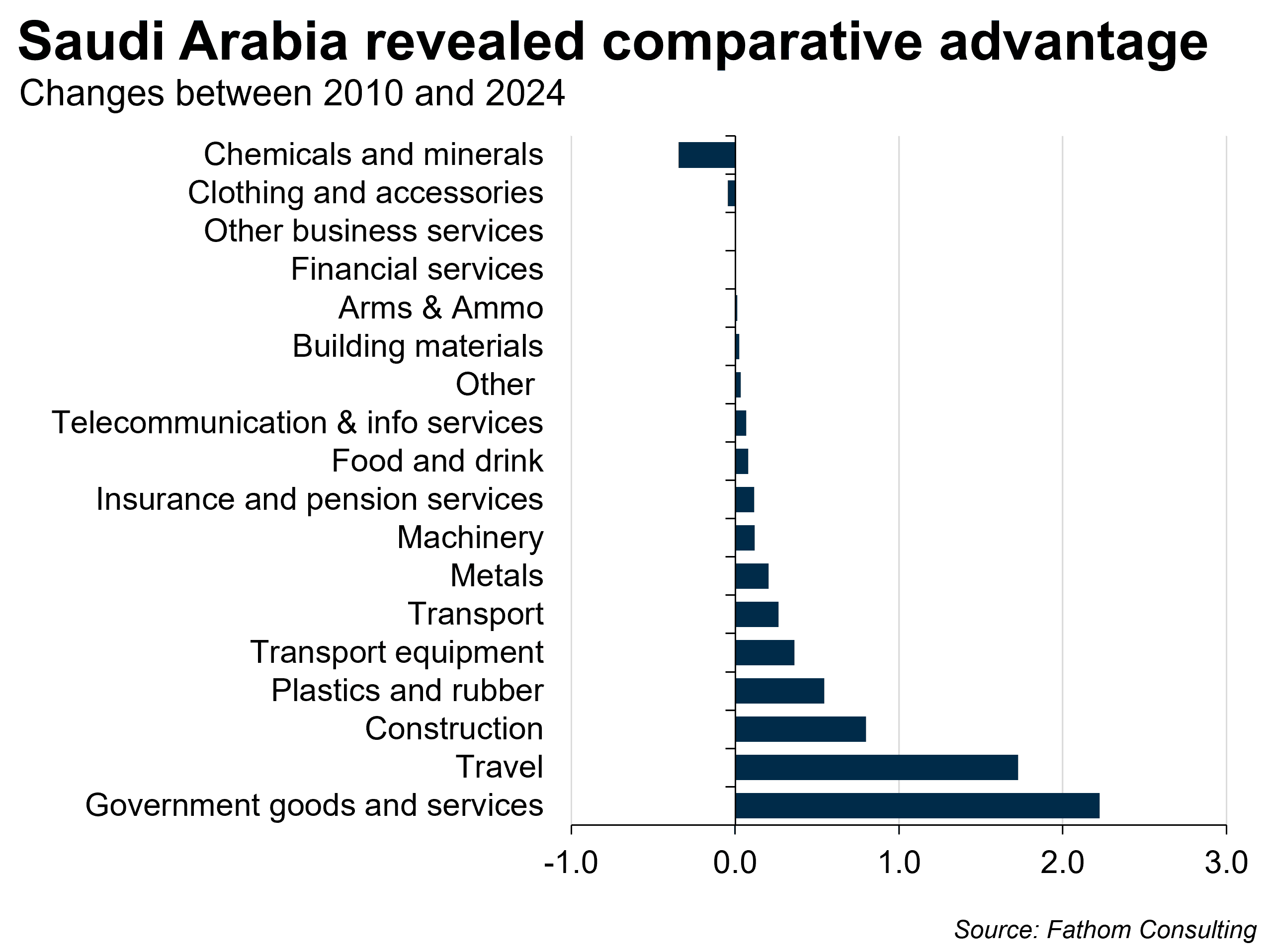
Focusing on that one for now, an increase in these exports would tally with some things that we know have happened: increasing diplomatic and military presences in Saudi Arabia by foreign powers including the US, with all the associated spending and construction (and employment of foreign nationals) at foreign expense that implies. This is a form of diversification! But it’s not the kind of diversification that leads to sustainable growth in the long term. Unfortunately, there is precious little evidence of that, so far: even the travel exports are more likely to be associated with Hajj-related visitors than with a fundamental change in the attractiveness of Saudi Arabia as a tourist destination.
Saudi Arabia is not collapsing under the weight of its contradictions. For now, it appears to be doing reasonably well, even if the hoped-for diversification has not been achieved (which might be viewed as a good thing, as genuine diversification away from oil could leave Saudi Arabia holding extremely valuable stranded assets ‒ for more detail on which, see Fathom’s Energy Transition Scores). The news of a potential deal with the US to develop a nuclear power programme is just the latest piece of evidence here. Of course there are many challenges, not least the on-going conflict in Iran. But, for now, there are grounds for cautious optimism.
If you are interested in hearing more on this subject, please enquire here for a free presentation.
Further reading
Hormuz block: an oil price shock scenario
Can economics explain geopolitical alignment?
The charts and data featured in this blog are available to LSEG clients through Chartbook on Workspace. To learn more about accessing Fathom’s data, models and tools, get in touch with us here.