

A sideways look at economics
John Maynard Keynes’ acerbic remark that “…in the long run, we’re all dead” resonates because it is true, [1] and because it rightly draws attention to the here and now rather than some uncertain and distant possible future. But it has encouraged some commentators to dismiss long-term considerations as altogether irrelevant. I’m ready to bet Keynes never intended that. Political cycles in democracies practically insist on ignoring the long-term: if a policy is net costly in the short term it will be rejected, almost irrespective of its long-term impacts. But the long term is where the economic fundamentals bite, and they bite hard. The fundamentals are: demographics; capital accumulation; and productivity (which can be affected by the availability of land, of energy, of infrastructure, of open markets, of ecosystems that support innovation, of the rule of law including respect for property rights, and many other factors). The first of those, demographics, is in the spotlight here.
By the end of this century for the first time in our history, the human population will be in decline as a result of voluntary changes in fertility. The African continent was the first source of growth of the human population, and will probably also be the last. The population of working age has already passed its peak in high-income countries and is set to peak globally around 2070 according to the UN. Some economies will see drastic falls in working age population, of as much as three quarters by the end of the century. Fewer working people, all else equal, means lower whole-economy output. Most supply-side models suggest that a reduction of 10% in the workforce would be associated with a reduction in GDP of between 5% and 8% in the long term, leaving everything else the same. In the case of South Korea, to take an extreme example, a 75% reduction in the workforce by the end of the century might see GDP fall by around 45%.
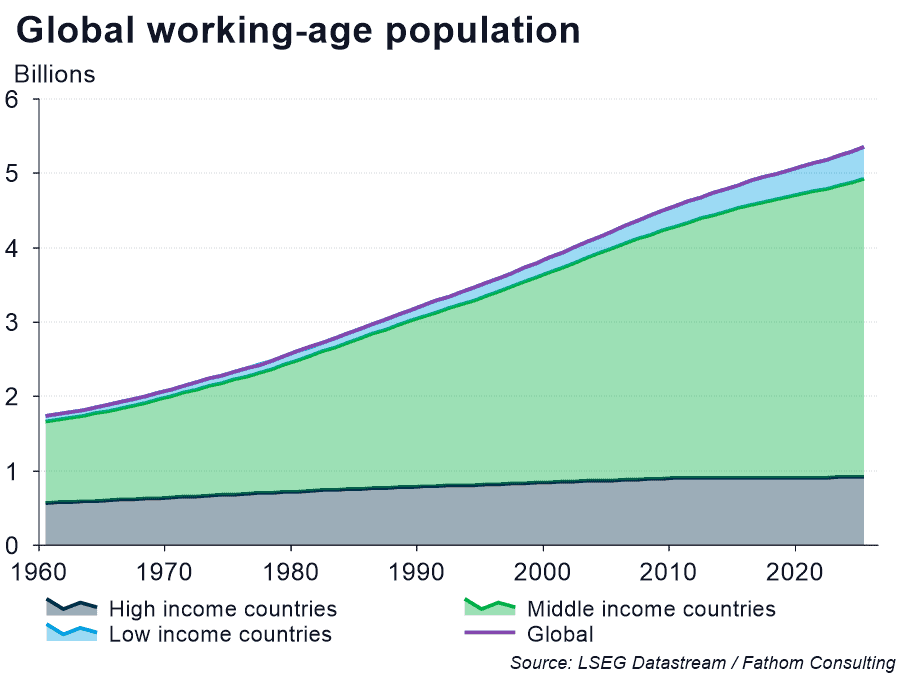
Of course, over that horizon, all else will not be the same. Growth in total factor productivity is likely to have added between 40% and 100% to South Korean GDP over the same period. However, the contribution of the other fundamental, fixed capital, is ambiguous, for reasons I develop below.
First, though, one of my favourite charts. Each dot on the chart below is a country. The vertical axis captures the estimated marginal product of fixed capital (which is how many units of GDP are created by adding one unit more to the stock of fixed capital in the economy); while the horizontal axis is the historic volatility of that concept. The way to read this chart is as a trade-off between risk and return for global allocators of fixed capital. Charts like these are familiar in financial literature but are not usually applied to macroeconomic concepts. The solid line in the chart is the average trade-off between risk and return across all countries. The dotted line is the frontier: countries on that line offer the best return for any given level of risk. The USA is at the low-risk end of this frontier, which makes sense: it is, uniquely, a fully diversified economy, with a leading position in most important industries; and it is also one of the most dynamic economies in terms of innovation. Saudi Arabia is at the high-risk end of the frontier. Any fixed investment in oil extraction would generate very high returns, if it were judged to be a sensible part of managing Saudi oil reserves; but since the Saudi economy is so dependent on oil, it is also subject to the volatility in global oil markets, which means investment opportunities there are high-risk too.
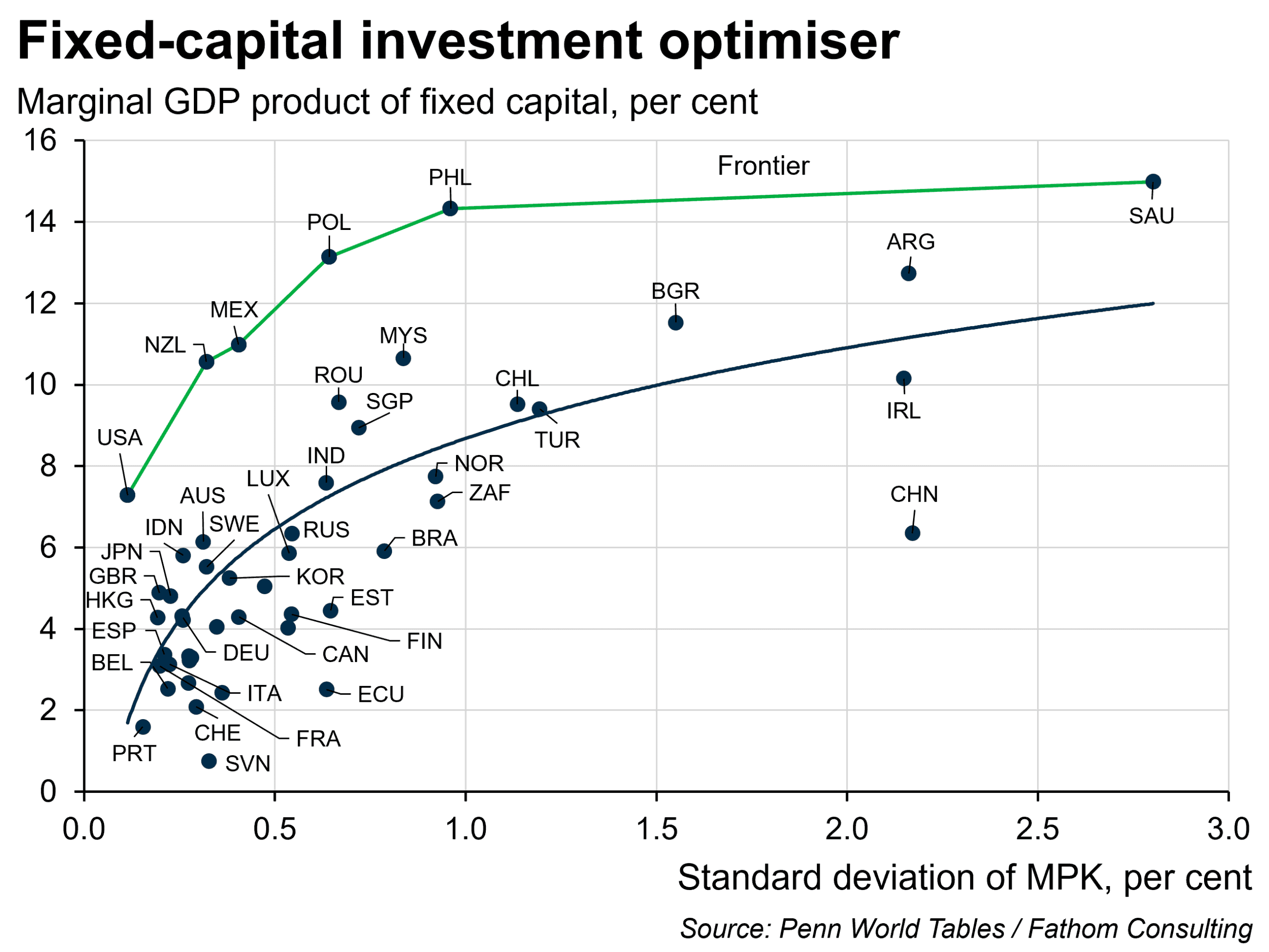
There’s a bit of make-believe here: fixed capital is not liquid, is not allocated by some imagined global allocator and does not slosh around the global economy like financial capital does. But in the long-term (for those of us that care about it) the same patterns do appear. Some countries, like China, can be forced far below the global average trade-off by dint of decades of excessive investment driven by subsidy and other non-market measures. For the rest, advanced economies, with high levels of fixed capital per person, generally exhibit relatively low risk and low returns; while emerging economies are generally further out towards the top right, offering higher risk and higher return.
The chart shows in which countries the trade-offs between risk and return for fixed capital investment are most or least attractive. Both concepts, risk and return, are derived from a Cobb-Douglas CRS production technology. But the same general result would obtain under most alternative ways of estimating productive potential. In most cases, the marginal product of capital is an increasing function of the output to capital ratio. The exceptions are technologies in which the capital stock is not treated as ‘fungible’ but instead is broken down by sector or task (see Acemoglu et al), and the non-structural approaches that have no role for fixed capital or any other so-called factors of production in determining long-run productive potential.
Parking those other representations of productive potential, if we accept for now that the marginal product of capital is a function of the output to capital ratio, that has a couple of implications. First, if another factor of production were to decrease in size, that would cause output to fall too and, with it, the marginal product of capital. So, if the workforce were to shrink, that would cause output to shrink too, and the marginal product of capital would fall as a result. But second, if total factor productivity were to increase, that would cause GDP to increase and, with it, the marginal product of capital. For the remainder of this century, in most countries, those two forces are in tension. The workforce is falling in most countries; but can the growth of total factor productivity be sufficient to offset the dampening effect that will have on capital accumulation?
The answer depends on the outlook for the workforce and for total factor productivity, country by country. The chart below shows how this looks for the G20 economies. Any country above the sloping green line is likely to see increasing incentives for fixed investment over the coming decade; those below will see decreasing incentives.
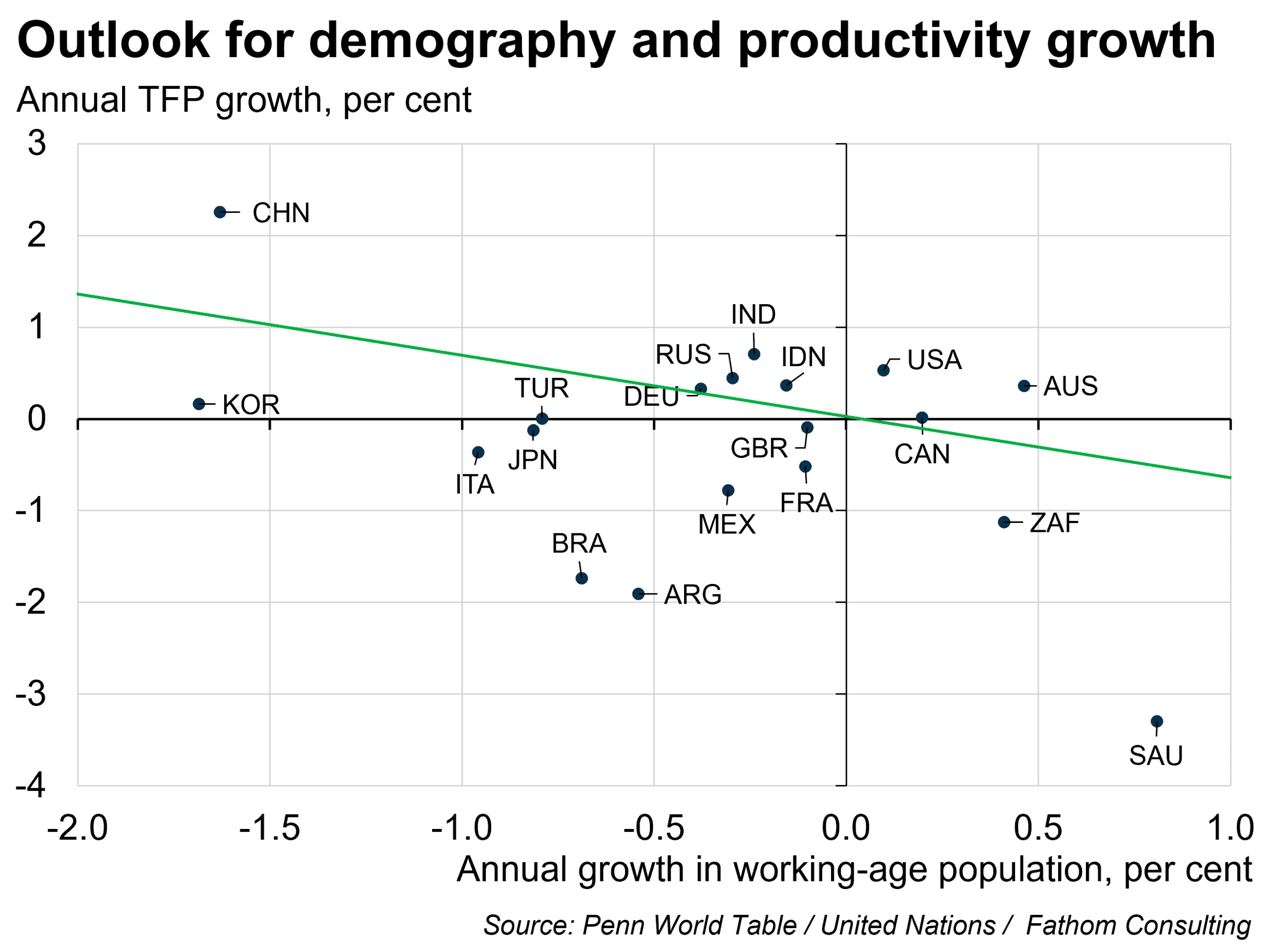
In the case of China, the big outlier to the upside, the incentives to undertake fixed investment there are extremely low at present, thanks to decades of excessive fixed investment. The message in the chart above is that those incentives are likely to improve in the years to come. In the case of Saudi Arabia, an outlier to the downside, the incentives for investment are extremely high right now; the chart above suggests they are likely to deteriorate sharply in the years to come.
That picture is problematic for anyone concerned about the outlook for the blue corner (those countries geopolitically aligned with the USA) in a potentially fragmenting global economy. With the exception of the USA and Australia, most US allies are on or below the line; while China and its allies, along with some non-aligned countries, are above the line. The red corner and the non-aligned countries are set to see increasing incentives for investment, while the blue corner will see diminishing incentives. The blue corner is much bigger in terms of GDP than the red corner right now, but that advantage is likely to dwindle over time (even if traditional alliances continue to hold).
We cannot just wish away these fundamentals. But perhaps we can change them. The growth in the working age population is driven by fertility rates, which are very hard to budge through public policy. But it is also driven by policies around immigration, which can be changed (albeit at a political cost, sometimes). The growth in total factor productivity, though, is much more amenable to policy-driven change. The kind of policies that would support stronger blue-corner growth in TFP are urgent considerations now. If we can’t find and implement these policies, the blue corner will lose in the end. And we can’t have that.
If you are interested in hearing more on this subject, please enquire here for a free presentation.
You must remember this
A kiss is still a kiss
A sigh is just a sigh
The fundamental things apply
As time goes by
From ‘As time goes by’, (Dooley Wilson), as featured in the film Casablanca
Further reading
Saudi Arabia: alive with contradictions
China’s industrial policies, a help or hindrance?
[1] notwithstanding the efforts of certain wealthy people to extend their lifespans indefinitely, though why anyone would want that is utterly baffling to me: I can hardly think of anything worse than to live forever