

A sideways look at economics
In November 1967, Harold Wilson gave his famous ‘Pound in your pocket’ speech. As Prime Minister of the UK he had just cut sterling’s fixed exchange rate against the dollar by 14%, and now attempted to persuade the British public that this did not affect them. He claimed: “It does not mean that the pound here in Britain, in your pocket or purse or in your bank, has been devalued.” He soon rowed back from this obviously fatuous remark: that is literally what it meant. Scroll forward 60 years, and the Japanese Prime Minister made a similar about-face. In February, Sanae Takaichi stated that the falling value of the yen was great for exporters. Unlike Mr Wilson’s remark, this had the virtue of being true, but it was not the whole truth: a weaker yen hurts domestic consumers in exactly the ways that a weaker pound did back in 1967. Ms Takaichi quickly rowed back: but her government’s position on the yen remains unclear, and events over recent weeks have muddied the waters even further. What’s going on with the yen?
The yen is trading far below ‘fair value’ as economists would normally judge it
One way of assessing the fair value of a currency is to estimate the value at which external imbalances would eventually stabilise. Japan has built up enormous net foreign assets, the result of decades of surpluses on the current account of the balance of payments, and it continues to do so. Most treatments of ‘fair value’ for a currency would start from the proposition that net external assets (or liabilities) cannot increase forever. If they are increasing, it suggests that the currency is below (or above) its fair value. In Japan, that logic would suggest the yen is undervalued.
The chart shows Japan’s current account balance as a share of GDP. Every time that number is positive, it implies Japan is accumulating more net external assets. When it exceeds the growth rate of nominal GDP (in Japan’s case, that’s around 4% at present, though it was much lower than that in recent years), it means Japan’s net external assets are increasing relative to GDP. The path shows no sign of ‘correction’: Japan’s net asset position abroad is enormously positive, and is increasing not just expressed in yen, but as a share of Japan’s GDP. The chart shouts: “Undervalued Currency”.
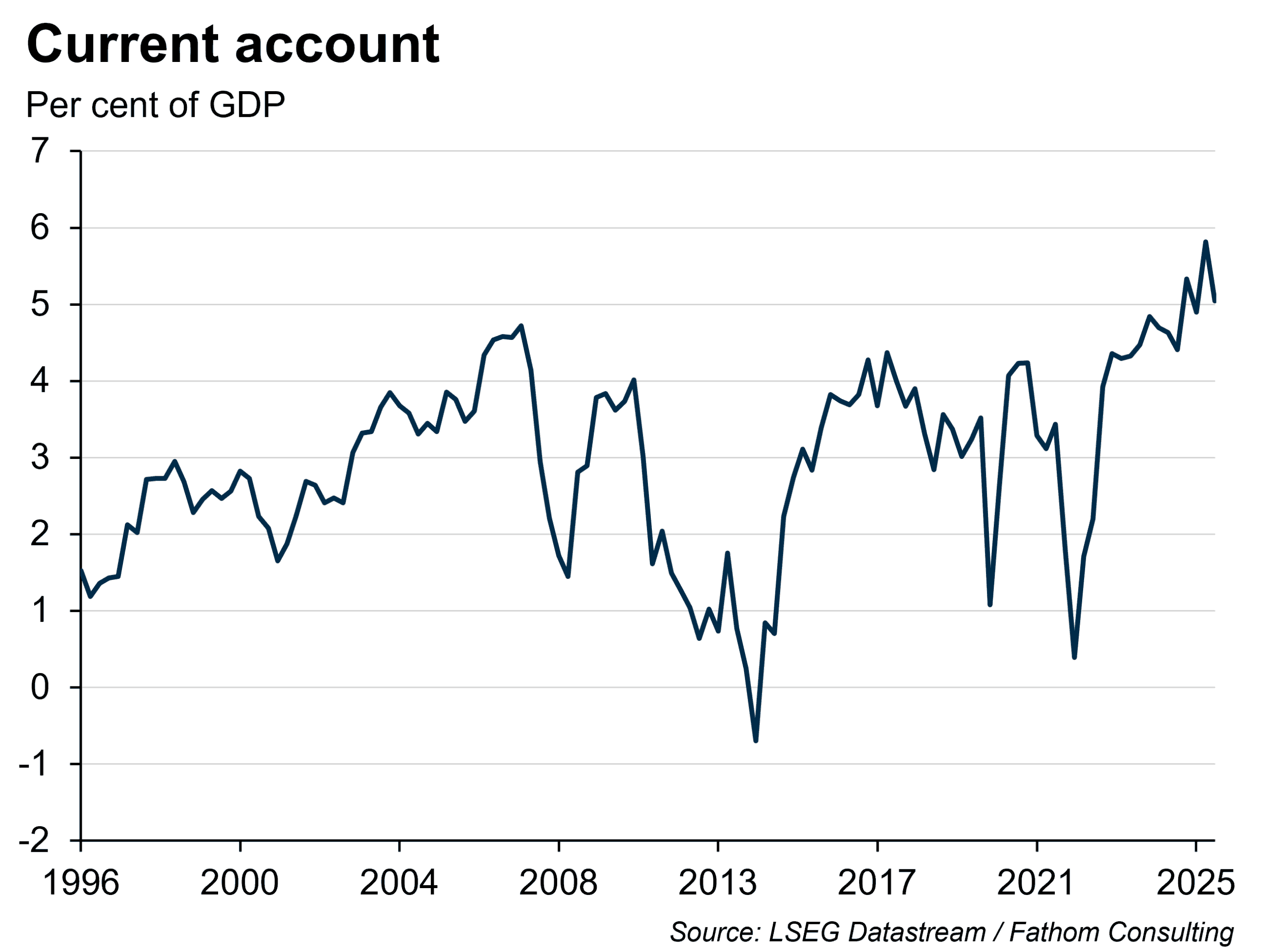
A critic of this approach might argue, with some justice, that the current account position of different countries merely reflects the different appetite for saving in different countries. Some countries want to save; others want to borrow. There is nothing fundamentally ‘wrong’ with allowing that to happen. This is true; but net asset positions cannot increase to infinity, expressed as a share of GDP. Even so, we should triangulate before concluding the currency is undervalued.
Another way of estimating ‘fair value’ is to make use of the concept of ‘purchasing power parity’ (PPP): how many dollars would you need to buy the same basket of goods and services in Japan as $100 would buy you in the US? If the answer, at current exchange rates, is greater than $100, that implies that the yen is overvalued; if less, undervalued, relative to PPP. In the long run, some models imply that the actual value of a given currency will converge on PPP (although it should be pointed out that this is a property of models more than it is a demonstrable characteristic of the real world). Most estimates of PPP suggest that the yen is currently undervalued. The OECD estimates the PPP yen/dollar rate at just under 100. On that basis, the current yen/dollar rate of just under 160 suggests the yen is roughly 40% undervalued. So, we now have two independent sources claiming that the yen is substantially undervalued. Is that enough?
Not quite. These two approaches are not entirely independent: indeed, they ought to converge on each other in the long run. If things appear to be ‘cheap’ in Japan, that goes with Japanese exports doing well compared to imports, and therefore with a current account surplus, which will tend to increase the stock of net external assets. The point at which things stop being cheap is the point at which net external assets stop increasing, loosely speaking.
It is fair to say the evidence strongly suggests undervaluation, even if it doesn’t prove it. Which leads to the next question.
Why is the yen falling? Four candidate explanations.
1. Relative interest rates? No.
Movements in the value of a currency are often assumed by economists to be driven by cross-country differences in prevailing interest rates. Suppose the Fed surprised the markets with a sharp hike in the Fed funds rate. That would trigger an inflow of money into dollars from other currencies (assuming there had been no corresponding surprises to the prevailing rates in those currencies), causing the dollar to jump in value. After the initial jump, though, and for as long as the higher Fed funds rate remained in place, the dollar would be expected to depreciate each year by exactly the amount by which the Fed funds rate had surprised on the upside. Otherwise, asset returns across currencies would not be equal in expectation, so there would be an arbitrage opportunity ‘left on the table’ to be exploited by somebody; and it is a necessary condition of rational, efficient markets that this cannot be the case. This is known as the uncovered interest parity (UIP) condition. If markets behaved according to this condition, then the yen should be expected to appreciate against all major currencies, including the dollar, since prevailing interest rates in Japan are lower than in most other developed economies.
Note that the UIP pattern of movements in the value of a currency should cause the currency to converge on PPP (or other estimates of its fair value) in the long term. The Fed will tend to hike rates when inflation in the US is high, which means the basket of goods and services in the US is getting more expensive compared to the same basket elsewhere. That will cause the dollar to jump in value, making the US basket more expensive still. After that, though, the dollar will gradually fall, as will US inflation, until it converges on PPP (or other estimates of fair value). UIP suggests that the yen should be appreciating. But it is depreciating.
The difficulty with UIP is that, in practice, interest-rate differentials explain very little. In a model of the yen/dollar rate, interest-rate differentials explain perhaps 5% of the movement in the value of that currency (the explanatory power varies depending on the sample period). Nearly everything is in the residual.
2. Relative prices? No.
The fair value of any currency is a ‘real’ concept: one that takes account of changes in relative prices across countries. The real exchange rate is the nominal exchange rate (expressed in such a way that a higher value means an appreciation) multiplied by the domestic price level, divided by the foreign price level. So it could be that a lower value of the yen is just offsetting higher prices in Japan, with no impact on the real exchange rate. But this is not the case: in fact, it is the reverse. Japanese inflation is rising, yes, but it remains lower than in most advanced economies including the US. The real value of the yen is actually falling faster than its nominal value. So relative prices cannot be the explanation for the falling yen.
3. Risk? Maybe.
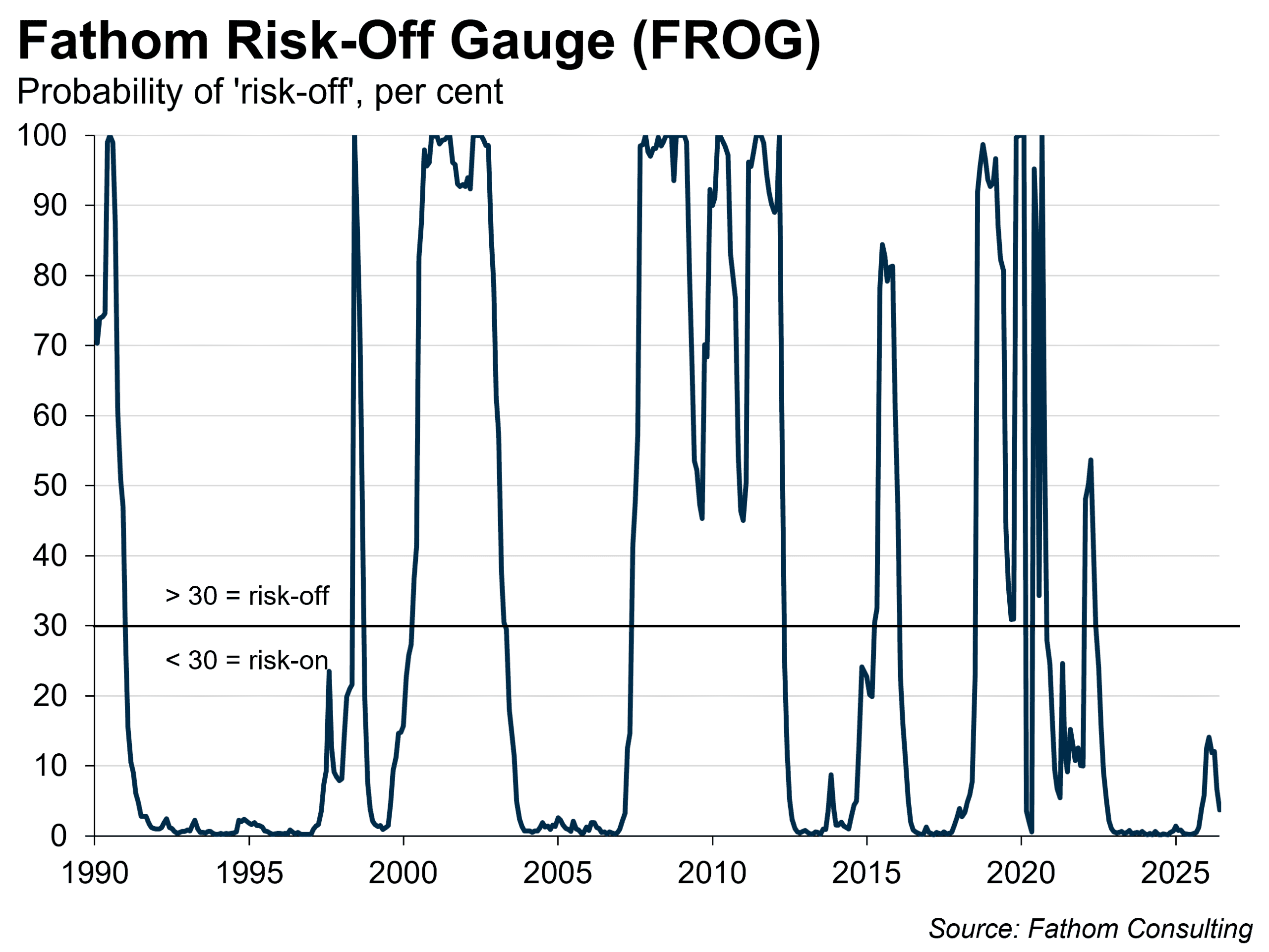
The UIP condition asserts that asset returns should be equal in expectation across countries; but, strictly speaking, it’s risk-adjusted asset returns that should be equal. How are markets adjusting expected returns for risk? That depends on two factors. One is the risk characteristics of the various assets being considered. (Are they more or less volatile than others? How do they co-vary with each other?) The second is the markets’ appetite for risk. Markets shift from being ‘risk-on’ to ‘risk-off’ and back again, sometimes very rapidly, in response to signals that might have little or nothing to do with the particular asset in question, in this case the yen. When markets are risk-on, they tend to sell ‘safe’ assets and buy ‘risky’ assets until the new, risk-adjusted expected returns are reached (and vice-versa when they are risk-off). Traditionally, the yen has been regarded as a safe asset, so could it be that markets are in a risk-on phase and therefore selling the yen alongside other relatively safe assets?
Fathom’s Risk-Off Gauge (FROG) is very low at present, implying markets are indeed currently in a risk-on phase. Their appetite for risk is relatively high, so safe assets like the yen should be selling off. This could be part of the explanation. A difficulty here is that the dollar is also regarded as a safe asset, so the impact on the yen/dollar rate of a risk-on move in markets is ambiguous in sign. Most often, in the past, the yen has moved further than the dollar in both directions: up when markets are risk-off; down when they are risk-on. Both were regarded as safe, but some were safer than others: specifically, the yen was safer than the dollar.
However, that judgement about relative safety brings me to the second component of risk premia: the fundamental risk characteristics of the asset in question. In the cases of both the yen and the dollar, those characteristics are, arguably, changing. The Trump administration has, at times, spoken about the reserve currency status of the dollar and how that is damaging for the industrial structure of the US economy, suggesting that it would welcome the permanent devaluation of the dollar that would follow if the markets reconsidered its reserve currency status. And the yen carry trade, which was a reliable source of revenue for investors for as long as Japanese interest rates were lower than elsewhere and the value of the yen was stable, looks like it may have come to an end. Higher inflation in Japan, after COVID, was the trigger for that change. Consequently, the characteristics of the yen considered as an asset have changed too; perhaps that change includes a reconsideration of the yen as a safe asset. If so, we should look for two effects. In the long run, once the adjustment has been made, the yen will no longer weaken when markets are risk-on. But first, along the way, the risk premium attached to holding yen must increase. So, first of all, you will see the yen sell off.
So risk could be an explanation: either because the yen is safe and markets are risk-on (appetite for risk); or because the yen is being repriced as not safe (fundamental risk characteristics). It could be a bit of both.
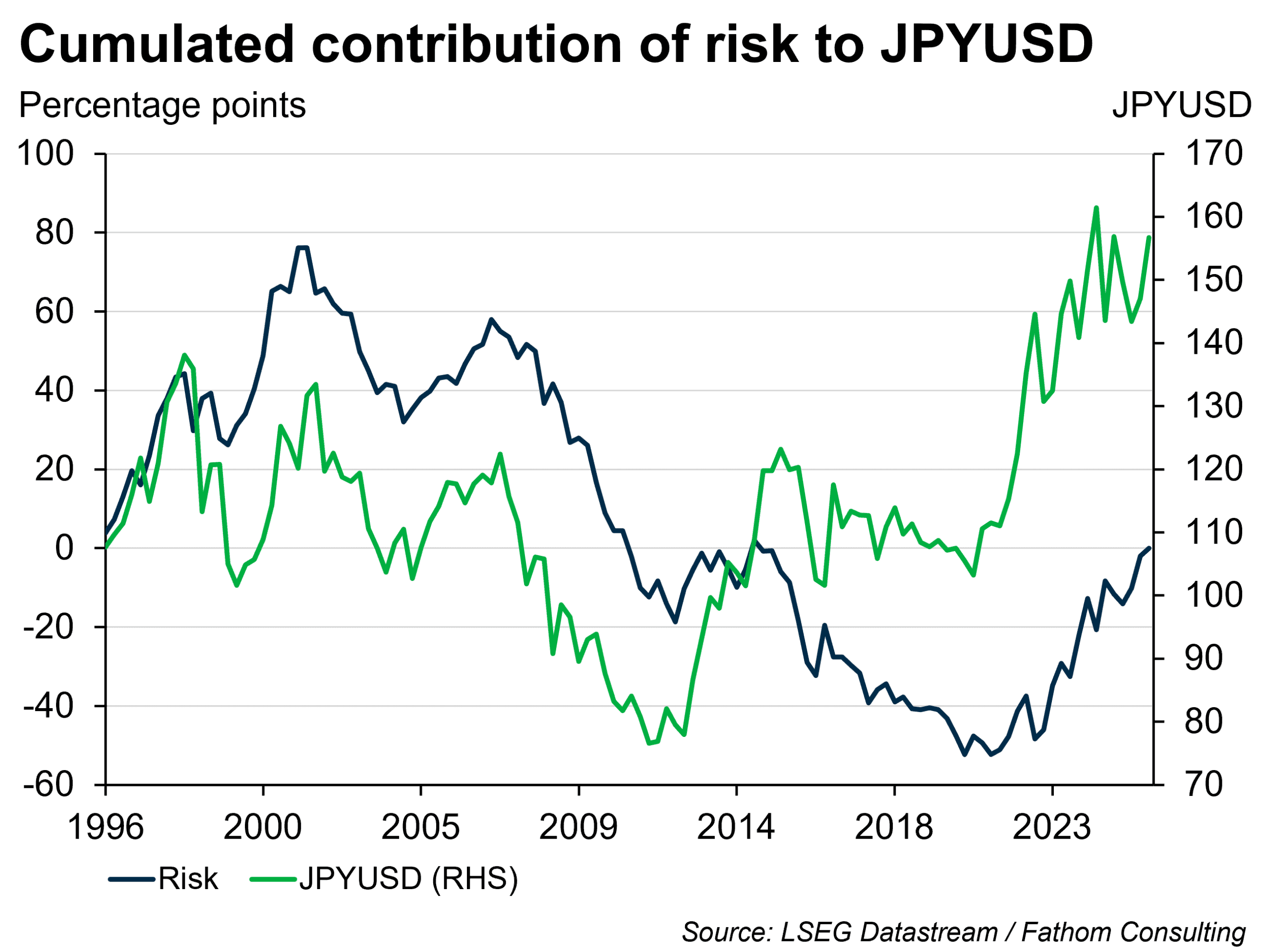
The chart below shows the contribution that implied risk premia have made to changes in the value of the yen. Since 2021, the yen has depreciated against the dollar by around 50%, and virtually all of that can be explained by increasing risk premia on the yen/dollar rate. These premia have been calculated as the residual element in a UIP equation: the part that is not explained by relative interest rates must be attributable to risk. This metric does not discriminate between risk appetite and risk characteristics: it is a blend of both. But it looks like it accounts for most of the recent movement in the yen. QED? Not so fast.
4. Repricing of all Japanese assets? Probably not, but…
The final possible explanation is this: the value of all assets in Japan is being repriced, and the quickest way to start that process is via the currency. That brings me back to the Harold Wilson quote at the start of this note. The bad news for British consumers in 1967 was that the pound in their pocket was indeed being devalued, despite Wilson’s protestations, and this affected their real standard of living across the board. You thought you had an income that would buy you this basket of goods and services? It turns out the basket is 14% smaller than you thought it was. You can almost hear Wilson, removing the pipe from his mouth, replying: “No, because it’s only imported goods and services that have become more expensive!”. In the first round, he’d be correct. But then consumers (a) substitute into domestically produced goods and services and (b) have to live with a small loss in real income even so. And the substitution cannot be met by increased production (unless there has been a productivity miracle at the same time ‒ reader, no such miracle occurred). Consequently, guess what? The price of the rest of the basket goes up too, but wages don’t go with it. The substitution effects go into reverse: the income effects get worse. The consumer winds up 14% worse off. Wilson was wrong.
What’s going on in that world? A devaluation causes the consumer to be 14% worse off? No. The consumer was always 14% worse off, they just didn’t realise it yet. That’s where Wilson had a point. The cause was not the devaluation: that was a symptom. The cause was a weak economy, relative to others. And the cause of that: weak productivity growth. By 1967, Britain had reduced the huge burden of government debt that it had accumulated through the two world wars. But it had lost its economic dynamism along the way, and without that its citizens were living beyond their means. The devaluation was that moment when Wile E. Coyote looks down and notices he’s running on thin air.
Perhaps the same is true in Japan now. The devaluation could be a symptom of a fundamentally weak economy: Japanese consumers were already substantially less wealthy than before, they just didn’t realise it. A critic here would argue that Britain’s case was totally different. Britain’s debt, by 1967, was sustainable ‒ unlike Japan’s now. And Britain’s problem was a current account deficit, suggesting that the currency was overvalued, not undervalued. That critic would have a point. The parallel with Japan is the initial assertion that devaluation is not problematic, and the subsequent rowing back from that assertion. The underlying economic patterns were very different.
However, one last shout for this explanation. The card that supports Japan’s whole house of cards was, and is, inflation. While inflation was low or zero, the house could remain upright ‒ provided it was treated delicately, without any sudden movements. But inflation jumped after COVID, and put the whole house of cards at risk. That perhaps explains the risk premia rising in the chart above. And it provides grounds for repricing all Japanese assets too, not just the currency. The value of government bonds is at risk, and changing the value of the currency will do virtually nothing to address this since they are largely held by Japanese citizens. The value of Japanese equities is high in yen, but not in dollars, and even their current levels are at risk in this world. More: current account deposits in banks; pension pots; anything where the asset side of that liability for the financial sector has a large component of government debt in it ‒ all of that is at risk too.
Two quarters ago, in our Global Outlook, we argued that the yen would depreciate further because the Bank of Japan would choose to do more financial repression, allowing inflation to rise but preventing bond yields or short rates from following suit. That choice is clearly not ideal, but all the choices available to the BoJ are unpalatable unless inflation goes away of its own accord, an outcome that seems increasingly unlikely. The choices are constrained (and unpalatable) because of the fundamental weakness of the economy, which is itself the result of an unsustainable government debt burden and a corporate sector that lacks dynamism, both of which are structural issues that have built up over many decades.
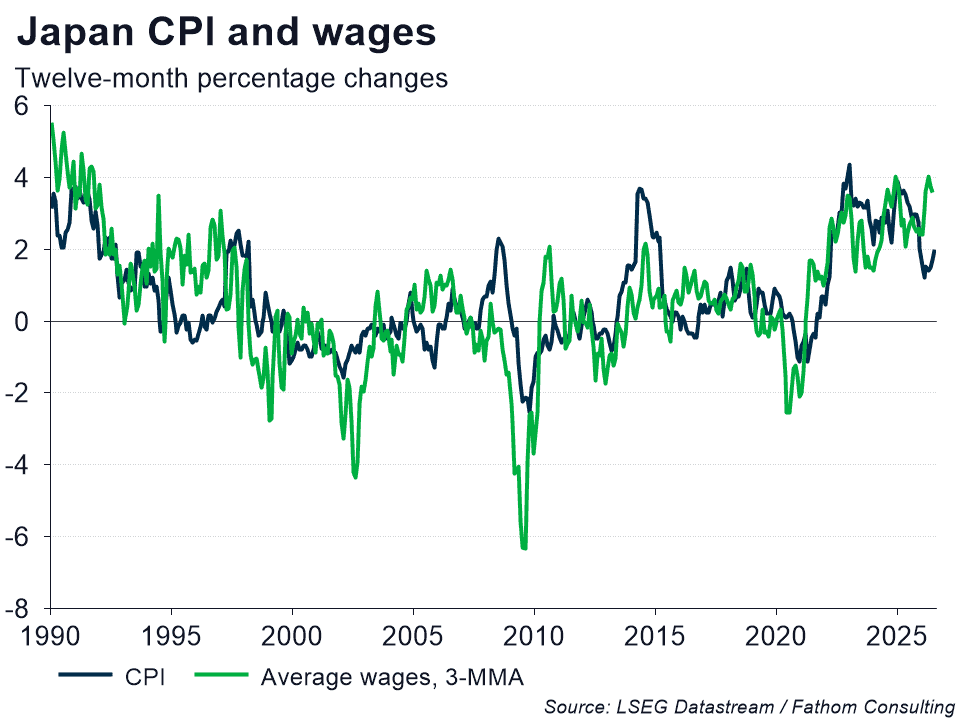
The US Treasury intervened heavily in recent weeks to try to stem the decline in the value of the yen, a step that maybe slowed the decline but did not bring it to a halt. Now that intervention has stopped, the yen is sliding again. The Bank of Japan has remained on the sidelines for now, unwilling or unable to prevent the yen from falling further or, by extension, to control the increase in inflation that is to come. The recent dip in CPI inflation is likely to be short-lived, looking at what is already happening to wages (chart below) and producer prices ‒ not to mention the impact still in the pipeline of the weaker yen.
Finally, Ms Takaichi’s government pumped a massive fiscal stimulus into the economy last November and has subsequently increased it further. The textbook response of a currency to such a move would be appreciation, based on an expectation that looser fiscal policy will have to be counteracted with tighter monetary policy to avoid inflation increasing, except in circumstances where the economy started in a deep recession (which was not Japan’s case). As we have seen, however, the currency has depreciated. That is because monetary policy is not responding; instead it is accommodating that fiscal splurge. Higher inflation is the likely result; indeed, it might be seen as the desired outcome. Persistently higher inflation means the house of cards will fall, and a repricing of all Japanese assets will follow.
Wile E. Coyote always recovers after a fall, to resume the chase, usually with redoubled energy. Perhaps this is the future for Japan? But it may smart a little, to begin with.
Further reading
What’s happening in Japan? Kaizen it ain’t.
Global Outlook, Spring 2026: preview
Japan’s corporate sector: not zombies but cash cows